Site Meter

Tuesday, October 31, 2006

More on Tiger Shrike

More on Tiger Shrike

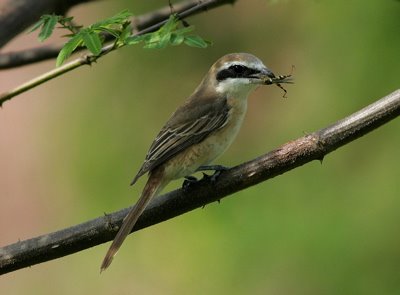
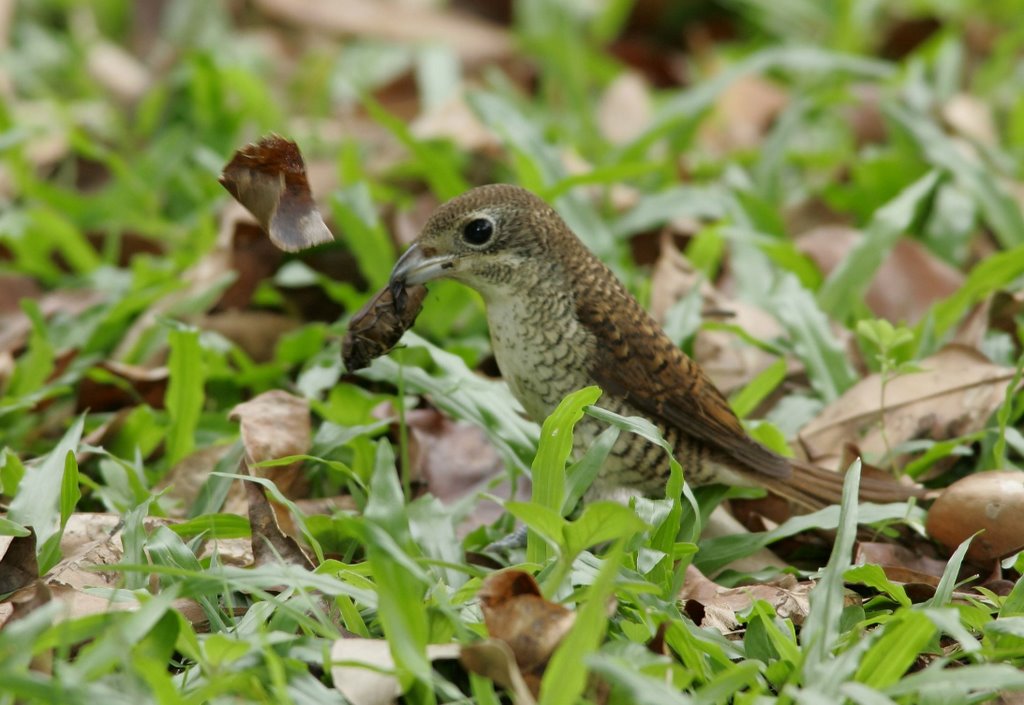
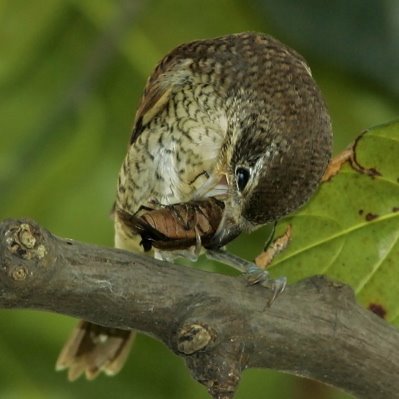
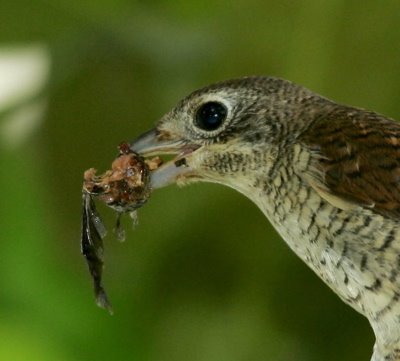
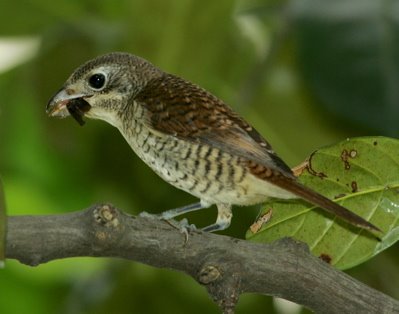
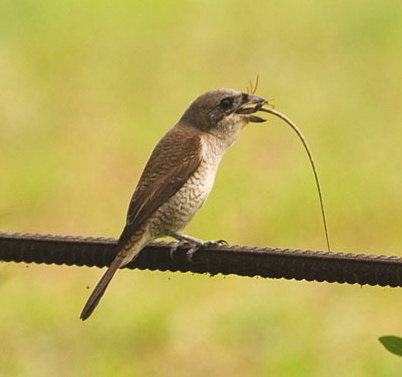
An earlier posting on how a Tiger Shrike (Lanius tigrinus) meticulously dismember a scarab beetle lamented the fact that there has not been any report of the bird taking vertebrates in Singapore. It is very possible that someone may have seen the incident to subsequently forget about it. This is exactly the situation. After reading the blog, Mike Hooper kindly sent an image of a Tiger Shrike swallowing a lizard, seen at the Kallang Riverside Park on 7th October 2006 (above).

And according to our bird specialist R. Subaraj: “…not enough of the lizard remains visible for a positive identification but I suspect that it might be a young Changeable Lizard (Calotes versicolor), based on the long tail and the yellowish colouration of what is visible.

And Subaraj continued: “Several years ago, at Marina East, I came across the headless corpse of a Yellow-rumped Flycatcher (Ficedula zanthopygia), a migrant, impaled on a thorn of a short tree. Though there was no direct evidence, I suspect that it was the doing of the local Long-tailed Shrike (Lanius schach).

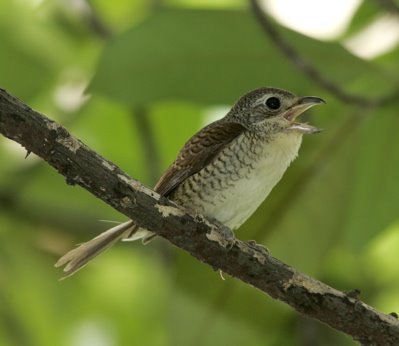
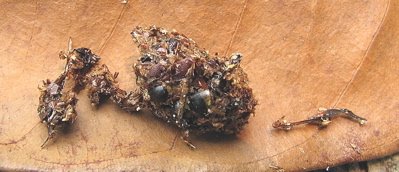
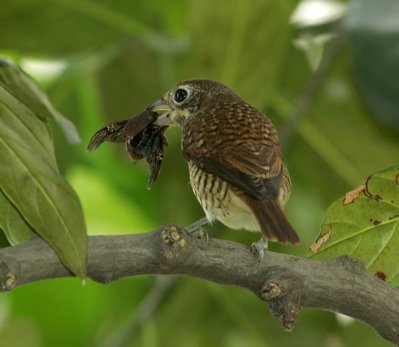
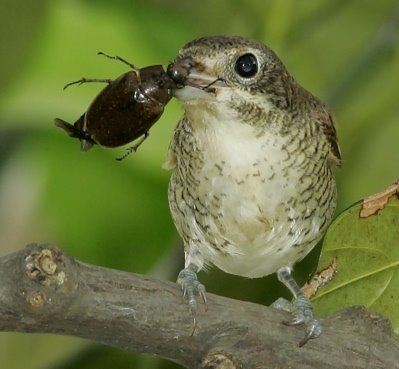
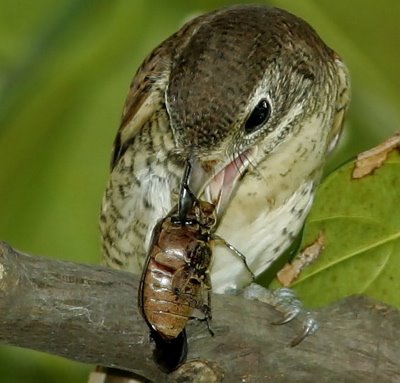
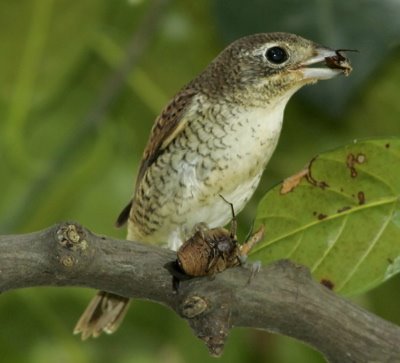
“In Malaysia, I once came across the "larder" of a wintering Brown Shrike (Lanius cristatus). It had impaled a selection of insects onto the barb wire on the top of a perimeter fence! Modern adaptation?” Coming back to the shrikes, according to Chan Yoke Meng, these birds have no problem feeding on caterpillars, spiders and other invertebrates. They usually swallow them within seconds (above: top Brown, lower Tiger). As with raptors, bee-eaters (a,b), herons and kingfishers, shrikes cast pellets of undigested parts of the food they eat. The image above shows the bird after casting the pellet while the lower image shows the pellet. Beetle parts are clearly seen.
Input by Mike Hooper, R. Subaraj and Chan Yoke Meng. Images by Mike (top) and Meng (the rest).

Labels:

Monday, October 30, 2006

How the Tiger Shrike dismantled a beetle

How the Tiger Shrike dismantled a beetle

Shrikes are songbirds. But when they hunt they behave like little raptors. An earlier posting showed how aggressive a juvenile Tiger Shrike (Lanius tigrinus) was when eyeing the white-eyes in a cage. Given a chance we are sure it would have devoured one of the caged birds. The diet of these shrikes consists of large insects and small vertebrates that include songbirds, reptiles, rodents and even mammals. So far there has not been any local report of a shrike capturing a vertebrate prey. But in mid-September 2006 we observed a juvenile Tiger Shrike manipulating a large scarab beetle (above).
The juvenile bird was on a perch, looking handsome and posing for the camera. But it was actually eyeing the surroundings. Suddenly it dived towards the ground and caught hold of a scarab beetle by one of its legs (above). Returning to its perch and with one of its feet holding down the beetle, it started to stab the wriggling insect with its sharp beak. Then, holding on to the head (above), it thrashed it against the branch until it managed to tear away the upper portion from the body and got a first taste of its crunchy meal (below). Beetles have a thick protective sheath, the elytra, over the back portion of the body. This is made up of the hardened forewings, tucked under which is the pair of functioning membranous wings. The other parts of the body have a covering of thick cuticle. So beetles are generally well protected from predators. But not from shrikes! The shrike next tried to crush the headless beetle with its powerful beak (above). But the beetle's elytra proved too hard. With another swift swing it got the elytra detached. The bird then tried to squeeze out the soft tissue and in the process nearly lost its grip on the perch. It continued to crush the thorax with its powerful jaws, pulling at the soft tissues, determined to get to the succulent part. At this point the beetle thorax was totally mangled (above). Swallowing the thoracic portion, it tried to swallow the remaining part but could not succeed (above). It was either too hard or too big. It tried to crush and flatten it further in between its mandibles before finally finishing its meal (below).
Tha above account is by Melinda Chan. All images by Chan Yoke Meng. The beetle was identified with the help of Dr Cheong Loong Fah

Labels:

Sunday, October 29, 2006

The 2006 Gotong Royong Bird Race: The results

The 2006 Gotong Royong Bird Race: The results

Hi Everyone,

Just a follow-up note to say that the post-bird race gathering was held last night and everything was made official through the announcement of results by the Arbitrator.

The gathering was a low-key affair in comparison to previous years. No NSS President or Vice-President in attendance; no VIPs; no sponsers; just a quaint little group of bird racers and bird group members....though even here there were a few notable absentees. It was held in the open-air section of the new Taman Serasi food court at the Singapore Botanic Gardens, with members of the public at adjacent tables. We purchased our own dinner and chit-chatted amongst ourselves.

After dinner, the Arbitrator, Kenneth Kee announced the results, along with a few tid-bits from the race. My team, STRIX, won with a brand new record score of 159 (5 more than the previous record of 154 set in 1991!). The Eagles, led by Lim Kim Seng were 2nd with 125 and the Oriental Cuckoo, led by Ding Li, were 3rd with 105. There were 4 other teams taking part for a total of 7 teams (last year there were 12 teams). We were also the first team to reach 100 birds at 1137hrs while the Eagles reach their 100th bird at 1400hrs and the Oriental Cuckoo at 1855hrs. Unfortunately, neither the challenge trophy or the Century Shield were presented as they had been misplaced! There were no prizes or tokens too, so it was just an announcement of results.

The bird of the day was an Oriental Plover seen at Changi by Ding Li and his team, the 5th Singapore record. Other goodies claimed by teams on the day included Rufous-bellied Eagle, Blue-and-White Flycatcher, Caspian Tern and Common Kestrel. There were also a few species that the Arbitrator mentioned were strangely missed by all teams on the race but most of them, in my opinion, are not bird race regulars. Some do not normally show up until November while others are genuinely scarce. The exception is the Yellow Bittern which is very late this year and I have yet to see one this season despite the fact that they are usually present in numbers during October.

This year's concept, as race organiser Alan OwYong mentioned, was a "Do-It-Yourself" Bird Race. Teams could start and end whereever they wanted to and were then given 2 days to prepare and submit forms and notes online. It is a novel and interesting idea but unfortunately it attracted far fewer participants. My personal feeling about it is that there was a lack of excitement and closure which comes with having to submit your results to an Arbitrator by a specific time at the end of the race and then this is followed up with the results being announcement a couple of hours later. A compromise may be to have the race on the Saturday (maybe even midnight to midnight) and then giving teams up to noon Sunday to submit their results online (allowing a good night's rest in-between). This can then be followed-up with a dinner gathering on Sunday evening (allowing the Arbitrator all afternoon to sort out the submissions), with the results announced and awards presented after. This would be better than having to wait a week.

Anyway, I am glad that the results are finally announced and the new record is acknowledged. The lack of trophies and tokens being presented is not important. As this is a competition and a bunch of teams took part against each other, there must be a result and it must be announced. This has been done and a new record is in place for future competitions. As for me personally, I will continue to try and take part each year (it's fun) but perhaps at an easier pace.

Regards,

R. Subaraj
29th October 2006

Congratualtions is in order as the Strix team, besides winning the 2006 Gotong Royong Bird Race, broke the record set by Lim Kim Seng in 1991 with 5 more sightings. Well done, Subaraj. And this reminds me of a story...

Image by Joseph Lai.

Friday, October 27, 2006

Black-naped Tern's first flight

Black-naped Tern's first flight

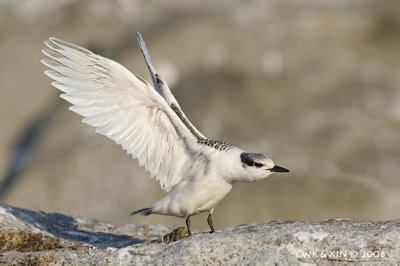
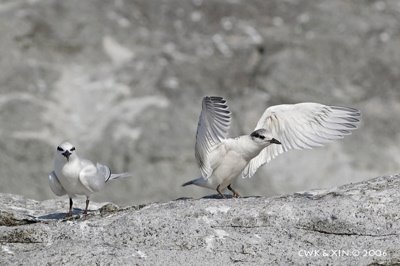
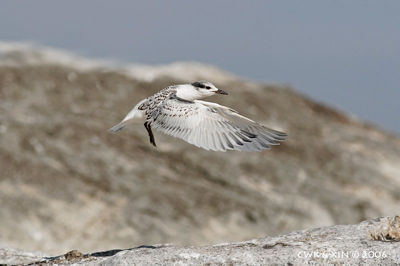
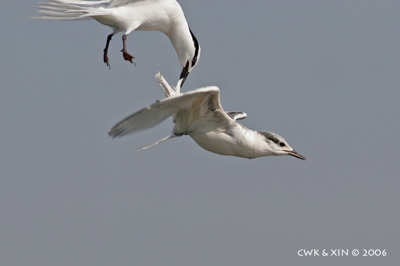
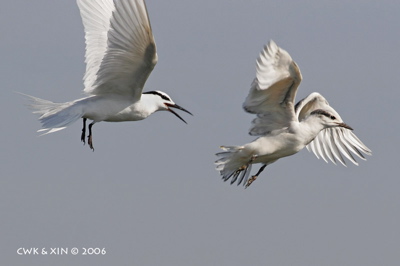
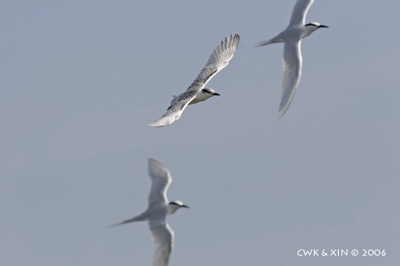
"The Black-naped Tern (Sterna sumatrana) nests in a shallow depression on the rocky surface of small outcrops. Generally, two eggs are laid and incubated by both parents. Soon after hatching, the chicks wander off from the exposed nest to seek shelter behind some boulders or whatever. With the male bird flying off to look for food, the female generally keeps a watch on the offsprings. "The period to fledgling is slightly less than a month. All through this period and even after, a chick will continuously beg for food from its parents. Days before fledgling, it will exercise its wings, especially when a strong wind blows through (above). The parent bird would generally refrain from feeding it in an attempt to encourage it to make the first move into flight. No doubt its most anxious moment is just before it attempts at flying. "The juvenile will spread its wings, no doubt to understand how the wind catches for lift. With aid from blasts of continuous wind, the juvenile trains for its first liftoff (above). As it experiments further, the parents would keep a close watch to check progress (below). "Sometimes it needs a timely peck from the parent to trigger take off (above). This is done when the parent feels that the juvenile is ready. "The magical moment arrives and the juvenile makes its first flight. And I was just as exhilarated and filled with awe as the juvenile itself. Once the juvenile fledges, the parent takes off immediately after it to keep check on its progress and possibly to orientate it on its maiden flight (above). "The juvenile, although excited to fly, learns to use its other tail functions, like flap control and maneuvering (above). Once satisfied that the fledgling has mastered the basics of flight, the parent watches from the back, as it tries to glide around (below).
"The moment of pride for the parent as the juvenile comes in tandem to demonstrate its own proficiency, like a confirmation of flight-hood (below, left).


"Wary that the juvenile may not have what it takes, especially when a predator is near, it gives a timely peck to bring it back to the landing spot (above, right). The above occur within a short moment that generally escape notice. To be able to catch them on film is both rare and powerful - maybe a chance of a lifetime to experience. Within days after, the juvenile followed its parents on a journey to the ends of the earth (below). "Avian photography can be fulfilling - so as long as you keep your distance and do not cause distress to your subjects." Dr Jonathan Cheah Weng Kwong and Xin spent time studying these birds and documenting the various stages of this exciting event as outlined above. All images by Dr Cheah.

Thursday, October 26, 2006

Tanimbar Corella and Yellow-crested Cockatoo

Tanimbar Corella and Yellow-crested Cockatoo

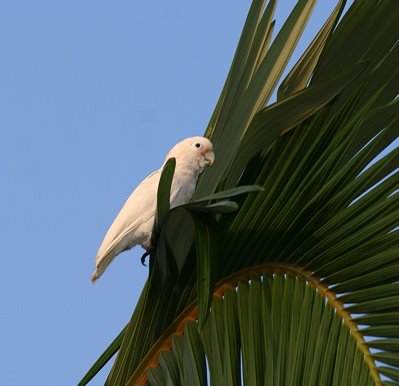
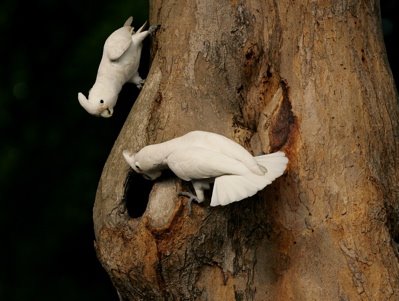
If you are at Changi Village and hear loud screeching, look around you, especially at the many tall angsana (Pterocarpus indicus) trees along the road. These are the Tanimbar Corella (Cacatua goffini) (above), also known as Tanimbar Cockatoo. There are usually about five birds around these trees and they are hole nesters.

There are up to 20 such corellas in the Loyang/Changi area. They are also found elsewhere in Singapore, including about 40 on Sentosa.

The other parrot commonly using these trees are the Red-breasted Parakeet (Psittacula alexandri), also known as the Moustached Parakeet. There are also about three Yellow-crested Cockatoos (Cacatua sulphurea) (below) around Changi but they hardly visit the village.

All the above birds are not natives of Singapore. Tanimbar Corella is native to the Tanimbar Islands of Wallacea. The Red-breasted Parakeet has always been found in Java, Bali, India, Andaman Isle, China, Indochina, Myanmar, Thailand, Sumatra, Borneo and Java. Both were introduced to Singapore three to four decades ago through the bird trade. All have established themselves in Singapore and have feral (i.e. tame birds that returned to the wild) breeding populations.

In Singapore, the Tanimbar Corella feeds on the fruits of various wayside trees like Sea Almond (Terminalia catappa), pong pong (Cerbera odollam) and starfruit (Averrhoa carambola). They are wasteful eaters, pecking away a few morsels only.

One or two Sulphur-crested Cockatoos (Cacatua galerita), also escapees, have recently been seen in Sentosa.

PS: All three cockatoos are endangered. Yellow-crested and Tanimbar are listed in Appendix I of CITES while Sulphur-crested is in Appendix 2. This means that commercial trade in these birds is prohibited as of 14th June 2006.

Text by R. Subaraj, images by YC (top) and Meng and Melinda Chan (bottom).

Labels:

Tuesday, October 24, 2006

The 2006 bird race: A note from R. Subaraj

The 2006 bird race: A note from R. Subaraj

Dear Friends,

I just took part in the Singapore bird race over the week-end with Martin Daniel and Leong Tzi Ming. Our team STRIX was driven around by Sham who played the role of a non-participating driver. This was my 21st year leading a team in this annual event. Personally, I enjoy doing this once a year as it is fun and challenging... it is like a keen runner looking forward to his annual marathon.

Over the years, the bird race has constantly changed it's format and rules so we have to adapt accordingly. This year was no different. Registrations and submissions went online; teams could begin and end whereever they liked as you only had to submit your results by today, the 24th October 2006; the timing changed to 6.00am Sat to 6.00am Sun; the end of the race get-together is to be held only a week after, on Sat 28th. There was an insensitive point though as the organiser elected to have the bird race on Deepavali Day... whoever decided this has a lot to answer for.

Despite these changes, the unfortunate Deepavali date and the haze, my team decided to go out and do what we always do... go all out while enjoying the day. Sham was not part of the team this year but played the role of non-participating driver. This allowed her to visit our parents in the morning while we were in the forest. I made it clear that she was only to drive us around and she could not be with us during the birding nor could she point out birds to us.

We chose to do a relatively fast-paced (what was I thinking!) itinerary which would take us on a near complete circuit around Singapore. We made a couple more stops than we usually did and while the day proved tiring, it was also highly successful. We spotted 159 species (and only heard 5 others), which is the highest score that I have ever had on a bird race and, after 15 years of trying, finally broke the existing record of 154 species (which was set in 1991 but also included species on call). Six species on the list required notes, according to the rules, so I wrote out reasonably detailed notes for each of them and have just sent them along with the official forms to the organisers, via e-mail. I see no reason why any of the 6 will be rejected as the notes are quite thorough for a fast paced event like this. Phew!!!

Some of the highlights of the day :-

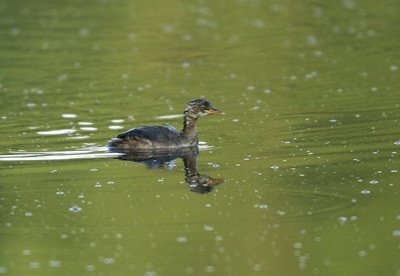
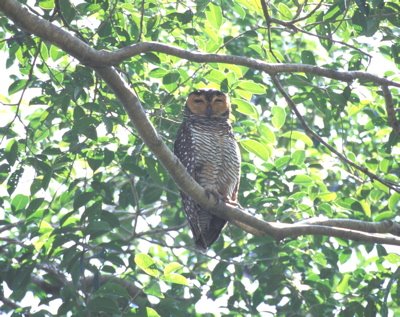
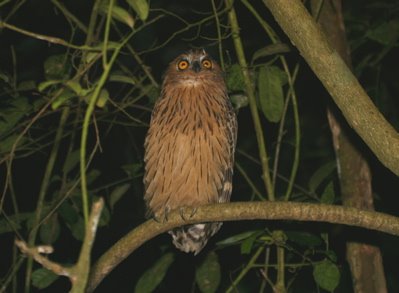
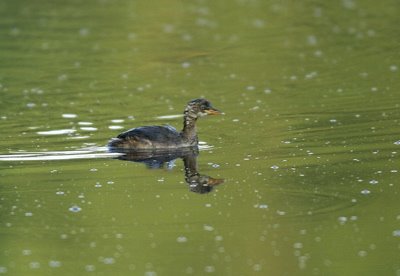
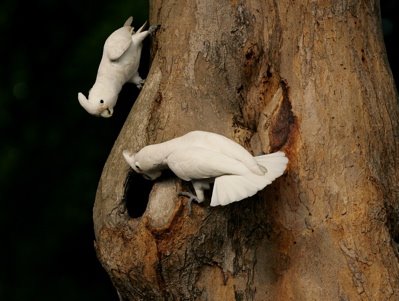
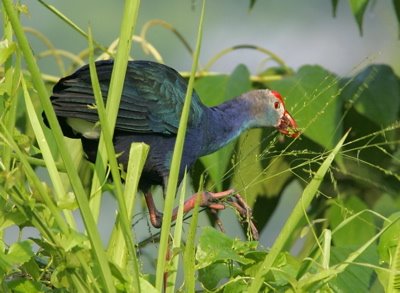
We started the day in the forest at MacRitchie and Sime and left the area with 59 species seen, including goodies like Grey and Malaysian Eared Nightjar, Inornate and Eastern Crowned Warblers, Dark-sided Flycatcher, Greater Green and Blue-winged Leafbirds, Thick-billed Green-Pigeons, Oriental Pratincole, Eyebrowed Thrush, Forest and Grey Wagtails and Black-headed Bulbul. We then headed north-east to Serangoon, making a couple of short stops along the way that produced a few more birds including a Common Tern and Chinese Goshawk at Ponggol and Rose-ringed Parakeet and Oriental Honey-Buzzard at Jalan Kayu. Serangoon produced the goods as always with 26 additions within an hour, including Intermediate Egret, White-shouldered Starling, White-browed Crake and Cinnamon Bittern. Our 100th bird, Little Grebe (above), was seen here at 1137 hours. After picking up the Tanimbar Cockatoo at Changi Village (above), we headed to the reclaimed land at Changi Central. This is always a time consuming site due to the unpaved roads and tracks but holds species difficult or impossible elsewhere. In an hour and a half, we added 15 species including Black-headed and White-headed Munias, Malaysian Plover and both sand-plovers, Sanderling, Rufous-necked Stint, Common Buzzard and quite possibly the spectacle of the day... with a sub-adult and a juvenile Pied Harrier as well as a Crested Goshawk over our heads at the same time! We also had about 63 Oriental Pratincoles! From the east, we headed south to Marina South to pick up a few common species but a bonus here was a Brown-streaked Flycatcher. Then it was on to Tuas, in the south-west corner, for Red-wattled Lapwing, Savanna Nightjar and Pintail Snipe. From Tuas, we headed up to the north-west. At Neo Tiew, another big surprise awaited us in the form of a juvenile Purple Swamphen (above). We also had Slaty-breasted Rail and another lapwing here. Picking up the missing White-bellied Fish-Eagle at Kranji, we moved to the Sungei Mandai mudflats for low tide. Here, we picked up a few muddy shore waders and a couple more tern species. The highlight here though had to be the Chinese Egret, strolling on the flats alongside many of their Little cousins. It was now time to head into the centre again and the Bukit Batok Nature Park. Woodpeckers were scarce all day with only 1 species in the bag... so we were pleased to find both Banded and Common Flameback here along with Straw-headed Bulbul, Lineated Barbet and White-crested Laughingthrush. Yet another bonus was seen, in the form of a Grey-faced Buzzard. Our last day spot was the Botanic Gardens where we picked up the only Lesser Whistling-ducks of the day and the Red-legged Crake. We dipped on our namesake again though... the Strix seloputo (Spotted Wood Owl), despite hearing it call from the distance (above). We were tied for the record as dusk fell, so off we went to Lower Peirce where a Buffy Fish-Owl was the record breaker (above). We had dinner and then went on to pick up both common resident swiftlets at their roosts and a pair of Barn Owls. Our final bird was a perched Black-crowned Night-Heron in Pasir Ris, shortly after midnight. We called it a night and ended the race, exhausted but pleased.
The funny thing about having such a high score this year was that conditions were anything but favourable. While it did not rain nor was it too hot... the haze was pretty bad in the morning, though it cleared up by afternoon. The prolonged dry period meant that water-logged fields were dried up, drains and ponds were very shallow or partially dry and the humidity was something else. Yet, the birds showed up well and migrants were quite varied on the day.

I hope that you all do not mind my sharing this with you. I do hope that my e-mail with results and notes is received by the organisers... it should be, and I hope that all the birds are accepted by the arbitrators... they ought to be. We'll find out this on Saturday. If everything stays the same, I just might be able to take it easy for the next bird race in 2007!

Regards,

R. Subaraj
24th October 2006

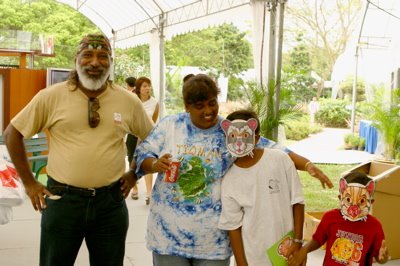
Images of owl and Subaraj & family by YC, others by Chan Yoke Meng.
Monday, October 23, 2006

A House Crow went fishing

A House Crow went fishing

Crows are omnivorous. This means that they eat anything and everything, from grain, fruits, flower nectar, insects, eggs and birdlings, small mammals and what have you. They are scavengers, thriving where there are scraps of food available. That is why they are so successful around urban areas.

We have posted accounts of crows attacking and eating a rat and a bat. We also have an account of a White-bellied Sea Eagle (Haliaeetus leucogaster) catching a rat swimming in the sea off Changi. But this is the first time we have an account of a House Crow (Corvus splendens) actually fishing.

Meng and Melinda Chan witnessed a House Crow in Punggol last year quietly standing on a rock by the sea. Suddenly it dived into the water and emerged with a fish. With the fish firmly in its bill, it bashed it against the rock until it was stunned or probably dead. Then it started ripping it apart and eating it piece by piece. It was then about 7.00 pm in the evening and the light was low, so the image they managed to capture was not as bright and crisp as they would like it to be.

For the records, there have been reports of House Crows picking fish from shallow water or even plunging into deeper water to fish.

Input and image by Meng and Melinda Chan. Thanks to Kok Hui we have the correct ID of the bird in the above image.

Reference: Madge, S. & Burn, H. (1994). Crows and jays. London: Christopher Helm.

Labels:

Saturday, October 21, 2006

Orange-bellied Flowerpecker feeding

Orange-bellied Flowerpecker feeding

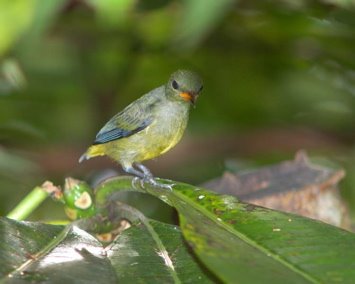
K.C. Tsang was out birding in early May 2006 when he had a chance encounter with a family of Orange-bellied Flowerpecker (Dicaeum trigonestigma):

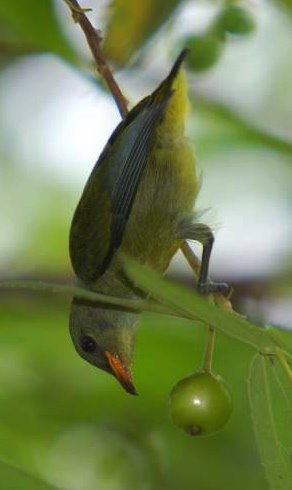
“It is very seldom that one is able to get a family picture of the Orange-bellied Flowerpecker all in one morning. The male, which has a very brilliant orange belly, was found attacking the fruit of the Indian cherry tree (Muntingia calabura) (left). He uses the lower mandible to pierce the partially ripe fruit. He only takes the sweet juice of the fruit, unlike other bigger birds that take the fruit whole.

“After his turn is over, the female may also take on the same punctured fruit, or she may do her own harvesting of the fruit (below, left).

"The chicks I think must have been fed somehow as I have not been able to see the feeding action, and they seem quite contented just perching on the branch (below, right).


“The last bird I believe is a sub-adult male, as one can observe the changes in its feathers (below).”

Input and images by K.C. Tsang

Labels:

Friday, October 20, 2006

Anting by an albino Javan Myna

Anting by an albino Javan Myna

We have earlier reported on anting by Javan Myna (Acridotheres javanicus), Common Myna (Acridotheres tristis) and also by Blue-crowned Hanging Parrots (Loriculus galgulus).

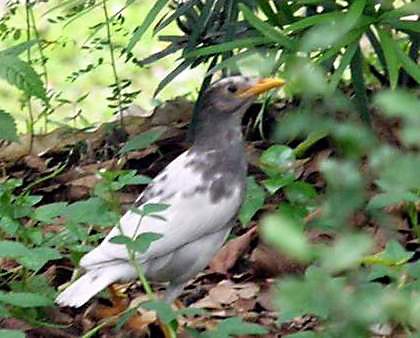
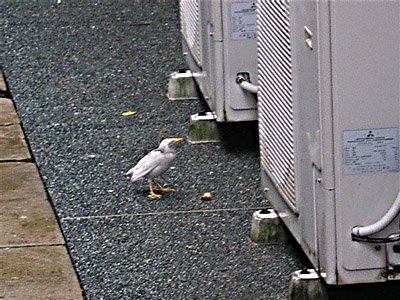
In May 2006 Angie Ng observed a Javan Myna anting at the carpark of the Singapore Botanic Gardens (SBG). However, the myna she saw was an albino juvenile.

As Angie recounts: “I think it was a myna; it was with another normal myna. Saw them playing under one of the trees in the upper carpark in SBG. They shied away when I approached them; then when I went closer, I saw the kerengga ants (Oecophylla smaragdina) and guessed they were anting.” In the meantime Steven Chong sent in this account: "...I was at Nature's Niche, SBG Saturday weekend 30.10.06 around 2.45 pm when I heard this commotion outside the bookshop..." He went outside to investigate and saw the albino myna grabbing a morsel from the 6-8 other normal mynas, to return to the same spot soon after, "standing behind the aircon compressors behind Nature's Niche, as shown in the pix (above), again by itself, but it had dropped the morsel. I didn't think it ate anything, just gazing at what it fought so hard to get at....probably also just realising it couldn't eat what looked hard and non edible. I showed the pix to Morten Strange who was in the bookstore and he commented that this was one of the two albino siblings that grew up around SBG and apparently doesn't get along with the rest of its 'family'."


Input by Angie Ng and Steven Chong; images by Angie (top) and Steven (bottom).

Labels:

Thursday, October 19, 2006

Landing a Brahminy Kite in the Andaman

Landing a Brahminy Kite in the Andaman

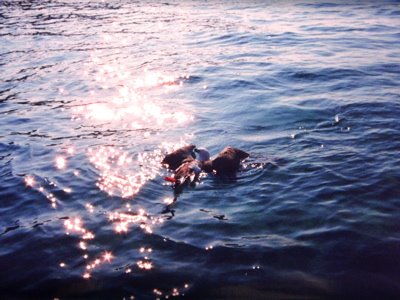
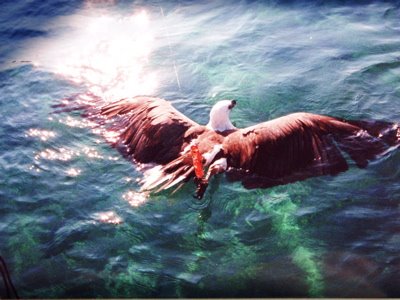
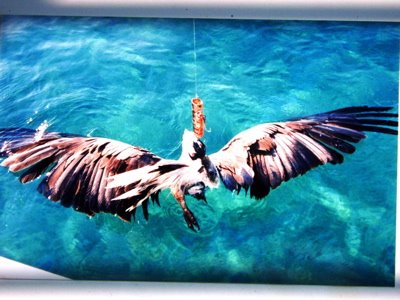
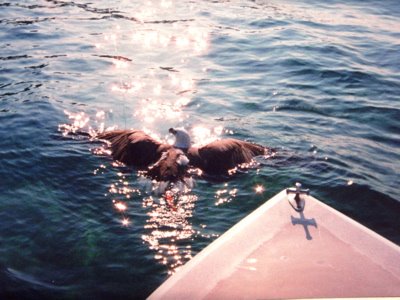
Stephen Lau and his fishing buddies were in the Andaman and Nicobar Islands some four years ago. This is a great fishing safari destination and they were there to fish. But instead of the large sea water fish, they landed a Brahminy Kite (Haliastur indus). Stephen recounts the incident:

“There were three of us in a dingy and we were successfully catching fish using a technique called popping i.e. using our casting rod and a lure (a popper) which makes a popping sound when it is dragged at intermittent speed over the surface of the water. The lure's motion is a series of short hops and as it dives forward, its concaved front end emits a pop sound. We were catching 1.5-2.0 kg groupers at every cast on the surface of a coral reef at depths of around 5-7 m. “A Brahminy Kite suddenly swooped down and picked up the lure with both feet and as it made it's get-away one of it's foot was hooked up by one of the three triple hooks on the lure.
“As it was unable to release the lure we had no choice but to start reeling it down towards us whilst it was airborne. Finally it settled down into the water with its wings outstretched and we reeled it sufficiently close to catch hold of its foot and the lure to perform the unhooking. “It was strange. It never struggled throughout the whole operation. Once freed it sat in the water for a short while before lifting itself off and flying to the nearest tree. There, standing on one leg, it continued looking at us.”

Input and images by Stephen Lau. KC Tsang confirmed the identification of the kite.

Labels:

Tuesday, October 17, 2006

Do birds have teeth?

Do birds have teeth?

Do birds have teeth? A few species may look as if they do. But these are actually tooth-like notches on their mandibles. And they are also not used to chew food. However, a developing chick inside the egg may have an egg-tooth, a sharp projection on its bill. But this is not a true tooth. As the chick inside the egg develops, the shell thins from the inner lining as calcium is absorbed. Even then the shell is still a substantial barrier between the hatchling and the outside world.

The chick needs to break out of the egg by pecking hard on the inner wall of the eggshell. This it does with the help of a sharp egg tooth found at the tip of the upper beak. This tooth disappears in the weeks after hatching.

This is the theory most birders know. But how many of us have actually seen the egg tooth? Only with the help of photographs do we have a chance of actually see the tooth.

In the above image of two Peaceful Dove (Geopelia striata) (previously called Zebra Dove) chicks, the egg tooth can distinctly be seen at the tip of the beak.

The image below shows very clearly the egg tooth in two Pink-necked Green Pigeon (Treron vernans) chicks.
Text by YC, images by YC (top) and Chan Yoke Meng (bottom).

Labels:

Monday, October 16, 2006

Hunting techniques of Great-billed Heron

Hunting techniques of Great-billed Heron

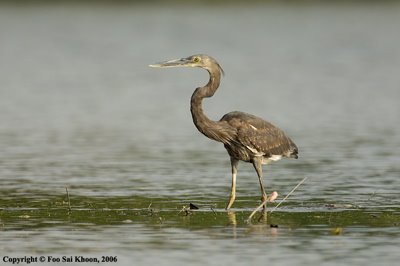
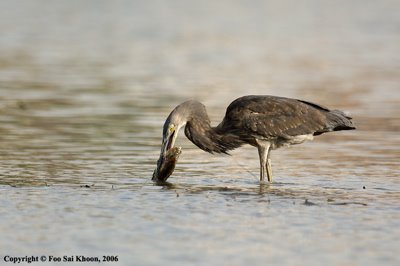
The Great-billed Heron (Ardea sumatrana) is one of the tallest bird seen in Singapore and as such will always be a talking point. However, it is a rare resident. Its appearance in Chek Jawa in the offshore island of Pulau Ubin and also in the Chinese Garden in Jurong recently has got birders and photographers excited. Foo Sai Khoon, an avid photographer, managed to capture a series of images of the heron successfully catching a fish.
Although reported to prefer mangroves, mudflats and rocky islets, it is commonly seen also in inland rivers. Thus its presence in the freshwater pond in Jurong is nothing unusual.
As with most herons, the Great-billed is a carnivore. It hunts alone, catching mainly fish, crabs and other crustaceans as well as mudskippers. It has a long and thick bill that allows it to handle large prey. Its long legs make it easy for the bird to stalk prey in shallow water (top).
Herons use various methods to hunt. The bird may stand motionless in shallow water for fish or some other aquatic prey to come within easy reach before suddenly pouncing on it (second from top). Or it may wade slowly along, searching for prey.

As the prey is in the water, the bird needs to compensate for refraction. Thus the head and neck are moved from side to side (left) as well as forward and backward. Such movements allow the bird to improve on its binocular vision and to calculate the exact distance of the prey.

The bird generally captures its prey by grabbing it with its bill or even impaling it. We have already seen how the Little Heron (Butorides striatus) baits prey. Once the prey is caught, it is swallowed whole, usually head first (above two). Parts that are not digested, like scales and bones, are regurgitated in the form of a pellet.


Input and images by Foo Sai Khoon. The images were originally posted here.

Labels:

Sunday, October 15, 2006

An Oriental Pied Hornbill eating a bee

An Oriental Pied Hornbill eating a bee

On 16th July 2006 at about 10 am, Yeo Seng Beng was pleasantly surprised to see three Oriental Pied Hornbill (Anthracoceros albirostris) around the Binjai Park area. The three birds, two adults and a smaller juvenile, were slowly moving together from tree to tree. Armed with his camera, he followed the birds. And apparently they allowed him to get close enough for him to notice a bee between the beak of one of the birds. As Seng Beng wrote: “From one of the photos, you can see the bumble bee in it's mouth. I could even hear how crunchy it was, as it was eating it! That's how close the birds allowed me to approach.”

The Binjai Park and the surroundings areas have been visited more than a few times by these impressive hornbills. Their arrival would be announced by their characteristic loud calls and they would loiter around some trees along the roadside and even in someone's garden. And without fail, their presence would result in great excitement as seldom do people see such large and impressive birds in our urban areas.

Seng Beng has also been active in persuading National Parks Board to reintroduce binjai trees (Mangifera caesia) back to Binjai Park. After all, the estate has been named after these exotic fruit trees that belong to the mango family. The area was possibly once a fruit orchard planted up with many such trees. Currently there are still a few tall and very old trees around the housing estate - within the confines of private compounds!

We wish to thank Dr Yeo Seng Beng for sharing his experience and images with us.

For past postings on hornbills around the area, see 1, 2, 3, 4 and 5.

Labels:

Friday, October 13, 2006

Saving a raptor’s nest of 50 years in a 100 year old Alstonia tree

Saving a raptor’s nest of 50 years in a 100 year old Alstonia tree

The Changeable Hawk-Eagle (pale morph) (Spizaetus cirrhatus) is a protected wild life species under the Protection of Wild Life Act 1972 of Peninsular Malaysia. Under this Act, no poaching, selling, pet-keeping, eating, killing or possessing of the bird dead or alive, including any body parts, is allowed. This includes taking or destroying nests or eggs. Flaunting the Act is punishable by law and liable to a penalty fine or term in jail or both. Frequent bird surveillance of my local area confirms the sighting of a raptor roosting in a pulai or alstonia (Alstonia sp.) tree that is claimed by village owners to be more than 100 years old. Rising to more than 50 metres tall, the heart of the umbrella shaped canopy caresses an old raptor nest (above, arrowed), used and reused during the past 50 years, as believed by the villagers.

From this nest and hidden from public eye, generations of Changeable Hawk-Eagles were raised from hatching of an egg per clutch, and trained by their parents to fly and to prey for their survival.

“It is music to my ear” said a villager, whenever the raptors shrill with ascending, loud, high pitched whistles at dawn and at dusk to announce their iconic arrival to roost at the alstonia tree.

It was not long before development knocked on the front doors of villagers. They were persuaded to sell their tree and “pulai tree” as known to the villagers, became a hot topic of debate in the family living rooms.

As a frequent birder-visitor to the village, I was approached by a village elder to help save the tree and the avian occupants. He was a man with good hindsight. Living close to the alstonia tree, he would have much to lose as there would be risks of erosion and landslides, compromising lives of families living nearby, and mudflows into his property. His days of enjoying a cool evening breeze would be over and his living areas would be like a hot oven and raptors would shrill no more for his grandchildren to hear and know who these raptors were.

Felling the alstonia tree for a short term monetary gain is a poor vote as it cannot measure the immeasurable loss in the long run for the future welfare of the villagers. It is like selling one’s soul for a sack of rice. Evicting an old friend’s home and avian family of more than 50 years that has been living harmoniously and peacefully is a bad conscience one has to live with.

As requested by the village elder, I submitted a paper highlighting the importance of preserving the alstonia tree and the legality of protected species of avian wild life for the village family committee to deliberate upon. They decided on a positive vote.

Today, I am pleased to say, whenever I visit this village, the iconic alstonia tree with the Changeable Hawk-Eagle’s nest remain intact and looking tall as much as my pride. My presence in the village is made welcomed by the calls of the avian wild, smiles and greetings from villagers and children crowding to peep into my scope. It is a warm and rewarding feeling. But for how long more is hard to say as developers have plans to turn this small pocket of multiracial village into a concrete jungle.

I was just simply taken there at the right time, right place and for the right purpose by divine intervention or whatever that one would choose to believe.

I was just passing through and perhaps… bought some time for the villagers to further reminiscent their childhood days, added value life to the 100 year old alstonia tree and an extended eviction grace period for the avian of the wild.

SUBMITTED BY: DAISY O’NEILL, PENANG, MALAYSIA

Labels:

Thursday, October 12, 2006

Raid on the hornbill’s potential nesting cavity

Raid on the hornbill’s potential nesting cavity

For the months of February to May 2006 a pair of Great (Buceros bicronis) and Rhinoceros Hornbills (B. rhinoceros), both female, was regularly prospecting a potential nesting cavity in an old albizia tree (Paraserianthes falcataria) in Eng Neo. Whenever the birds were there the Great, acting in the role of a male, would fly to the cavity and deposit food, presumably figs, inside. This is typical hornbill courtship behaviour, to assure its partner that it would continue to feed her during her confinement within the cavity throughout incubation and nestling development.


It could be assumed that the cavity would be a storehouse of figs, as daily the Great would repeat this ritual. That this was so was confirmed by visits of other birds like Hill Mynas (Gracula religiosa) (above, left) and Javan Mynas (Acridotheres javanicus) (above, right) entering the cavity and helping themselves to the figs.

Image of Hill Myna by Chan Yoke Meng and of Great Hornbill and Javan Myna by YC.

Labels:

Wednesday, October 11, 2006

Illegal mist-netting of birds

Illegal mist-netting of birds

On 2nd Sep 2006 Tang Hung Bun wrote: “This morning my friends and I were shocked to see a poachers' net (18m by 3m) in the Kranji area. There were five Baya Weavers (Ploceus philippinus) caught in it. My friends quickly freed the birds, but two of them were already dead. These two were probably trapped in the net for a long time and suffered a slow death. They were juveniles. Before we left, we destroyed the net."Ashley Ng added: “These poachers usually set up their mist net early in the morning before sunrise or the day before. They will come back the next few hours or days to check on the netting… Why leave the birds to die? Poachers usually have a list of species they want to catch. Those unwanted species are usually left to die a slow death.

“Which species to catch? Based on habitat, they are probable interested in munias, doves, bulbuls which have better market rates than baya weavers.

“Occasionally, other bigger mammals such as bats and squirrels get trapped on the mist net and eventually die.” From Penang, Malaysia, Daisy O’Neill has this to say: “...mist netting is the most common method used on the 'mainland' across the causeway, especially in more remote areas. I came across another bird trapper doing it in 'motorbike style' (above). “He has a Zebra Dove (now Peaceful Dove, Geopelia striata) in his homemade, creative contraption he is holding. He selects his poled position and waits behind some bushes. At times, he coaxes the dove to 'coo' for mates to join her. Doves would land on the old fishing net hung loose in the 'racket' loop to catch the landing dove, trapping it when its feet get entangled in the net (below). So simple! “He was given a friendly advice to be wary of species of birds that are protected, that can land him with a jail term and fine.”

An earlier posting on the poaching of the Straw-headed Bulbul (Pycnonotus zeylanicus) can be seen here.

Input by Tang Hung Bun, Ashley Ng and Daisy O'Neill. Top three images by Tang and bottom three by Daisy.

Labels:

Tuesday, October 10, 2006

The fig tree at Bukit Timah: 3. Suggestions for next year

The fig tree at Bukit Timah: 3. Suggestions for next year

Part 1 of the account on the fig tree at the summit of Bukit Timah lists the 29 species of birds that were documented in and around the vicinity of the Benjamin fig (Ficus benjamina) during its short figging period. The list was compiled by birder Yong Ding Li. In Part 2, our bird specialist R. Subaraj made a detailed analysis of the list as well as adding to the species of birds. In this final part, suggestions are made on what birders can do when the tree bears fig next year. For the 2007 figging, I would suggest that local birders move on to a higher level of birdwatching. The many old (in terms of experience as well as age) birdwatchers should begin to study the behaviour of these different birds that are attracted to the figging tree. Like when (in terms of time of day and days of the week) these birds visit and whether they all arrive at the same time or at different times? Do these species interact in a friendly manner or aggressively towards one another? Do the different species feast at different areas of the tree (peripheral of the crown, crown interior, branches, etc)? For a specific location of the tree, is there a pecking order of feasting? In fact there are so many aspects of bird behaviour that can be observed during this short span of less than two weeks the tree will be figging. If different birdwatchers report back on different periods of the day or days of the week, someone can then compile the information. This will help us have a better understanding of bird behaviour when the tree at Bukit Timah produces its next bountiful yield of figs.

Understandably, some of the older and more experienced birders have seen these birds already and may not be interested in spending time at the tree. Never mind. But the newer and younger (and dare I say, more energetic and enthusiastic) birdwatchers should lead the way to the next level of birdwatching in Singapore.

After nearly half a century of birdwatching in Singapore, it is about time we take the challenge to understand the birds that we see everyday, not just keep on listing them.

Input by YC, image of Tiger Shrike (Lanius tigrinus) eating insect (top) by Chan Yoke Meng and Asian Fairy Bluebird (Irena puella) (bottom) by Johnny Wee.

Labels:

Sunday, October 08, 2006

Arrival of the Asian Paradise-flycatcher

Arrival of the Asian Paradise-flycatcher

Asian Paradise-flycatcher (Terpsiphone paradisi), also known as the Common Paradise Flycatcher, is a migratory bird wintering in tropical Asia. It began to arrive in Singapore around late September and early October and this was the time Meng and Melinda Chan sighted a pair in the Central Catchment forest. The male was a white morph with tail longer than the female but the spectacular long central feathers were absent. The pair took turns darting out of the forest canopy to catch flying insects, returning immediately to feed.

It is insectivorous, often hunting for insects like bees, small beetles, flies and neuropterans. It has been reported to hunt with mixed flock. In this instance the female was seen perching near to a Yellow-vented Bulbul (Pycnonotus goiavier).

Note: On 12th June David Tan sent in images of the bird nesting in Taman Negara, Malaysia. On 28th September KC Tsang reported seeing a juvenile at Sungei Buloh Wetland Reserve. There may be other sightings as well. There is also an earlier posting on its nesting.


Input and images (top, male; rest female) by Meng and Melinda Chan.


The latest addition of the back view image of the bird (left) is by Allan Teo.

Labels: ,

Saturday, October 07, 2006

The fig tree at Bukit Timah: 2. Comments by R. Subaraj

The fig tree at Bukit Timah: 2. Comments by R. Subaraj

The first part of the series, on documentation, was posted a few days earlier. The account attracted the attention of our bird specialist R. Subaraj who has this to say:

"I just had a read through the latest posting on the fruiting fig tree at Bukit Timah. The species list is great but reflects what was seen at the summit rather than just the tree itself. To the non-birder or less experienced, the list is therefore misleading as readers will believe that all the birds listed were seen in the fig tree and were there for the figs, which is definitely not true (but see below).

"Those that were seen over the summit and definitely not in the fig tree were Oriental Honey-buzzard (Pernis ptilorhyncus), Japanese Sparrowhawk (Accipiter gularis) and the Himalayan (Collocalia brevirostris) and Edible-nest Swiftlet (Collocalia fuciphaga). Those seen generally in the summit area were Large-billed Crow (Corvus macrorhynchos) and Blue-throated Bee-eater (Merops viridis). Additionally, the following species that may have been recorded in the fig tree, were there for insects rather than the fruits: Asian Paradise (Terpsiphone paradisi) and Yellow-rumped Flycatchers (Ficedula zanthopygia), Arctic ( Phylloscopus borealis) and Eastern Crowned Warblers (Phylloscopus coronatus), Tiger Shrike (Lanius tigrinus), Dark-necked Tailorbird (Orthotomus atrogularis), Crimson Sunbird (Aethopyga siparaja) and Greater Racket-tailed Drongo (Dicrurus paradisus). It is also important to note that the great variety of species at the summit and in the fig was because of the time of the year....when many migrants were present.

"My comments are based on many past visits to this glorious fig tree since 1990.

"I visited the summit fig on September 27th, with Sham. There was less variety, birdwise, in the tree but we also had an Ashy Bulbul (Hemixos flavala), Brown-throated Sunbird (Anthreptes malacensis) and a small flock of Asian Glossy Starlings (Aplonis panayensis). I hope that you can add the above to the article so that readers are better informed about which species were actually visiting the fig and who the real frugivores are."

NOTE: I am afraid I have to take responsibility for the misunderstanding. In Yong Ding Li’s words, the birds listed “...are in and in vicinity of the tree.” In my enthusiasm to post the article I did not include this qualification. This has now been rectified in the blog post. Sorry about that. YC

Image of Asian-paradise Flycatcher (top) by Johnny Wee; Tiger Shrike (middle) and Asian Glossy Starlings (bottom) by Chan Yoke Meng.

Labels:

Friday, October 06, 2006

Nesting of the White-rumped Shama

Nesting of the White-rumped Shama

One day this year, Joe Yao came across a male White-rumped Shama (Copsychus malabaricus) perching on a branch of a tree (above). He returned to the same location at around the same time the next day and there it was at on the branch. Realising a photo opportunity, he returned a third time, equipped with his camera and draped in a camouflage net, hoping to get nearer the perch. As luck would have it, the bird did not land on the same perch but on the ground nearby. As Joe turned around to leave the place he came across a rotting palm trunk, probably that of a fishtail palm (Caryota mitis). There, inside the hollow rotting trunk were four chicks packed together (above). He realised that he had stumbled upon the nest of the White-rumped Shama. Over a period of 12 days he returned to the area to document the development. The nest was completely empty on his last day of visit but he managed to locate one of the fledged chicks. As he recounted: “Hopefully, all four of them are safe and sound to grow up into adults, and this supposedly near extinct species would have increased by four in number. To fully appreciate the beauty of this species, you have to listen to its melodious call.”

Joe has made a video clip of both the male and female shama (below-top) and also one of the fledged chick (below-bottom) which can be viewed here.

Note: The White-rumped Shama is a spectacular songster with a great variety of whistles as it has the ability to mimic other birds. This unfortunately has been its downfall as it is regularly trapped and traded. The situation is such that there may be more shamas caged than in the wild. Whether the pair that Joe encountered were escapees is anybody’s guess. The fact that the bird is breeding, and nesting near to a public area, points to the possibility of the species making a slow comeback.

Input and images by Joe Yao.

Labels:

Thursday, October 05, 2006

White-bellied Sea Eagle in action

White-bellied Sea Eagle in action

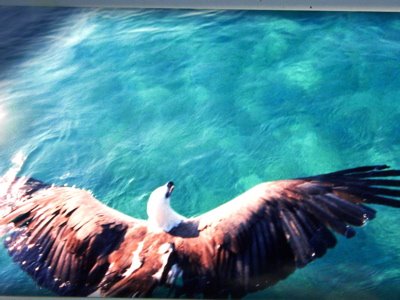
In September 2006 K. C. Tsang sent in a dramatic image of a juvenile White-bellied Sea Eagle (Haliaeetus leucogaster) swooping down upon a fish at Changi Ferry Point.

This eagle usually fish from a vantage perch. Once it spots a fish swimming just below the surface of the water, it would fly over and pounce on it, normally only immersing its feet and legs in the water. The powerful talons would grip the fish around the head and the eagle would bring it back to dry land or a convenient perch to be eaten. The bird may even soar over the water surface to hunt, but this usually ends up catching dead fish.

Unlike Osprey (Pandion haliaetus), this eagle does not dive into the water to fish.

Account by YC and image by KC Tsang.

Labels:

Wednesday, October 04, 2006

The fig tree at Bukit Timah: 1. Efforts at documentation

The fig tree at Bukit Timah: 1. Efforts at documentation

A figging fig tree is heard long before it is actually seen. This is exactly the situation with the old fig tree growing at the summit of Bukit Timah. This Benjamin fig or waringin (Ficus benjamina) figs rather irregularly. But each time it figs, the tree attracts numerous birds, in terms of number of birds as well as number of species. At such times the tree generates great excitement among local birders. They all flock to it to watch the birds having a feast, to record the number of species that are attracted to the tree and to make a count of each species.

This has been going on for years and generations of birdwatchers continue to get excited by the event. With so many species of birds congregating in one tree, trampling around the countryside to see the different species becomes unnecessary. And each time the tree figs, one or a few enthusiastic birders will make available a list of species that visit the tree.
This year's figging happened during the last week of September and lasted for less that two weeks. The tree is once again silent. This time Yong Ding Li, an enthusiastic new-generation birder who provided the list, enthused: “The famous fig tree at the summit, known to be of sacred importance to many birdwatchers 'fruited' the last three days and activity is still on with massive clumps of orange red figs. The bulbuls and bluebirds are actively making their gastronomic pilgrimage there, and so should we! (avian pilgrimage I mean).”

Ding Li's list of the birds and their numbers (in and around the vicinity of the tree), recorded on 25th September: Oriental Honey Buzzard 1; Japanese Sparrowhawk 2; Great Hornbill 1; Rhinoceros Hornbill 1; Thick-billed Green-Pigeon 2; Himalayan Swiftlet 5-7; Edible-nest Swiftlet type 20-30; Asian Fairy Bluebird 15; Lesser Green Leafbird 2; Greater Green Leafbird 2; Blue-winged Leafbird 5; Red-eyed Bulbul 12; Cream-vented Bulbul 6; Olive-winged Bulbul 8; Black-crested Bulbul 2; Asian Paradise Flycatcher 2; Yellow-rumped Flycatcher 3; Arctic Warbler 4; Eastern Crowned Warbler 18; Hill Myna 10; Tiger Shrike 1; Chestnut-bellied Malkoha 2; Dark-necked Tailorbird 2; Crimson Sunbird 1; Scarlet-backed Flowerpecker 2; Orange-bellied Flowerpecker 3; Greater Racket-tailed Drongo 2; Large-billed Crow 2; and Blue-throated Bee-eater 2.

This is an impressive list of 29 species of birds that joined in the fig feast or were around the area. I am sure birdwatchers are appreciative of his efforts.

Thank you, Ding Li for compiling the list. Image of the tree (top) and longi-section of a ripe fig (bottom) by YC.

Labels:

Tuesday, October 03, 2006

Tiger Shrike and the caged white-eye

Tiger Shrike and the caged white-eye

Tiger Shrikes (Lanius tigrinus) are small, harmless-looking songbirds that are far from harmless. In fact they are aggressive predators, behaving like small raptors when hunting. No doubt about it, they are carnivorous and their diet includes large insects, small rodents, reptiles and mammals. They also eat small songbirds. Their upper mandible ends in a strong, hooked bill that they use with great efficiency to kill and dismember prey. Chan Yoke Meng was recently witness to a juvenile Tiger Shrike trying to get at four white-eyes confined safely inside a cage. As the shrike landed on one side of the cage, the captive white-eyes panicked and fluttered to the other side. The shrike then flew to the other side, sending the white-eyes panicking to the opposite side. Even after shrike gave up and perched nearby on a nylon rope, the white-eyes were still in a state of frenzy. I suppose the white-eyes could consider themselves lucky to be inside a cage that day.

Melinda Chan sent a link that shows a Long-Tailed Shrike (Lanius schach) killing a Eurasian Tree Sparrow (Passer montanus) and successfully airlifting the carcass to its nest after several tries. This was photographed at Candaba Swamp, Pampanga, Philippines on July 17, 2004.

Input and images by Meng and Melinda Chan.
Labels:

Monday, October 02, 2006

Poaching of Straw-headed Bulbul

Poaching of Straw-headed Bulbul

The following account and images were received on 9th September 2006 from some nature lovers who wish to remain anonymous:“We met two poachers at Mandai yesterday morning. They were using a live decoy of a caged Straw-headed Bulbul (Pycnonotus zeylanicus). “We were walking along a trail when we heard the song of the Straw-headed Bulbul. There was a pair perching high up on a branch of a tree. But the bulbul's singing was coming from a patch of vegetation nearby. As we came nearer to the patch, someone cleared his throat. We immediately realised that there were poachers around. Two of them were hiding among the vegetation - with a small cage.
“We pretended not to see them and casually walked past to avoid any unpleasantness. From a distance we managed to snap one of the two poachers (top image).”

Ashley Ng of Pigeon-Hole has suggested the following should anyone encounter poachers: (1) Take down particulars such as vehicle number, number of people in the group, description of poachers, activities, etc. (2) Call the police or NParks (Ranger Station no: 64685736) immediately, or dial 999 for help. These days the authorities are very helpful, especially on public affairs and illegal activities. They are very responsive and are able to reach the location within 10-15 minutes. (3) Post the report to various groups for further preventive action. [Inserted 7.38 am, 2nd October 2006]

Labels: