Site Meter

Thursday, November 30, 2006

Common Kingfisher: Hovering

Common Kingfisher: Hovering

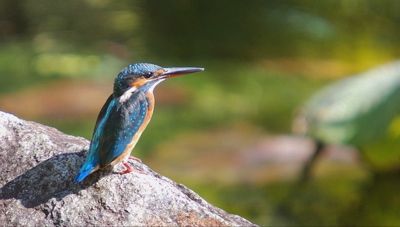
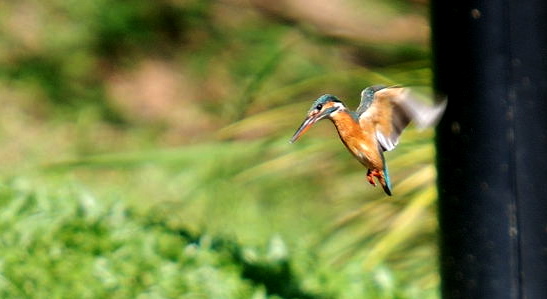
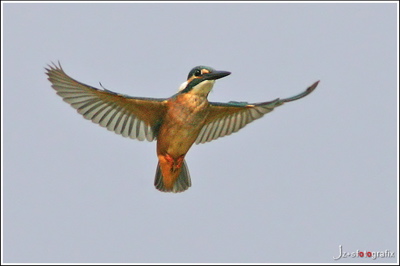
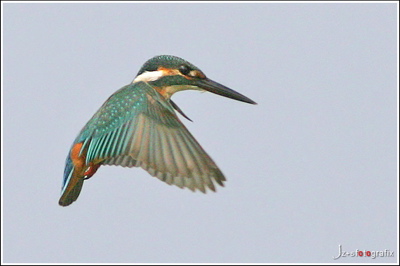
On the morning of 21st November 2006, KC Tsang was admiring a Common Kingfisher (Alcedo atthis) quietly perching on a branch of a tree. He had his camera setup ready and so took a shot of the bird (above). Then suddenly it flew off and hovered above the ground, “like a helicopter” he wrote (below). The bird then swooped down on the grass below and caught an insect. As KC wrote: “According to my long-time birder friend… this must be a new behaviour.” Well, most kingfishers hunt from a high perch, splash-diving into the water or dropping onto the ground to catch a prey (below). These birds take insects and other invertebrates, crustaceans, fishes, frogs, geckos, snakes and sometimes even small birds. Several species use the technique of hovering to forage but only in the Pied Kingfisher (Ceryle rudis) has the technique been perfected. Lui Jianzhong was kind enough to share his images of a hovering Common Kingfisher taken in Hongkong some time ago. The bird was hovering over the mudflat looking for a potential meal like mudskippers, fishes or shrimps (above and below). Hovering is an energy-intensive activity, achieved by beating the wings more or less horizontally – to provide lift but not thrust. The ability to hover for long periods is advantageous when foraging in areas away from a nearby perch. This means that the bird can maximize its time for hunting, rather than returning to a nearby perch to scan the area.

Our bird specialist R. Subaraj has this to say: "This is not new behaviour! The Common Kingfisher is well known for using this method in addition to fishing from a perch and has been observed and documented hovering on several occasions in Singapore and Malaysia."

Input by KC Tsang and Lui Jianzhong; images by KC (top three) and Jianzhong (bottom two).

Labels:

Wednesday, November 29, 2006

Of marsh harriers and other exotic species

Of marsh harriers and other exotic species

In an earlier post on Common Moorhen (Gallinula chloropus), it was mentioned that Western Marsh Harriers (Circus aeruginosus) and Steppe Eagles (Aquila nipalensis) were seen above the paddy fields in Malaysia where Allan Teo was observing and photographing the moorhens.

Yong Ding Li made a pertinent comment, “Take note on the point about Western Marsh Harrier... It is actually a very very rare migrant to South East Asia and more so for Singapore (I suspect only one recent record and even then it is probably mis-IDed many times). Instead here it is replaced by Eastern Marsh Harriers (Circus spilonotus). In the oriental region, western is only regular in the subcontinent, occuring in wetlands and plains of places like Rann of Kutch, Bharatpur where it can be rather common.

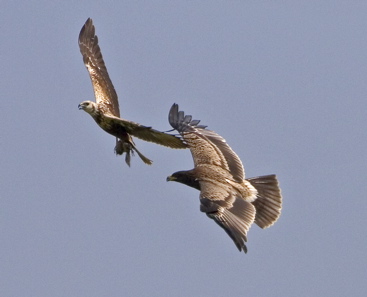
However, R. Subaraj has this to say: “To me, the birds in the photo (above) look like a young female Western Marsh Harrier (on left) and a juvenile Steppe Eagle.

“With regards to Ding Li's statement regarding the status of marsh harriers here, it is a little out-dated. Until 2005, he is right, as reflected in Robson's guide. It was common in Myanmar but rare or a vagrant to Thailand and Peninsula Malaysia... no confirmed Singapore records! At the end of 2005, both Western and Eastern Marsh Harriers were reported from Changi Reclaimed Land and in the weeks to follow, several birders had visited the site and confirmed the presence of both species... with as many as 3 Westerns.

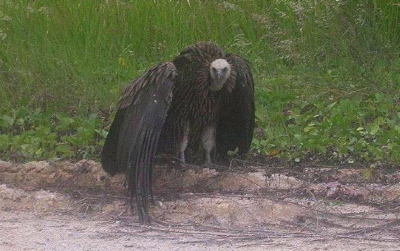
“Being a skeptic myself, I visited the area a few times during that period and personally confirmed at least three Western Marsh Harriers, along with a few Eastern, with excellent views. Reliable collegues and visiting birders, with me or independently, concurred. Hence, the Western Marsh Harrier does occur in Singapore as a vagrant, at least. “It is worth monitoring our area for the next few months to see if they visit again and become a regular occurrence... or if the last season was just unusual. In the last two decades, unexpected raptors have kept turning up in Singapore. Himalayan Griffon (Gyps himalayensis) (above) and Lesser Kestrel (Falco naumanni) are two others that fall into a similar category as the Western Marsh Harrier... birds that formerly only occurred no nearer than India and Myanmar. Other unexpected raptors that have turned up include Oriental Hobby and Jerdon's Baza (Aviceda jerdoni)... normally sedentary species found no closer than the northern half of Malaysia, where they were considered rare.

“So what is going on! Why are these species suddenly turning up in Singapore? Perhaps it is the changing climate conditions? Or the continued deforestation and/or persecution of birds further north and south of us? Perhaps a bit of both!

“Other factors that certainly contribute are the superior optics available, the better field guides and identification books and the increased number of observers covering various parts of our nation. The digital photography age is also making a significant difference in confirming species.

“Finally, and equally significantly, the shrinking habitats available due to development means that birds have less choices if they turn up in Singapore and birders have a better chance of finding them!”

Input by Yong Ding Li and R. Subaraj; images by Allan Teo (top) and Wang Luan Keng (bottom).

Labels:

Tuesday, November 28, 2006

Peregrine Falcon feasting on a Black-naped Oriole

Peregrine Falcon feasting on a Black-naped Oriole

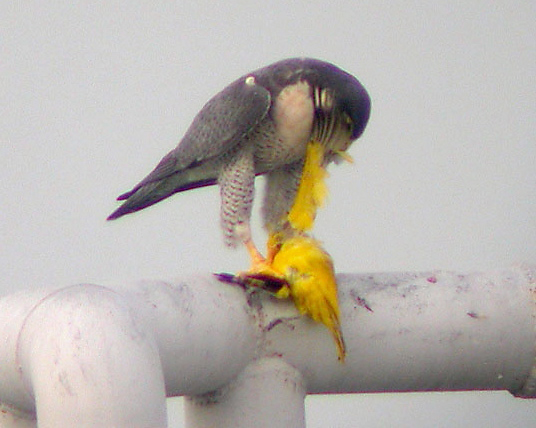
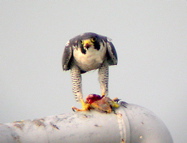
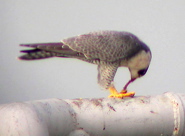
Cheong Weng Chun was going through some of his old bird images when he came across a composite image of a Peregrine Falcon (Falco peregrinus) feasting on a Black-naped Oriole (Oriolus chinensis) (left). The images were taken on 7th March 2004 in Port Dickson when he was just beginning to take an interest in digiscoping birds. He shared the images with like-minded birders then and showed the composite images in the BESG’s e-loop a few days ago.

Through the courtesy of Weng Chun, we are presenting his images highlighting the stages of the falcon's feast, first preparing its catch and then feasting on it…

Peregrine Falcon feeds exclusively on birds like doves, sparrows, waterfowls, feral pigeons and songbirds. It is fast and agile in the air, being the world’s swiftest bird, having the ability to reach a speed exceeding 300 km/h when pursuing a prey. It hunts birds in mid-air, first hitting the prey at great speed with its foot, then swooping back to catch it. The bird has a conspicuous tomial tooth, a sharp triangular-shaped downward pointing projection found at the outer edge of the upper mandible near the curved part of the beak (see above). This sharp “tooth” is thought to serve mainly in the killing of prey by breaking the victim’s neck. In the above image the prey was brought back to its favourite perch to be eaten. The dead bird was first decapitated and then carefully plucked of its feathers (below). With the help of its tomial tooth and powerful bill, the falcon tore through the featherless prey and began its feast (below).


In about 30 minutes or so all the flesh had disappeared from the dead bird and the falcon began to pick at the bones (below). Soon even the bones were picked clean...


...leaving only a satiated falcon (below).
Input and images courtesy of Cheong Weng Chun

Labels:

Monday, November 27, 2006

Oriental Pied Hornbill courtship

Oriental Pied Hornbill courtship

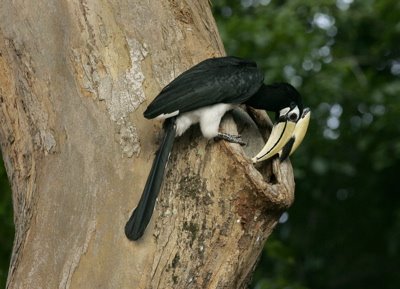
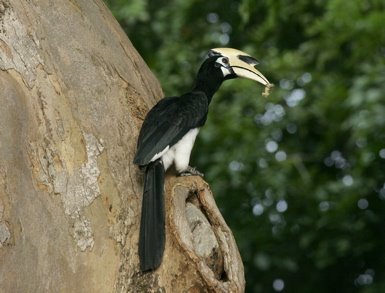
A pair of Oriental Pied Hornbill (Anthracoceros albirostris) was seen at Changi Village around 5.45 pm in early October 2006 in a courtship ritual. The pair was perching on the branch of one of the old angsana trees (Pterocarpus indicus) lining the main road. The male had just caught a gecko, which, in its struggle to get free, lost its tail (above). The bird approached his mate and offered the gecko to her. The mate appeared to accept, opening her bill, but apparently he was just teasing her (above and below).The male bird trotted off along the branch, soon followed by the female. He then flew off to a nearby tree trunk with a cavity that developed as a result of faulty pruning of a branch. There he waited for some time with the gecko still in his bill. He then went through the motion of placing the gecko inside the cavity a few times without getting the female to fly over (below). After some time trying to entice her to come over to check on the cavity, as is usual with hornbills, he flew off to a nearby branch to eat the morsel himself. See also the courtship between a Great Hornbill (Buceros bicronis) and a Rhinoceros Hornbill (B. rhinoceros) here.

Input and images by Meng and Melinda Chan.

Labels:

Sunday, November 26, 2006

Why do birds yawn?

Why do birds yawn?

James Heng brought back this account from his birding trip to Bach Ma National Park, Vietnam earlier this year:

“The ranger informed me about this pair of Brown Fish Owls (Ketupa zeylonensis), a cousin of our Buffy Fish Owl ( Ketupa ketupu) (left), that has been nesting at the same pillar at the gates of the park for several years.

“The pillar is about 4 m high, and is beside the road leading up to the summit. A small number of people use the road so the owls tend to hide amongst the large leaves of the trees to avoid detection. I've not seen them yawn even once when they are wary of people at that spot.

“But by mid-morning though, one would fly to a nearby branch about 3 storeys high where it feels safe. On that perch, it's eyelids will tend to droop and it begins a whole series of yawns before dozing off.

“After watching it yawn several times, I began to yawn too! It was really amusing.

“Hmm, wonder if the reverse it true - if we yawn repeatedly at them, would they yawn too?”

Now why do birds yawn?

Yawning may sooth an itchy throat. Maybe they yawn for the same reason we do, because they are sleepy. Or there is a need for oxygen intake. The yawning is most often triggered when one is tired. Yawning is common at night as our bodies prepare for sleep. The presence of foreign materials in the throat may induce yawn-like actions.

There are those who believe that yawning in birds help remove excess heat.

Very little has been studied on the sleeping habits of birds. We generally assume that, like people and other warm-blooded animals, they sleep when they are tired and full of food. And when they wake up, they yawn and stretch before flying off to forage.

Now, is the Blue-throated Bee-eater (Merops viridis) on the left yawning? Most probably not. Maybe it is casting a pellet?


If you need to see a Buffy Fish Owl yawning, go to our earlier posting.


Input by James Heng; top image by YC, bottom image by Johnny Wee.

Labels:

Saturday, November 25, 2006

Do birds sleep?

Do birds sleep?

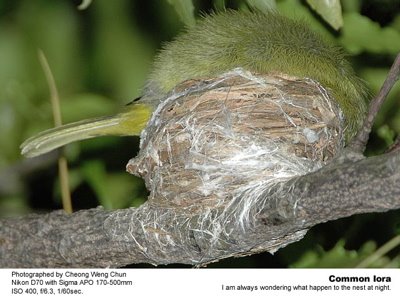
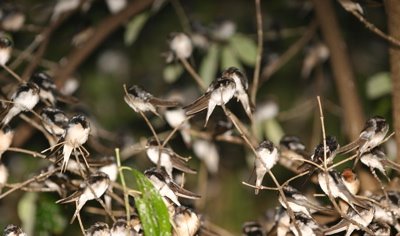
Yes, birds do sleep. Like all warm-blooded animals, they sleep when they are tired and full of food. After all, most birds cannot see well at night. Only a few, like the owls, have large eyes specially adapted for night vision. When they sleep their toes automatically lock tight, thus preventing them from falling while asleep. The above image of the Common Iora (Aegithina tiphia) snug in its nest, was taken by Cheong Weng Chun at night. Although it shows the back view, I am sure the bird was fast asleep. Many species like mynas, crows, starlings, Pacific Swallow (Hirundo tahitica) and Barn Swallow (Hirundo rustica) (above) come together in the evening before dusk to roost on the branches of certain trees. During this period they generate much noise as they squabble over their favourite perch before settling down for the night. Although asleep, these birds are alert and will suddenly move off amidst much noise if disturbed. Early next morning, just before dawn, they wake up, yawn, stretch, refreshed but hungry. Then off they fly to forage.

Hole nesters like woodpeckers usually sleep in tree cavities. Ground nesters sleep on or near the ground.

Obviously nocturnal birds like owls and nightjars sleep during the day.

And many birds "talk" in their sleep and some even sing on moonlit nights.

Input by YC, image above by Cheong Weng Chun, below by YC.

Labels:

Friday, November 24, 2006

Black-naped Oriole manipulating a cocoon

Black-naped Oriole manipulating a cocoon

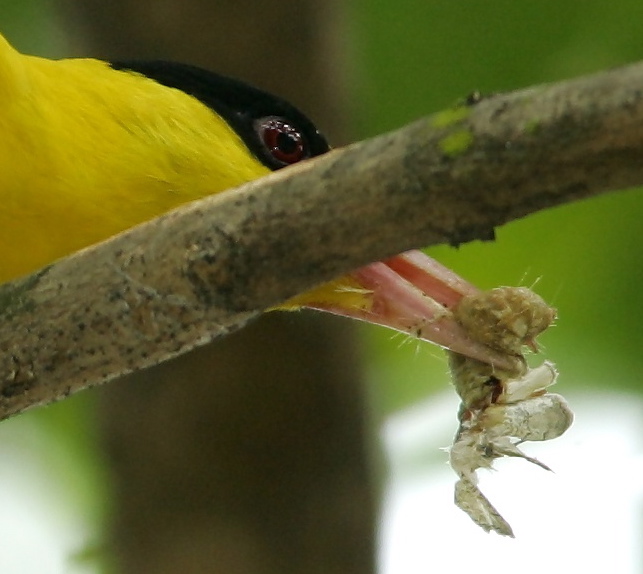
In October 2006 Meng and Melinda Chan chanced upon a Black-naped Oriole (Oriolus chinensis) snatching a whitish cocoon from the branch of a tree (above). The thick, tough silken covering that made up the cocoon was a challenge to the bird (below). Gripping the cocoon in its bill, the bird furiously rubbed it against a branch in an effort to remove the silk covering (below). In less than three minutes it succeeded in removing most of the cocoon silk to get at the succulent pupa inside (bleow). In a flash it swallowed the defenceless pupa. Satisfied with its meal, the bird gave a short call (below). Many moths and a few butterflies weave a cocoon of silk, inside which the caterpillar pupates. These cocoons are thick and tough or they can consist of a few strands of silk that keep the pupa from falling, or hold materials together to form a shelter.

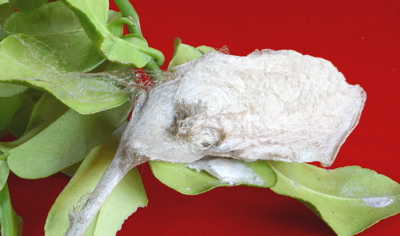
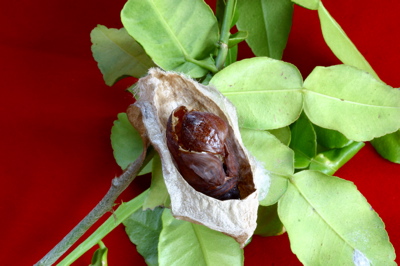
Cocoons may be formed from substrate materials held together by silk. Some are so tough that they need a special escape lid woven to the end for the emergence of the adult, like the silkworm. The cocoon of the Atlas Moth (Attacus atlas) (above) is a good example of how tough the silken cover is. The image below shows the longi-section of the cocoon with the remains of the pupa after the moth had emerged.
Khew Sin Khoon, who operates the website Butterflies of Singapore (http://www.geocities.com/RainForest/Vines/2382/index.html), agrees that the cocoon is most probably that of a lepidoptera. He believes that it is probably that of a moth rather than that of a butterfly. Why? Because there is too much silk and “the fuzzy stuff” to be that of a butterfly.

Input by Melinda Chan, images of oriole by Chan Yoke Meng and those of the Atlas Moth cocoon by YC.

Labels:

Thursday, November 23, 2006

Laughing Kookaburra

Laughing Kookaburra

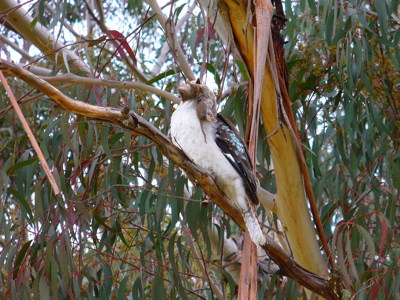
The kookaburras are the largest members of the kingfisher family and they are heard as much as they are seen. The Laughing Kookaburra (Dacelo novaeguineae) is well known for its loud crackling laugh, usually heard at dawn and dusk. At other times during the day, sudden outbursts may occur when the bird succeeds in capturing a prey.

The bird that Gloria Seow saw in the Blue Mountains in New South Wales, Australia in September 2005 did just that. Despite having a field mouse clamped tightly between the mandibles, the bird was making its infamous laugh.
The bird usually perches for long periods on a branch or tree stump keeping both eyes open for any possible prey. Once it spots one, it pounces on it to take it in its bill. Small items are swallowed whole while large prey are beaten against the ground or taken back to the perch where it is first bashed against a branch before swallowing. It takes frogs, lizards, snakes, insects, snails and even small birds and their eggs.

Generally these birds are tame and allow one to come quite near. Thus Gloria was able to come pretty close to take the picture above using a x6 zoom camera.

The bird was perching on an eucalyptus tree (Eucalyptus sp.), also known as a gum tree. Thus Gloria actually saw the kookaburra “sitting on an old gum tree” alright. And heard it laughing.

Input and image by Gloria Seow.

Labels:

Wednesday, November 22, 2006

Common Moorhen

Common Moorhen

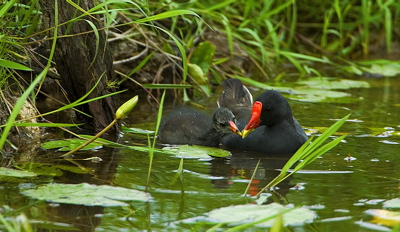
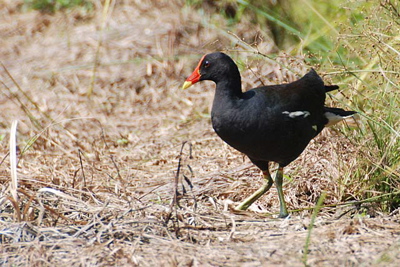
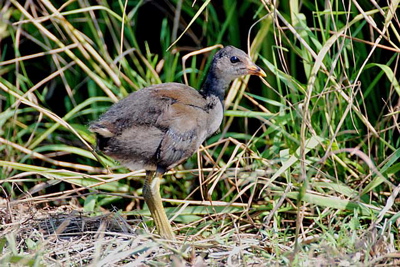
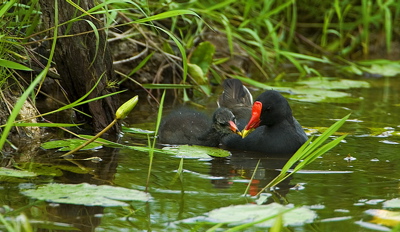
The Common Moorhen (Gallinula chloropus) is a bird of wetlands. It is easily recognised from its red bill and prominent shield against a blackish plumage (above). The juvenile is dark brown and pale below, with an olive bill and without the prominent shield (below). Allan Teo recently spent over three hours in a rice field in Malaysia observing a family of Common Moorhens. Enclosed within his cameo sheet hide and comfortably seated on his field chair, he set up his equipment and waited patiently for the family to reappear. His camera was directed at the exact spot where the birds were earlier foraging, but went into hiding among the rice plants when he appeared. The birds benefitted from the limited shelter provided by the rice plants but the shelter was not dense to totally cover them up. The birds were shy and skittish, moving between the narrow spaces where the plants were sparse and swimming in small pools where the plants were absent or trampled (above).
The parents were always on the lookout for danger, especially from the many raptors that roamed the sky above. Besides, there were also other predators among the paddy.

As Allan recounts, “It took about 20 minutes from my arrival and installation of the hide before the parent birds reappeared. They cautiously emerged from between the rice plants. They swam around in the pool of water for 5-10 minutes before they called for the chicks to come out from among the rice plants.”
All the time the chicks stayed hidden among the tall rice plants, staying very still. They were not visible at all. Cautiously, they emerged, entering the water only when the parents coaxed them (above). Every 10-15 minutes the chicks would touch beaks with the parents, probably for re-assurance. Then suddenly from above, there appeared a black kite with its head looking downwards at its flight path (above). It must have spotted the moorhens. Immediately the family scrambled for cover and disappeared form sight. Large migratory raptors like Western Marsh Harrier (Circus aeruginosus) and Steppe Eagle (Aquila nipalensis) can easily take an adult moorhen. In the above image, the former is clutching a bird in its talons with the latter trying to snatch it or to make it drop its prey. There were also White-bellied Sea Eagles (Haliaeetus leucogaster) above, patrolling the area over the rice fields the year round. These birds have sharp eyes and can easily spot the moorhens.

When the coast was clear, the cycle repeated itself - the parents came out alone, tested the waters after which they called the chicks out to the water and performed the re-assurance ritual of touching beaks.
Moorhen chicks are precocial, meaning that they hatch in a relatively developed state, with the body covered with down and the eyes open (above). They leave the nest soon after hatching, usually after one to two days, swimming by the third and diving by the eighth. Both parents feed and care for the chicks. Immature birds of the previous brood as well as adults of the group may also chip in. Brooding may continue until about 14 days. The chicks can feed by themselves around 21-25 days but continue to be fed for up to 45 days. They fledge at 45-50 days.

The chick above is one of four from a family of the moorhen Allan spotted. There were at least three families in all.

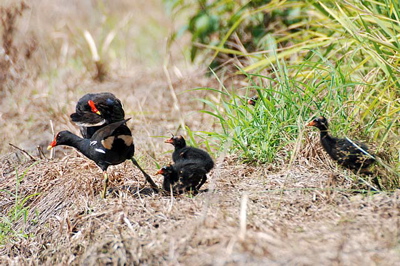
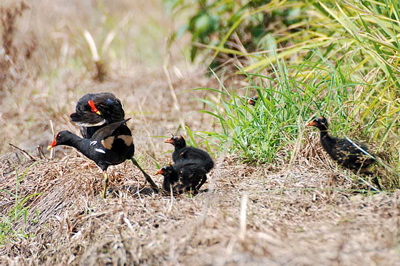
Around the end of October 2006 Cheong Weng Chun also encountered Common Moorhens in the paddy fields of Malacca, Malaysia (below). The parent birds were feeding the chicks with apple snails that were collected from the shallow areas. Only small snails were selected, the larger ones were not taken. Weng Chun thinks that the shell of the smaller snails is probably softer than that of the bigger ones.
Input by Allan Teo and Cheong Weng Chun. Images by Weng Chun (top two and bottom) and Allan (the rest).

Labels:

Tuesday, November 21, 2006

Nesting of Dollarbirds

Nesting of Dollarbirds

Dollarbirds (Eurystomus orientalis) are hole nesters. They do not excavate their own nests but make use of old nests made by woodpeckers and barbets. The nests can be in a dead tree or tree trunk or in living trees but the nest seen by Jonathan Cheah in late April and early May 2006 was the rotting top of a palm stem, probably a nibong (Oncosperma sp.). The nest is usually unlined and the bird lays a clutch of two white eggs, although in this case only one chick developed. Both parent birds helped in the feeding of the chick. What they brought were mainly insects, high protein food.


As rollers generally eject pellets of the undigested insects that they ate earlier, it would be interesting for future observers to note whether the chicks also cast pellets.


Our bird specialist R. Subaraj has added that Dollarbirds commonly nest at the top of rotting coconut trunks.


Input and images by Dr Jonathan Cheah Weng Kwong.

Labels:

Monday, November 20, 2006

Frolicking Black-naped Orioles

Frolicking Black-naped Orioles

During the months of February and March 2006 there were always a few Black-naped Orioles (Oriolus chinensis) perched on the fronds of my palms every morning. Most mornings I was awaken by the loud fluty whistles of these attractive yellow birds. The duetting lasted at least 10-15 minutes before the birds flew off to some other trees to continue with their singing. On and off one or more birds would return during the late morning, making loud sounds or singing. Sometimes a small flock of up to eight birds would frolic around, flying from tree to tree. Two to three birds would frolic together, chasing one another as they expertly maneuvered with wings outstretched, flying between trees, to end up on either the palms in my garden or the wayside trees along the road. At times when I was around observing their antics, they would fly close to me, making high pitch sounds as they pass close by. On and off, two of the flying birds would make contacts, either in fun or otherwise.

When not making their maneuvers, a pair would duet, one making a short call to have a reply.

Whether they are playing, doing their courtship things or two males confronting each other, I do not know.

According to our bird specialist R. Subaraj, this was still the migratory season and the birds could possibly be migrants.

Input and images by YC.

Labels:

Sunday, November 19, 2006

Nest of the tailorbird

Nest of the tailorbird

An abandoned tailorbird nest was found by Melinda Chan's friend among the bushy simpoh air (Dillenia suffruticosa). The large leaf of the plant was folded and the edge neatly stitched together using spider webs that were threaded through holes made for the purpose. Within the resulting pouch was the oval nest, 12 cm long, 6.5 cm at the upper broader end and 4.5 cm at the narrower end. The nest opening was 5 x 4.5 cm and 6 cm deep. Nesting materials consisted of dried grasses, plant fibres and other plant materials. The white winged seeds of African tulip (Spathodea campanulata) figured prominently among the brown materials.

Inside the nest were two un-hatched eggs. The eggs were empty and had holes on the shell. A slug was seen inside the nest feasting on the damaged eggs.


Note: When smaller leaves are used to build the nest, more than one leaf may be involved. A commonly used material to line the nest is the fibres of the kapok tree (Ceiba pentandra). These nests are usually built less than a metre from the ground. The stitched part of the leaf is usually facing downwards such that the nest is kept dry from the rain.

Input and images by Meng and Melinda Chan (except bottom image by YC).

Labels:

Saturday, November 18, 2006

Tricks of the trade: 1. A photographer’s questionable method

Tricks of the trade: 1. A photographer’s questionable method

At Punggol Park in late September 2006, some enthusiastic but misguided person has interfered with the nesting of a sunbird in order to get his or her perfect shot.

The nest was attached to a bulrush reed (Typha sp.) that was growing by the water’s edge. The photographer, obviously troubled by the constant swaying of the reed and nest, solved the problem by tying the stem where the nest was attached to the surrounding plants.

It was possible that the reed where the nest was attached was subsequently cut and firmly secured to a bunch of other reeds, again to ensure that there was minimum swaying of the nest with every breeze.

The nest was then still active as a female sunbird was seen flying back and forth from the nest. There must have been eggs inside, or else chicks.

A week later the nest appeared 'loosened' and abandoned.

The bottom portion of the nest was damaged, possibly by predators - whether two-legged or four legged cannot be established. The nest contents were probably gone. Now can we blame the birds for building their nest by the water’s edge where people are constantly moving around? Do we blame the guilty person for such unethical method to get perfect shots of the nesting birds?

One happy photographer has obtained his/her perfect shots. But one nesting effort has gone to waste. Pity!

Labels:

Friday, November 17, 2006

Oriental Scops-owl: The bird

Oriental Scops-owl: The bird

The Oriental Scops-owl (Otus sunia), a smallish bird (16-20 cm) that is a winter visitor and passage migrant to Singapore, was sighted on 12th November 2006 at MacRitchie.

It roosts in holes or against tree trunks or even under dense foliage. When sighted, the owl was on a branch of a tembusu tree (Fagraea fragrans). When it realised that is was spotted, it remained quietly on the branch, eyeing suspiciously the birders around. Although its eyes were half-opened, it continuously kept track of the people around. When more people arrived, the bird remained unconcerned, or so it seemed. This could be because its perch was high enough to be well away from the birders below.

According to the literature, it assumes a “tall-thin” posture when spotted. This it does by stretching vertically, compressing its plumage and erecting its ear tufts. At the same time it keeps its eyes almost closed. Thus most of the images show this phase, the body slim, the plumage compressed and the ear tufts erect (above and below). However, a few images taken some time after most of the people drifted off showed the owl in a more relaxed mood. It’s body was puffed up but the ear tufts were still erect. Oriental Scops-owl takes a wide variety of prey, especially insects and spiders. It also eats moths, beetles, cicadas, grasshoppers and small rodents and birds. It generally hunts from a perch, swooping down to catch prey on the ground, in flight or from the forest canopy.

And according to KC Tsang, “…it was an adult Rufous Morph, but I am not sure if it is of the stictonotus race.”

Warning on owl pellets: Owl pellets may contain harmful and dangerous bacteria such as salmonella and hantavirus that can cause mild influenza to respiratory and kidney failure. Do not handle with the bare hands and wear a dust mask. Pellets should be wrapped in aluminum foil, heated in a conventional oven for 45-60 minutes at 300ºF (approx. 150ºC). Only then should you examine the contents, usually small bones. So birders, be warned! Source: "Owls: A wildlife handbook by Kim Long, Johnson Books, Boulders."

Input by Melinda Chan, KC Tsang and YC. Images by Chan Yoke Meng.

Labels:

Thursday, November 16, 2006

Oriental Scops-owl: Addendum

Oriental Scops-owl: Addendum

Since the posting of the signting of the Oriental Scops-owl (Otus sunia) and the discussion on past records, R. Subaraj has responded with the following;

“With regards to the Oriental Scops-owl article posted in the blog, I have the following comments.

1. The latest record of sighting on 12th November is not the earliest date. I finally managed to dig up the details. The bird that crashed into a house at Jalan Belatok, off Upper Changi Rd (an additional location) did so on November 9th 2003 and was found by Chew Ping Ting. I retrieved it, fed it and then sent it to Sg Buloh Wetland Reserve, where they measured, weighed and ringed it before releasing it. This would therefore be the earliest date of arrival of the owl.

2. Prof Sodhi's mist-netted bird was also from the mid-1990s and was captured near Upper Peirce (another additional location).

3. Old museum specimens, without specific sites but labeled "Singapore", have always been suspicious as the actual location of collection may not have been Singapore, as in those days, specimens were often labeled as being from the country where they were processed or shipped, due to lack of more information.

4. Luan Keng's opinion about races is that of an academic... definitely not that of a field person. Feld researchers/observers use all field identification markings available to determine facts, including the race of a bird. The race of a bird tells us quite a bit including where the bird is from and whether there are behavioural differences with other races. Through field studies, much information can be learnt. Determining true species should not be dependent on DNA alone but should include morphological studies as well. Many of the world's top specialists are using a combination of both in their field research and to make decisions about species.

At the end of the day, the Oriental Scops-owl has helped highlight and confirm just how fragmented the local bird (and nature) community really is, as different factions have different ideas of just how many records of the species really exist for Singapore... and none are accurate and up-dated! Not everyone wants to share and combine their data or knowledge and we find ourselves truly lacking the accuracy that once was. Why? Different reasons really... elitism, ego, keeping secrets before publication... you name it. It all exists and is part of the ongoing saga of this soap opera!"

Comments by YC:
1. It may not be fair to say all colonial specimens labeled "Singapore" are suspect. Those who work in museums may be able to differentiate between the different collectors - some are more reliable than others. And we can reliably assume that W. Davison's specimen was from Singapore.

2. Birders have always been individualistic, selfish, and what have you - just like any other groups. And they always will be. But we have to realise that unpublished private records remain useful only to the person/s keeping them. Until and unless they are published, these private records are not part of the public domain and cannot claim precedent if subsequent claims
appear in print. Thus unless you publish, you cannot make any claims, period!

3. We can always make this blog a medium for such records. After all, web publication is slowly being accepted as a valid medium and many scientific journals are now going online. Thus future sightings, etc could be sent to this blog for posting - it would appear faster by light years than any print media.

Image courtesy of Chan Yoke Meng.

Labels:

Wednesday, November 15, 2006

Courtship feeding of a Red-bearded Bee-eater

Courtship feeding of a Red-bearded Bee-eater


Ashley Ng shared an image of a male Red-bearded Bee-Eater (Nyctyornis amictus) with a cicada in its bill trying to attract a potential mate. Bee-eaters do indulge in courtship feeding and this may be a rare image of the ritual. This species does not occur in Singapore but can be seen in Peninsula Malaysia.

As with bee-eaters, it hunts from a high perch keeping close watch on the airspace around. Once an insect is seen, it dashes off to capture it. The bird has been recorded to take carpenter bees (Xylocopa spp.), cicadas, beetles, crickets, termites and ants.

As with many insectivorous birds, bee-eaters cast pellets of indigestible insect parts regularly. This is also the case with most carnivore species such as raptors, owls and shrikes.

Input and image by Ashley Ng.

Labels:

Tuesday, November 14, 2006

Oriental Scops-owl: Sighting

Oriental Scops-owl: Sighting

The Oriental Scops-owl (Otus sunia) is a rare winter visitor and passage migrant to Singapore. So when a bird was spotted during the early morning of 12th November 2006, birdwatchers of every genre were out in force to view it.

It all started when R. Subaraj was conducting a bird-tour of the MacRitchie area. While scanning the trees with his binoculars, he was pleasantly surprised to see an Oriental Scops-owl roosting in a tembusu tree (Fagraea fragrans). As most birders have not seen the owl before, he immediately phoned a few close contacts, giving the location. Within a few hours, a few birders and photographers were at the scene. And by afternoon, more came. Why the excitement? According to DR Wells (1999), Birds of the Thai-Malay Peninsula, “There have been no recent records from well-monitored Singapore island.”
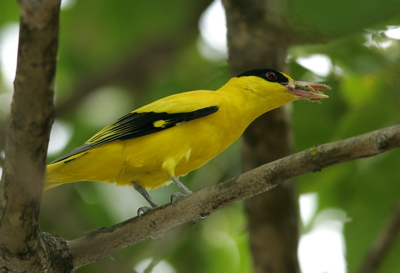
One of the first to arrive at the scene, KC Tsang managed to take a few pictures of the owl. And according to KC, “…I was informed that this bird was sighted, and recorded some four times only in Singapore, and is considered a vagrant by C. Robson.”

Whoever passed on this information to KC is obviously wrong. Subaraj was the first to disagree. He believes that there were more sightings than that. According to him there were at least six other sightings, and he referred me to the cover photograph of the Iora, the so-called Journal of the Nature Society (Singapore) Bird Group. The issue was the inaugural and only issue, published in 1994 (below).

The image of the Oriental Scops-owl that graced the “journal” was taken in Mount Faber by Goo Chuen Hang on 13th November 1994. In an article by Lim Kim Seng entitled “Singapore Bird Report” it was reported that this was the second report for Singapore (p 49).

Apparently this is again incorrect. The Mount Faber sighting was the fourth.

Our sometime field ornithologist, Wang Luan Keng, who is attached to the Raffles Museum of Biodiversity Research, NUS, has this to say: “I have a total of 13 past records. Most people missed out the museum specimens, which are important sources of records.”

The 13 previous records of Oriental Scops-owl encounters are:
1. An undated specimen collected in Singapore in the late 19th century by W. Davison (Hume Coll.)
2. A bird collected on 22 Dec 1916, Fort Canning (RMBR collection).
3. One bird collected in Singapore, 16 Nov 1938 (RMBR collection).
4. One bird photographed at Mt Faber, 13 Nov 1994 (Iora 1).
5. One bird seen at Mt Faber, 19 Feb 1995, most probably the same bird spotted on 13 Nov 1994 (SINAV 9).
6. One bird ringed at Sg Buloh Wetland Reserve, Jan 1996.
7. Another bird ringed at Sg Buloh Wetland Reserve in 2000.
8. One bird found dead, 13 Nov 2000 (donated to JBP).
9. One bird salvaged in Singapore in 2001 (donated to JBP).
10. Another salvaged, 26 Feb 2002 (donated to JBP).
11. One bird found dead in 2003 (no other information, donated to JBP).
12. One bird was found unable to fly at Lower Kent Ridge, 14 Nov 2003 (Kelvin Lim, pers comm..).
13. One grey morph seen in MacRitchie, 18h Dec 2005 (C. Moores, in litt.)

In addition, Subaraj reports that a bird was mist-netted by Prof NS Sodhi of NUS when he was undertaking a survey of the nature reserves. Also, one crashed into a home in Changi, cared for by Subaraj to be later ringed and released in Sg Buloh.
As Luan summarises, “You can certainly say that the bird is probably more common than recorded, judging from the museum specimens that everyone excluded. Most people dismiss museum specimens as useless but surely dead birds were once alive and should be counted as records too and not just what the birders can see?

“I don't know why people are so obsessed with races. Races of birds are not very meaningful at all. If they are distinct enough and their genetic makeup proves so, they should be treated as distinct species. Until then, you can only call them populations. And most of the time you can only tell them apart if you have the bird in the hand.”

Birders seldom sight the Oriental Scops-owl not because it is not there. Birders tend not to be aware of its presence, considering that the bird tend to remain silent during its wintering period here. So birders are not alerted to its presence, as in the case of other owls.

It is to be noted that the previous early arrivals of this owl were 13th November while this time the bird arrived on 12th November, one day earlier.

Important Notes:
Range: Breeds in the Indian subcontinent, Sri Lanka, Pacific Russia, Japan, Korea, China, and Indochina; migrates through the Indian subcontinent, S. China to Malay Peninsula, Singapore, N. Sumatra.
Locality: Fort Canning Park, Lower Kranji Reserve, Mount Faber, MacRitchie, Sg Buloh Wetland Reserve.
Habitat: Wooded areas, parks.
Early and late dates: (12)13 Nov - 26 Feb
Materials examined: BM 1 (1 AA), RMBR 3 (3 FF), UWBM 4 (3 FF, 1 MM).

Input by R. Subaraj, Wang Luan Keng, KC Tsang and YC. Images of the owl by KC. And thanks to Subaraj who generously shared his sighting, many birders got to see this rare owl.

Labels:

Monday, November 13, 2006

A Peregrine Falcon at lunch

A Peregrine Falcon at lunch

James Heng chanced upon an exciting avian event between 12.50-2.00 pm on 30th October 2006. He was going to have his lunch around a transmission tower beside the Woodlands Fire Station when he noticed the presence of a Peregrine Falcon (Falco peregrinus).

The bird was on the fifth platform of the larger transmission tower and was having its lunch. It had a black bird in its talons, limp and obviously dead. James narrowed it down to a possible Asian Glossy Starling (Aplonis panayensis), or even a myna.

The falcon was perched on the railing of the tower, with the prey held tightly in its talons. It was furiously tearing away bits of feathers and skin from the belly of the dead bird. Within minutes it got to the meat and was feeding off bits and pieces.

Then it started to rain. As the rain became heavier, the falcon stopped eating and looked around. James wondered: “…if it was because it needed rest, to let the food digest or to cover the prey's innards to prevent the cavity from being flooded over by the heavy rain?”

When the rain got lighter the bird resumed feeding on the carcass. This time it was feeding at a leisurely pace.

In about an hour the bird had completed eating the prey, including the innards. The empty shell of the prey was discarded, and got lodged on the railing one floor below.

Satiated, the falcon began to casually preen itself, looking around as it did so. The rain had by then stopped.

James had only a pair of binoculars with him. No camera, so he missed the chance of recording the action. He did not have his scope with him, thus by the end of the hour his neck, shoulders and forearms were aching.

Tired, aching but exhilarated by the event, he realised that although the falcon finished its lunch, he still had not started on his.

“Like us, this bird takes around an hour for his lunch break. I wonder if it does a siesta?” wondered James.

PS: Our bird specialist R. Subaraj has this to say: "Peregrine Falcons are mainly migrants that turn up during the winter months, sometimes wintering at a site. We also get a few records during the non-migratory season and based on colouration and size, these birds are believed to be visitors of the resident race from some place nearby, like Malaysia. These falcons are often found on transmitter towers, including Bukit Batok, Sentosa, Ubin and even Fort Canning. These structures offer a good vantage point, feeding and roosting perch."

Input by James Heng, images by Chan Yoke Meng.

Labels:

Sunday, November 12, 2006

Do birds recycle their nests?

Do birds recycle their nests?

Most birds that build cup-nests do not reuse them. They rebuild a new nest each year and sometimes recycle the nesting material. One reason for this is that the nest, after one cycle of breeding, often has outlived its usefulness. The dried soft plant materials would have begun to rot. Another reason is that there would be the typical odour left by the birds and their nestlings after the latter have fledged. Such odour can attract predators. A third reason is that old nests often contain a large number of ectoparasites that are potentially harmful to the developing young. Among birds that build large platform nests of twigs that are more lasting, recycling of the nests may be common. These include large nests of ospreys, eagles, storks, hawks and kites (above).

Hole nesters, especially birds that are not able to excavate cavities for themselves, need to reuse nests previously occupied by other species. Sometimes they evict the current occupants in order to make use of the cavities for themselves. The case of the Long-tailed parakeet (Psittacula longicauda) trying to take over the nest cavity of a pair of Dollarbirds (Eurystomus orientalis) is a good example. Yellow-vented Bulbul (Pycnonotus goiavier) sometimes build over an old nest or partially completed nest (above). However, Lena Chow reported that the birds in her garden did use the same nest a few times, although she was not sure whether it was the same pair of birds or different pairs. But she observed recycling of nesting material year in and year out. Similarly, sunbirds rarely, if at all, reuse old nests (above). House Crow (Corvus splendens) does not reuse last season’s nest but recycle the nest material if the old nest is nearby (below). Baya Weaver (Ploceus philippinus) on the other hand sometimes repair an old nest as can be seen by the green material weaved over the older brown material.
Input by Lena Chow, YC; images by YC except top by Chan Yoke Meng.

Labels:

Saturday, November 11, 2006

Tiger Shrike: Postscript

Tiger Shrike: Postscript

Gloria Seow was holidaying in Japan in October 2006 where she scored 77 lifers even though it was off-season for birds then. But that would be another story. What she e-mailed me was an interesting image of a dried-out field mouse. It was impaled upon a low bush growing in an open grassland bordering a marshy area in Hokkaido (below). According to the Japanese birders who accompanied her, it was possibly the work of a Bull-headed Shrike (Lanius bucephalus).
We have three species of shrikes. Tiger (Lanius tigrinus) and Brown (Lanius cristatus) are winter visitors as well as passage migrants while Long-tailed Shrike (Lanius schach) is a common resident. But according to our bird specialist R. Subaraj, "Long-tailed Shrikes are actually very uncommon residents with some movements that are not fully understood. That is why they tend to be at known sites at only certain times of the year. Additionally, there is sometimes an influx of this species.....migrants?"

Shrikes have the reputation of impaling their preys on sharp thorns. They are thus known as “butcher birds. We have an earlier posting on a Tiger Shrike dismembering a large scarab beetle and another on the bird swallowing a lizard.
R. Subaraj reported seeing the headless corpse of a Yellow-rumped Flycatcher (Ficedula zanthopygia), impaled on a thorn of a short tree that he suspected was the work of a Long-tailed Shrike. And in Malaysia he once came across the "larder" of a wintering Brown Shrike consisting of impaled insects along a stretch of barb wire.

What we did not have is an image of a vertebrate impaled by a shrike. Now we have, thanks to Gloria, although it is not local but from Hokkaido.

Now here is a challenge to birder-photographers. Look out for a shrike-impaled prey and bring back an image!

Input and images by Gloria Seow.

Labels:

Friday, November 10, 2006

Where do Yellow-vented Bulbuls build their nests?

Where do Yellow-vented Bulbuls build their nests?

Yellow-vented Bulbuls (Pycnonotus goiavier) nowadays build their nests around people. Their nest are tucked between the branching forks of shrubs, potted plants and even artificial plants. They are so comfortable around humans that they construct their nests in urban gardens, in garages, along verandahs of high-rise buildings as well as around offices.
Lena Chow sent in a report on a pair nesting in her artificial plants that she placed in a pot located in her garage. “By way of update, only one egg of two hatched successfully in the nest in my artificial plant… Perhaps it is a case of dud plant, dud egg, ha ha. I am leaving the unhatched egg in the nest to see what the birds will do with it next year. These bulbuls have been coming to nest in my garden/garage every year for the past 3 years, and I fully expect the nest to be re-used next year.” In June 2006, over at Alexandra Hospital, a number of nests were seen among potted plants near to offices and hospital areas. Most of these nests resulted in successful hatching and fledging of the young. However, there were a few that the eggs did not hatch, probably because the parent birds abandoned them due to constant disturbances by passersby as these nests were along busy thoroughfares (top).


The nesting stages of the Yellow-vented Bulbuls shown above are by staff of the Alexandra Hospital, Singapore, obtained through the courtesy of Rosalind Tan. The birds also built their nest in a potted lady palm (Raphis excelsa) placed just outside the Business Office of the hospital (left).

Labels:

Thursday, November 09, 2006

Yellow-vented Bulbul: Food for the nestlings

Yellow-vented Bulbul: Food for the nestlings

The Yellow-vented Bulbul (Pycnonotus goiavier) is one of the more successful urban birds in Singapore. Part of this success is its ability to adapt to its food source. It is omnivorous, that is, it will eat insects as well as a range of fruits. At the same time it also scavenge on scraps of discarded food. Newly hatched nestlings are fed with insects and other invertebrates. The growing nestlings require a constant supply of protein. This keeps the parents busy bringing such food constantly.

Almost every garden in Singapore will have at least a pair of Yellow-vented Bulbuls. On certain months of the year the loud and somewhat pleasant bubbling songs in the early morning and later evening are music to the ear.

These birds are so used to humans that they will build their nests among ornamental plants grown in gardens or in potted plants placed in balconies or even along the verandahs of high-rise apartment buildings. The nests are deep cups made from grass, dry leaves, etc. Looking untidy from the outside, it is neatly lined inside.


Lena Chow recently sent an image of a pair nesting among her artificial plants (below). Talk about getting used to urban living…

Images of bulbul by Tang Hung Bun; nesting among artificial plant by Lena Chow; input by YC.

Labels:

Wednesday, November 08, 2006

Ruddy Kingfisher and pellet casting: Postscript

Ruddy Kingfisher and pellet casting: Postscript

The earlier post on the Ruddy Kingfisher (Halcyon coromanda) coughing out a pellet about an hour after it ate a snail noted that the photographer missed getting an image of the pellet coming out of the bird (above, top). Well, Meng pointed out that I should examine closely the throat of the bird in the first two images. I did as suggested and also adjusted the contrast of the images, and there in the throat is a dark object - the pellet (above, bottom; below). The first two images of the earlier posting showing the initial stages of the coughing thus clearly show the dark pellet about to be ejected. The third image where the bird is crouched low shows a clear throat, indicating that the pellet has already been coughed out (below).
Most kingfisher pellets are white, reflecting on the food they eat - fish. The composition of these pellets are mainly fish bones. These bones are collected in the gizzard and compacted into pellets to be subsequently coughed out. Should these bones be allowed to pass on to the stomach, imagine the damage they could cause to the bird.

In the above case the pellet is black as the bird earlier ate a snail. Obvioulsy it did not completely remove all the shell fragments.

Thanks to Chan Yoke Meng for the use of the images. It is his keen eyes that spotted the pellet in the throat of the bird in his images.

Labels:

Tuesday, November 07, 2006

Ruddy Kingfisher: Eating a snail, then casting a pellet

Ruddy Kingfisher: Eating a snail, then casting a pellet

The Ruddy Kingfisher (Halcyon coromanda), an uncommon passage migrant and winter visitor to Singapore, made a brief appearance of a few days towards the end of October 2006. Once news got around, birders and photographers congregated at Jurong, near the Chinese Garden, to get a glimpse and/or to take a picture of this rare bird.
Allan Teo was among the fortunate few who witnessed the bird manipulating a snail. After it got a firm hold of the mollusc in its bill, it expertly removed the shell by smashing it against the perch, first against one side, then against the other (above). It then used the horizontal force of its head swing that resulted in the smashed shell pieces flying apart, leaving only the meat. Happy with the shell-less snail, the kingfisher swallowed its prize catch (above: note damp patches on either side of the bird's perch where the snail was whacked).

After having their fill with the kingfisher, most of the people moved off to look for other rare birds. The few who patiently remained witnessed an usual event, the casting of a pellet. This came more than an hour after the kingfisher consumed the snail. The bird first made some sort of retching action, giving the appearance as if it was about to vomit. Then the bill widened substantially to show the large gape and equally large opening into the throat (above).