Site Meter

Sunday, December 31, 2006

Breeding ecology of the Little Tern 4: Feeding

Breeding ecology of the Little Tern 4: Feeding

The plumage of the Little Tern (Sterna albifrons) during the breeding season shows a prominent black cap on the head and a yellow bill tipped with black (above). The plumage of the juvenile is distinct from that of the adult (below).
Normally all the birds would be facing the persistent wind direction, be it morning or evening. Hence, the adults always got into a bit of trouble positioning themselves for landing in the mornings. Fish was sometimes dropped as a result. Passing on the fish to the juvenile were mostly done without problems in the evenings. The juveniles were normally near-hysterical whenever the parent arrived with fish (above). They would wave their wings to attract the attention of the arriving parent. The other juveniles normally remained patient and waited their turns. The parent that was keeping an eye on the juveniles would then fly off to get food for the other chick. Should the other chick managed to snatch the fish, the rightful chick would normally chased it around until the fish was dropped and retrieved it. Originally the chicks were fed with bits and pieces of fish. As the chicks grew they were slowly fed the entire fish caught by the parents (above). The parent bird would hold the fish just behind the head and direct it into the gaping mouth of the juvenile, head first. This would prevent the sharp spines of the fins damaging the throat as the fish slithered down the throat into the stomach. With a larger fish it was not possible to place it inside the gape. The juvenile had to receive the fish, gripping it just below the head. It then had to manipulate the fish so that it was swallowed head-first (below). Courtship feeding, as described earlier (a, b) continued throughout this period when the parents were continuously feeding the juveniles.

Input and images by Dr Jonathan Cheah Weng Kwong.

Labels:

Saturday, December 30, 2006

Migratory habits of Black Baza

Migratory habits of Black Baza

Black Bazas (Aviceda leuphotes) were commonly seen in late November 2006 around Punggol, Sarimbun, Khatib Bongsu and Lake View Promenade (Chinese Garden, Jurong). These birds were of course winter visitors.

On the 26th of that month Chan Yoke Meng encountered a flock of ten Black Bazas. The birds were very skittish, hunting insects that they brought back to their favourite high perches to be consumed. And whenever these bazas were around, there was quietness all around. Only when they moved off did the bulbuls and pigeons reappeared and began calling and singing.

Bazas look like mynas when flying but their flight pattern is distinctly different. Once you are familiar with the two flight patterns, it is easy to differentiate the two birds from afar. This baza encounter brought back memories of an exciting earlier encounter more than two years ago. On the morning of 31st October 2004, Tang Hung Bun was fortunate enough to witness the spectacular sight of a flock of more than 30 Black Bazas circling the sky above Sime Forest.

And a few weeks later, he had the opportunity of seeing a few Black Bazas foraging in the wooded areas behind his office. There were at least three of them. They hid themselves behind the branches and leaves. When they found something, they flew to it and landed in a rather awkward manner on a bunch of leaves to catch it. They would then fly to a branch to enjoy the meal. As Tang recounted, “The little green insect that you see in the black baza's beak in one of the photos (above) must be the black baza favourite food. I have seen the black bazas eating them quite a number of times.”

Tang’s earlier posting of his experience attracted the attention of R. Surachai who wrote to inform that Asian Raptor Research and Conservation Network (ARRCN) Thai volunteers counted thousands of these bazas flying south towards the Thai-Malaysia border towards the end of October of that year. This would mean that the birds were heading towards Peninsular Malaysia. The few birds that Tang encountered were obviously part of the large flocks that the Thais counted, birds that ended far south into Singapore.

Our bird specialist R. Subaraj has this to add: “I have personally seen a single flock of 100 birds spiralling on a thermal over Mount Faber. They can be seen anywhere in Singapore, with the largest flocks recorded over southern and central parts of the island. Many are also seen along the east coast at places like Loyang and Ubin.

"Small wintering flocks have always over-wintered at sites like the Central Catchment, Pulau Ubin and Sungei Buloh, to name a few.”

Input by Chan Yoke Meng, R. Surachai, Tang Hung Bun and R. Subaraj; images (from top) by Yoke Meng, Johnny Wee and Tang (lower two).

Labels:

Friday, December 29, 2006

Breeding ecology of the Little Tern 3: Life and death

Breeding ecology of the Little Tern 3: Life and death

Things are not always smooth sailing for the chicks of the Little Tern (Sterna albifrons) once they hatch. There is no guarantee that they would develop normally to eventually fledge. In fact not all chicks survive the 20 odd days to fledging.

When Jonathan Cheah was documenting the breeding ecology of the Little Terns (1,, 2), he noticed a larger chick limping through the viewfinder of his camera. As he moved closer he noticed one leg bleeding as the chick hobbled over a sand mound. He went over and found it lying motionless, a usual reaction when a chick is approached. Lifting the chick off the ground, he noticed a foreign object lodged on the chick’s webbed foot. After removing the object he gently placed the chick on the sand and it scuttled off happily (below). And he also experienced death of chicks. As Jonathan recounts, “The first two days of hatching are very crucial to the survival of the chicks. Failed nests can occur by bad choice of nesting grounds, too many eggs, even stress of parent by predators. Once the chicks can move, the survival rate increases.“ Around the nesting grounds he observed chicks dying (above) but the parent birds do not normally accept the fact that the chicks were dead. In one instance the parent covered the chick's beak with a rock to prevent ants from entering the carcass. It even continued to sit on the remaining egg and dead chick, whilst being harassed by the sudden increase in flies and ants (below). Unfortunately the remaining egg did not hatch, most probably due to a super heated ground. Obviously a poor choice of nesting location.

Input and images by Dr Jonathan Cheah Weng Kwong.

Labels:

Thursday, December 28, 2006

Territorial Nightjars

Territorial Nightjars

"The Grey Nightjar (Caprimulgus indicus) is an uncommon but annual migrant to Singapore. It breeds from northern Thailand all the way up to Siberia. Like the Oriental Scops Owl (Otus sunia) it is a nocturnal bird that is usually silent away from it's breeding grounds. In recent years, a few birds have been observed throughout the "winter" period (October - March) around the MacRitchie and Sime Forest areas of the Central Catchment Nature Reserve, proving that the species winters here. One to two birds have wintered around the Treetop Walkway area for the past two years or so and have been seen and photographed, during the day, roosting on branches of adjacent trees.

"In all my years of local bird observation, I have only heard this nightjar calling twice... at Sentosa. Calling may be an indication that the bird is holding a winter territory.

"On November 16th, 2006, while conducting an evening bird survey at the Treetop Walkway (above), I was pleased to hear a Grey Nightjar calling loudly at dusk. The call was a quickly repeated "tuc" note in a series of several in a row. The call was coming from a large Terentang tree (Campnosperma auriculatum) where this species has been regularly seen roosting before. Along with Benjamin Lee and Janet Hong, who were with me at the time, we quickly moved closer. What followed was both unexpected and exciting.
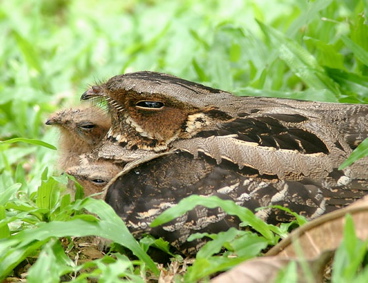
"The calling Grey Nightjar was being harassed by a resident Large-tailed Nightjar (Caprimulgus macrurus) (above). The latter may not have been pleased about this visitor calling loudly within what it considered it's territory. Instead of retreating and going silent, as expected, the Grey chased off it's larger cousin before returning to the tree to call loudly from a branch. This scene was replayed twice or thrice more, before the Grey chased the Large-tailed away. We could see the chase below us before they both disappeared into the darkness. Subsequently, the Grey was heard calling loudly again from a different tree.

"What can we make of this scene and the behaviour witnessed? Well, many migrants do not call because they are not at their breeding grounds defending their territory or seeking a mate. However, there are many others who call constantly while here. Why the difference? In many cases, this may be the difference between passage migrants and wintering visitors.
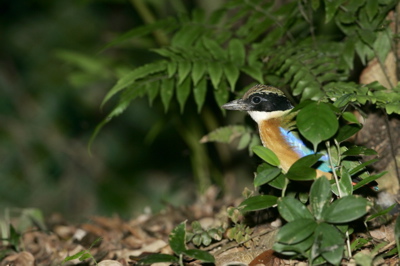
"A passage migrant simply passes through Singapore, on its way to further south... probably Indonesia. They may stop to feed for a few days or if the weather is unfavourable (as well as when there is a thick haze in the way) but they do not stake out a feeding territory for their short stint here, hence no need to call. Some, like the Yellow-rumped Flycatcher (Ficedula zanthopygia), may stopover for a bit longer and sets up a temporary territory by calling from selected perches. Others, like the Blue-winged Pitta (Pitta moluccensis) (above) only call once or twice, at dawn or dusk... contact call to any of their kind that may be about? Who knows?
"A winter visitor actually spends the cold northern winter here in tropical Singapore, often staying a few months before returning to their breeding grounds in spring. As they are here for quite a while, they set up a territory in which they feed and sometimes drive away others of their kind, like the Common Kingfisher (Alcedo atthis) (above) does. Throughout the "winter" months (this period varies from species to species), we are treated to the calls of Arctic Warblers (Phylloscopus borealis), Asian Brown Flycatchers (Muscicapa dauurica), Brown Shrikes (Lanius cristatus) (below), Siberian Blue Robins (Luscinia cyane) and many, many more northern visitors.
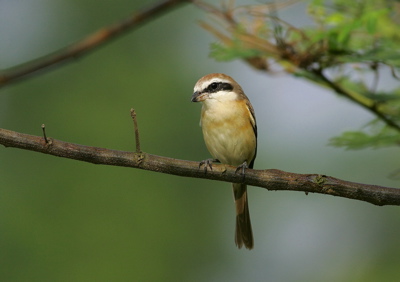
"So, the calling and aggression displayed by the Grey Nightjar on Thursday may simply be further proof that this species is now a winter visitor in Singapore."

Submitted by Subaraj Rajathurai, 18th November 2006

Images by YC (Treetop Walkway), Chan Yoke Meng (Blue-winged Pitta, Brown Shrike), KC Tsang (Common Kingfisher) and Tang Hung Bun (Large-tailed Nightjar).

Labels:

Wednesday, December 27, 2006

Moulting 1

Moulting 1

On and off I have been picking up various types of feathers in my garden and along my driveway (above: Javan Myna contour feather, top left; down, top right; tail, middle; Black-naped Oriole tail feather, bottom). During the time when I was interested in plants (and not in birds), I considered these as discarded feathers, detached as a result of fights between birds. Now that I am a “sometime-birdwatcher”, I am slightly more enlightened.

I now know that these feathers have been discarded naturally as a result of moulting. Now why do birds discard their feathers?

Feathers are important to birds. They insulate them from the cold and enable them to fly. But feathers undergo wear and tear. They become brittle, frayed and sometimes get damaged by ectoparasites. Worn and damaged feathers cannot function well and this can prove fatal if the bird cannot fly properly.

As feathers are dead structures, they need to be replaced regularly. And this process is known as moulting. In moulting, the growth of the new feather pushes out the old from its follicle.

Moulting may be partial or complete. Partial moult occurs when only certain feathers or groups of feathers are replaced. Complete moult occurs when all the feathers are replaced. Thus when birds develop their winter plumage or change from juvenile to adult plumage, moulting was at work.

The image below is a moulted breast or more likely belly feathers of a Buffy Fish Owl (Ketupa ketupu), picked up below the owl's roost by Melinda Chan. Our field ornithologist Wang Luan Keng has this to say: “Birds do have a season to moult, usually after their breeding season. In Singapore, most birds breed from Feb/March till July/Aug, maybe Sep. Many species here overlap moult and breeding slightly so they will start moulting in July/Aug and end by Oct/Nov when the NE monsoon starts. Many species, especially passerines, have straight forward sequential moult; others like cuckoos, hawks, herons, fruit doves etc have very complicated multiple moult series and yet some species like rails, grebes and probably bitterns moult all feathers at once and go flightless during that period. And mind you, we are only talking mainly about primary feather moult. We know even less about other flight feather moult and almost nothing about body feather moult.”

Input and images by YC; expert information by Wang Luan Keng and owl's feather provided by Melinda Chan.

Labels:

Tuesday, December 26, 2006

Breeding ecology of the Little Tern 2: The first few days

Breeding ecology of the Little Tern 2: The first few days

Most of the newly hatched chicks can be grouped into two main groups. They can be hatched helpless, with eyes closed, naked or sparsely covered with down, in which case they are altricial. On the other hand they can be hatched with their eyes open, covered with down and can soon walk or swim, then they are precocial. The chicks of the Little Tern (Sterna albifrons) are neither altricial nor precocial - they are semi-precocial. Although the chicks can move about within a few hours after hatching and are covered with down the next day, they are hatched with their eyes closed and partially covered with down (above). The advantage here is that the chicks do not need total parental care in a habitat that is exposed and dangers lurks at every corner. By the second day the chicks are fully covered with down (above). They lie motionlessly and await the calls of their parents. When the parents are nearby and no threat seems to be around, they pop out with gaping mouths, sometimes chirping (below). At any instance of danger, they remain motionless again. Otherwise they prop up and open their beak when they hear the calls of their approaching parents (above). The parents feed them non-stop, having no time to preen themselves after splashing in sea water to refresh. The chicks find comfort having the parent close by (below). The days of the adult involves warming the chicks, protecting the chicks from the environment and feeding the chicks. Feeding usually take the form of broken down fish parts since the chick cannot swallow. Feeding is rotational and also cycles between the chicks.

Input and images by Dr Jonathan Cheah Weng Kwong.

Labels:

Sunday, December 24, 2006

Food for the Yellow-vented Bulbuls' nestlings

Food for the Yellow-vented Bulbuls' nestlings


“Over a period of two weekends, this pair of Yellow-vented Bulbuls (Pycnonotus goiavier) were observed to be feeding their young (from the noise made, probably two of them). Regular visits, at the peak times, were about 10-15 minute intervals. The parents' foraging grounds were all around the garden and a big piece of wasteland behind my house. It's quite amazing that they were able to find that much food so easily.


“I've attached a series of pictures of the parents, and also the Chiku tree (Manilkara zapota) where the nest was hidden (above). I don't have any pictures of the nestlings as I didn't want to disturb the nest. The Chiku tree was pruned at that point in time, and had just begun to sprout new growth - just enough to keep the nest out of sight from prying eyes.


“Both parent birds returned to the same perch, the sawn off branch, and held whatever prey that they had secured whilst perched there (above). They scanned the surroundings for a few seconds, as if making sure that there were no predators in the vicinity, before plunging into the nest to feed their young. As they did so, the chirps of the nestlings could be heard loudly, as presumably, they competed for the food. “The range of food items fed to the nestlings was quite impressive, varying from fruits, to spiders, caterpillars and even a cicada (top, above and below)!"


“All shots taken with a Nikon D2X and the 80-400mm VR lens mounted on a tripod, and shot from my 2nd storey balcony. This explains the almost eye-level shots.“
Note: Most of the food fed to the chicks consisted of various invertebrates, mainly insects except what looks like a fig (Ficus sp.) (above). Growing chicks need lots of proteins and thus the animal food.

Input and images Khew Sin Khoon.

Labels:

Saturday, December 23, 2006

Sun and dust bathing

Sun and dust bathing

Keeping the feathers clean and in top condition is crucial to birds, if they are to function well and enable them to fly. Nearly all birds take a daily bath, if they have the opportunity. This is to rid the feathers of dust.

Bathing involves fluffing the feathers and vigorously beating the water. At the same time the head is dipped into the water regularly. The bird then shakes off the excess water and flies off to dry. The feathers need to be preened. Each feather, particularly the wing feathers need to be passed through the beak so that they are cleaned and the separate filaments put back in place. If water is not available, some birds like the Eurasian Tree Sparrow (Passer montanus), will take sand or dust bath (all three images above). They roll about the loose sand or dust and shake vigorously about. The sand or dust particles are believed to absorb excess preen oil as well as remove dry skin and ectoparasites. These include lice, mites, fleas, ticks and what have you that damage the feathers or even suck the blood of the birds. Evidence of dust bathing is the presence of bowl-shaped hollows on the dry ground. Sunbathing is another method indulged by birds. This is what the Peaceful Dove (Geopelia striata) is doing in the above image. They lie down with their wings outstretched. The sun is thought to straighten the feathers and at the same time spread the preen oil throughout the feathers.

Top image of sparrow taking a dust bath courtesy of Fuhai Heng. Other images by YC.

Labels:

Friday, December 22, 2006

Breeding ecology of Little Tern 1: Egg laying and hatching

Breeding ecology of Little Tern 1: Egg laying and hatching

The Little Tern (Sterna albifrons) is a small, slender and streamlined bird with a pair of narrow, sharp-pointed wings and forked tail (above). These adapt it well to a swift and graceful flight as well as plunge-diving for fish from a height above the water. The white belly helps to reduce its conspicuousness to underwater prey when the bird is flying over the water foraging.

As with most terns, there is courtship feeding when the male brings fish to feed the female. The pair may also indulge in aerial displays.

Once the pair has bonded and copulation occurs, the eggs are laid on a bare depression in the sand. A full clutch is three but usually only two eggs are laid (below). Both parents help in incubation and brooding. Whenever a parent bird arrives at the nest it will inspect the eggs and position them carefully before settling down to incubate them (below). Incubation usually lasts from 21 to 30 days. When hatched, the chick has its eyes closed (below left). The skin is clearly pink as the down feathers have yet to burst out of their sheaths. Within a few hours the chick dries up and begins to move about and by the next day it is totally covered with down feathers (below right). They are thus semi-precocial. The eggs are cryptic as they are thickly spotted with dark brown and pale lavender. However, with hatching the whitish inner surfaces of these egg shells can easily compromise the camouflage and attract the attention of predators. Thus they are removed as soon as possible and dumped some distance away (below).
Input and images by Dr Jonathan Cheah Weng Kwong.

Labels:

Thursday, December 21, 2006

Where do birds go when it rains? And what do they do then?

Where do birds go when it rains? And what do they do then?

It has been raining on and off these few weeks and the birds have not been around. Have you ever wondered what happened to them when it rained? And what do you think they did at these times? Well, there is at least one perceptive birder around and he has the answer...
James Heng sent in this account of his encounter with Pink-necked Green Pigeons (Treron vernans) at the Bukit Batok Nature Park one rainy afternoon in December 2006 (above: male pigeon left, female right).

“The year end has always been amongst the wettest period of the year. While the rain may be an inconvenience for some birders, it is also a good opportunity to observe the birds’ behavior during the rain. “On the afternoon of 18th December 2006, it rained while I was bird watching at Bukit Batok Nature Park (above). That was when I came across a small flock of Pink-necked Green Pigeons. There were two males and three females in that flock. I sought shelter by a hut that happened to be just 10-15m from the trees that they were perched. “When it started to drizzle lightly, two of them snuggled together shoulder-to-shoulder on a Cassia tree (as shown above, but on the frond of a ceram palm). There was obviously insufficient cover so when the drizzle turned to a downpour, all of them flew over to a tall, large-leafed tree, the cabbage tree (Fagraea crenulate) (below).

“They tended to choose perches that were at the top third of the tree. Upon closer observation, each bird was seen to perch on a branch that was immediately below at least two large overlapping leaves (below, showing branches with leaves but no birds). By having such leaves above them, they would remain dry. Perhaps due to the scarcity of choice spots, all the birds were perched separately.

“At about 3pm, during the first five minutes of the downpour, all of these birds shook their body and fluffed out their feathers. It might be to aid the drying of the wet feathers or perhaps to trap their body’s heat. After that, they became relaxed and sat down on their respective branches. In the next five to seven minutes they began to yawn and their eyelids became very heavy. They fought very hard to keep their eyes open. Before 15 minutes was up, all five of them were soundly asleep. So birds do take siestas! All this occurred as it rained relentlessly.
“When the PNG pigeon sleeps, its long neck is relaxed and it appears to be drawn into the bird’s body. The neck appears almost non-existent as only half of its head appears to be above its body. In fact, the bottom of the bird’s eyes is just at shoulder level. Just imagine the silhouette of a large fat plum. The male PNG pigeon has grey, pinkish-purple and orange on its head and breast. When it is all “balled up” in that sleeping state, the colors make it look like a clown!

"You have got to see it to appreciate such adorable proportions.

“When the rain ended some 45 minutes later, the Yellow-vented Bulbuls (Pycnonotus goiavier) and drongos were happily sunning themselves in the open again. Only one member of this flock of pigeons woke up to sun itself. The remainder of the four birds continued with their siesta.

“So after a thunderstorm, do search the horizontal branches of some of the tall broad-leafed trees. You might just be lucky enough to see those adorable “furry balls” in deep snooze.”

Input by James Heng, images by YC.

Labels:

Wednesday, December 20, 2006

Black Bittern the hunter

Black Bittern the hunter

As mentioned in the previous post, the Black Bittern (Ixobrychus flavicollis) is a rather uncommon winter visitor to Singapore. It foraged around an artificial lake in Jurong in November 2006, appearing extremely tame and allowing groups of birders and photographers to view and to record. The bird exhibited its skill in fishing with a sudden extension of its retracted long neck. The next moment it had a sea-bass fingerling (Lates calcarifer) firmly impaled in its upper mandible (above). In the image below the bird had caught a tilapia fry (Oreochromis mossambicus). Once the bird successfully caught a fish, it quickly retreated under cover of the vegetation to enjoy its meal. In the case of a biggish fish, it adjusted it so that the head was swallowed first. This is to ensure that the spines of the fins would not damage the throat. Within a minute or two the fish was completely swallowed (below). As with herons, the fish enters the gizzard where the flesh is stripped and passed on through the stomach while the bones and scales are compressed and finally ejected as a pellet.

Input and images by Meng and Melinda Chan, fish identification by Dr Khoo Hong Woo.

Labels:

Tuesday, December 19, 2006

Black Bittern

Black Bittern

The Black Bittern (Ixobrychus flavicollis) is a rather uncommon winter visitor to Singapore. Thus when it appeared in Jurong around early November 2006, birders as well as photographers were all there to witness and to record its presence.

The bird is reported to rarely appear by day except during rainy periods or when the sky is overcast. The images shown here were taken after a shower when the sky was overcast. But on other days the bird was always around – morning, noon and evening, and I assume, even at night. The area was well shaded by trees and thus even at the height of noon it was dimly lit. The bittern was seen foraging around the lake fringe (above), staying on the banks or flying low from one location to another. It stayed motionless for long periods at the water’s edge or in the shallow water, waiting for a fish to swim close by. Then it suddenly extended its long neck and either grabbed or speared the prey with its bill (below). The image below shows the bird with a catfish fry held firmly in its bill. The bird also moved into the shallow water, its body parallel to the water surface, its neck fully extended and its bill pointing straight ahead. Movement was extremely slow, one foot after the other. It always remained around the shallow water and with the sun always in front, so that it does not cast any shadow and alert the fish in the water.
The frustratingly slow pace of the bird tested the patience of birders and photographers alike, who were gathered to witness some action. But when the action came, it came fast and rapid...

Input and images by Meng and Melinda Chan.

Labels:

Monday, December 18, 2006

Jerdon’s Baza: Earlier sightings

Jerdon’s Baza: Earlier sightings

With the posting of the third sighting of the Jerdon's Baza (Aviceda jerdoni) and details of the bird feasting on a lizard, interests on the past two sightings have been generated. Thanks to Wang Luan Keng for the lead, we are posting here details of the 2002 and 2004 sightings – mainly because this passage migrant is so rare and rarely encountered in Singapore.
The first Jerdon’s Baza in Singapore was recorded on 6th December 2002 (Wang & Lim 2003). The bird probably crashed into a building and was picked up by a member of the public in Maju Camp, off Clementi Road. It died a few hours later. Upon autopsy, this bird was shown to have a bullet wound that subsequently healed. The specimen was a male (above and below). Two years later, on the morning of 23rd January 2004, Tang Hung Bun sighted another bird at Marine City Park. He was walking with his family along Marina Promenade just after a heavy downpour when he sighted the bird perching on a branch some 40 m away. Unfortunately he had a simple point-and-shoot digital camera with him then. He only managed two shots which are reproduced below. The bird was later confirmed to be a Jerdon’s Baza. And he was told that that was only the second time the bird was sighted in Singapore.


The global range of Jerdon's Baza as listed by Wells (1999) is SW India and Sri Lanka, the Himalayan foothills east from Darjeeling; SW Yunnan and Hainan; Southeast Asia to Sumatra, Borneo and the Philippines; and Sulawesi to the Banggai and Sula islands. According to Robson (2005), it is also seen in Peninsular Malaysia, although rarely so.

References
Robson, C. (2005). Birds of South-east Asia. London: New Holland.
Wang, L.K. & Lim, K.S. (2003). First record of Jedon’s Baza Aviceda jerdoni ) for Singapore. Singapore Avifauna 17(2):30-31 (mimeo.).
Wells, D.R. (1999). The birds of the Thai-Malay Peninsular. Vol. I, Non-passerines. Academic Press, London.

Input by Wang Luan Keng and Tang Hung Bun; images by Luan (skins) and Tang (birds).

Labels:

Sunday, December 17, 2006

Antarctica 4: Piecing the last jigsaw of Antarctica

Antarctica 4: Piecing the last jigsaw of Antarctica


The crossing of the 7-mile Lemaire Channel, widest at 1 mile across and half-a-mile at its narrowest was first navigated by De Gerlache in 1898. Expedition members on this journey made the journey again on Christmas Day, 107 years later - a very short period of time in terms of history.

As such, the crossing was met with much anticipation and excitement. Everyone on board was struck silent just listening to the ice-crushing barge cruising through ice precariously between the twin snowed peaks (below). It reminded me of the blockbuster movie, ‘Jason and the Argonauts’. It was simply awesome! The finale of the Antarctic expedition came when announcement bellowed through the loudspeaker to prepare for a ‘zodiac’ cruise among the icebergs. With the numerous landings we have had and rehearsed, dressing up for the outdoor became much easier and quicker. Soon, even the senior members were strapping on life jackets expertly, double layered socks inside our boots and were able to waddle smartly up and down staircases and onto awaiting zodiacs in a jiffy. In complying with strict regulations of the Environmental Protocol, on each returned trip to ship, we had to walk passed a trough of disinfectant solution. Leaned against the edge of the ship, front facing, we lifted our foot behind us, and had our boots water blasted under high pressure jet from a fireman’s hose (above).

Cruising around the ice, this was what we saw.


Ice came in various sizes and formations (above). Some white, some with many hues of blue; there was the green Jade ice, black ice with dimples like orange peel that has been floating in the sea for many, many years. Surfaces of ice carved by ocean currents came in different facets, designs, each unique in appearance and in form. On some icebergs, nature’s frozen platforms were created for crabeater and leopard seals to laze around (below). Encrusted on some cliff rocks were nesting colonies of the Antarctic Blue-eyed Shag (Phalacrocorax atriceps), a species of cormorant with a more efficient swimming foot - with web connecting all four toes instead of 3 in most seabirds. They have no external nostril openings and their breeding grounds are often near or among penguin colonies. Another unique species of bird is found here - the ubiquitous Snowy Sheathbill (Chionis alba) – the flying ‘cleaning machine’ of Antarctica (above).

This pigeon-sized species while appearing white, quiet and innocent looking, is the most conspicuous scavenger of all. They are the flying cleaning machines that gobble up penguin ‘poo’ and thrive on anything organic from carcasses and afterbirths of animals to sucking eggs or even kill life chicks of penguins. With rounded wings, they can swim and when on land, would perch unperturbed, taking their place amongst the penguins in a compromised liaison of recycling.

How does one continue to keep the largest wilderness area on earth relatively pristine yet permitting tourists’ visitations to this ecosystem wonder of nearly 14 million square kilometres? The National Environmental Research Council recorded 10,000 visiting tourists in 1999 alone during the summer season.


Much of the stimuli for Antarctic exploration in the 18th and 19th century were of commercial interests, bringing the Antarctic fur seals to near extinction and an over exploitation of various whale species that ended up in numerous sushi bars.

In 1980, the Antarctic Treaty nations adopted the Convention for the Conservation of Antarctic Marine Living Resources, to correct and maintain the populations of all the species in the Southern Ocean marine ecosystem through its strict monitoring and effective fishery management.

Activities in the Antarctic are governed by the 1959 Antarctic Treaty, signed by various nations designating Antarctica to be for peace and science. In 1991, the Antarctic Treaty Consultative Parties adopted the Protocol on environmental protection designating Antarctica as a natural reserve. It sets principles, procedures and obligations for the comprehensive protection of the white continent and its wildlife within and oceans around.

The Environmental Protocol applies to tourism, governmental and non-governmental activities in the Antarctic Treaty Area ensuring that minimal impact on the Antarctic environments is made as possible.

Hence, the IAATO (International Association of Antarctica Tour Operators) was conceived and began the registration of tour operators to adopt a voluntary code of conduct for visitors to Antarctica. Today, tour operators adhere to strict guidelines and undertake the responsibility to ensure visitors to the continent abide by the set rules as delivered by the expedition cruise company.

It does not end here. Many works are still being done quietly behind scenes by scientists and researchers on their tour of duties to the continent (above). They claim no glory for themselves but for science. The British Antarctic Survey is one of them and aspires to become the leading international centre for Global Science in the Antarctic context by 2012.

Having visited this 7th continent, it is not hard to see who those people are and why they are drawn to this cold, isolated and inhospitable world. One needs either one or all - passion, aloneness and addiction to the wilderness to be able to stay on and want more of it!

To me, it has been an educational field exercise of environmental and soul searching expedition; an open university in evoking the awareness of the importance of environmental conservation in one’s own conscience; of which guarantees no participant failures. It fuels a challenge to put thoughts into practice… a lonely and uphill path to take and few would really succeed.


Global warming is real in Antarctica and every visitor to the continent is a witness to view dramatically, frozen iced cliffs breaking off. The whipping sound of cracked ice was like a gunshot fired across the bay and chunks of ice formed millions of years ago just collapsed and crashed into the sea, creating a tsunami-waves enough to stir and wake a sleepy ocean bay.

By encouraging fellow birding friends to follow one’s own environmental-conscious behaviour; advocating the protection and conservation of important habitats in the world we live in and love the birds that live within; will we hope to contribute, to ensure whatever that is left, remains pristine for the enjoyment of future generations.

Have humans learned from past mistakes or are we continuing to abuse, hack down natures’ wonders as though there is no tomorrow?

Will Antarctica… the final, frontier continent be next to be axed?

SUBMITTED BY DAISY O’NEILL, PENANG, MALAYSIA.

The Antarctica series is dedicated to the memory of my English foster parents - Bert and Phyllis Johnson and to my spouse, James O’Neill, without which this journey could not have been made nor be written.

Labels:

Saturday, December 16, 2006

The fig tree at Upper Seletar: Addendum

The fig tree at Upper Seletar: Addendum

Meng and Melinda Chan reported fondly on the Benjamin fig (Ficus benjamina) at Upper Seletar that eventually fell and was chopped down (left).

The tree was the focus point of many birds as well as long tailed macaques (Macaca fascicularis) whenever it figged. As it was sited in a less accessible site, unlike that at Bukit Timah (1, 2 and 3), it attracted few birders and thus was less known.

The posting attracted the attention of Prof Vilma D’Rozario, a Nature Society stalwart and Chairman of its Education Group, who wrote: “I remember this tree fondly and will miss it. My family and I, and Angie, stationed ourselves just by the tree in May when we were doing our Vesak Day duty of watching out for illegal animal release. We saw monkeys feasting on the figs of this tree - beautiful. But yes, it was hanging precariously over the water. I think Angie took a photo of me and my family, if I am not mistaken... did you Angie?” Well, Angie Ng did take the pictures and kindly sent them to me, one of which is shown above. Vilma is in the centre, posing with her sister-in-law Adrianne, and niece Jillian (12) and nephew Andrew (7) - all members of the Nature Society (Singapore). The photograph was taken on Vesak Day this year at Upper Seletar. The group had chosen to 'guard' the water by the tree as this was a favourite release ground! And sure enough, they stopped three men from releasing four turtles and a family of four from releasing two baby red-eared sliders into the reservoir at that spot.

This clearly shows that there are nature lovers who are aware of this particular fig tree and are missing it now that it is there no more. As Vilma adds, "To me, the loss of this lovely fig tree is very sad indeed. I have on many occasions sat right by it, and enjoyed the vista before me. On Vesak Day this year, it was figging and there were macaques feeding on the figs."
Any more people with fond memories of this tree shown above?

Input by Prof Vilma D'Rozario, images by Meng and Melinda Chan (top and bottom) and Angie Ng (centre).

Labels:

Friday, December 15, 2006

Antarctica 3: Passage to Antarctic Peninsula

Antarctica 3: Passage to Antarctic Peninsula

On the wings of the Wandering Albatross (Diomedea exulans) will we imagine to fly, visit flightless birds that epitomize the Antarctic- the penguins (Sphenisciformes). We will visit 3 species-the Adelie (Pygoscelis adeliae), Chinstrap (Py. antarctica) (below right) and Gentoo Penguins (Py. papua) (below left) - a near threatened species.

Seventeen species of flightless penguins are identified in the southern hemisphere; while being the most aquatic of all sea birds, land only when moulting and in breeding mode. For the rest of the time, they live in the oceans, feeding on squids and krill (crustacean) - food of the whales that roam the Antarctic waters.

The first continental landing was made with the zodiacs (inflatable boats strapped with Yamaha engines). This is where we will alight from the boat craft systematically and wave ‘adios’ to the ‘Queen of the Southern Ocean’.


I soon found myself on an alien land, walking on black pebbly stones of the shoreline, fully clothed in all winter gears in a summer lit Antarctica. Strapped in by my life-jacket like a moon walker, I waddled like the Adelie Penguins and was greeted by loud and noisy honking calls (below). A colony of rabbit sized birds with reduced wings, flat and stiff were flapping happily to receive the expedition members. We received mandatory briefings on good bird ethics. ‘Strictly no less than 15 feet distance from any bird at anytime or at any distance that would startle a nesting bird’. That was the order of the day. In summer Antarctica, most of the penguin species are social, open nesters in colonies where most nests are lined with pebbles collected from the beach or stolen from nearby nests. Both parents share the incubation of eggs and feeding the young.

The sights, sounds and odour emitting from these penguin colonies were simply unforgettable. Bloodstained rocks were the result of duel fights that drew blood as seen in the picture, where lonely males approached partnered females too near for male competitor’s comfort.


There were times when eggs got predated by scavengering Brown Skuas (Stercorarius antarctica) in unattended nest sites (above).

While incubation usually lasts 5-6 weeks, fledging of chicks vary according to different species and may range from 7-14 weeks. The penguins have no problem surviving in the harsh climate of Antarctica with 80 % of insulative feather properties, 20% fat with a high internal body temperature of 38ºC (101ºF).

With bodies extremely streamlined, penguins developed a method of swimming- termed ‘porpoising’. While most penguins can submerge for 5-7 minutes, the largest species - Emperor Penguin (Aptenodytes forsteri) a breeding endemic, can submerge for up to 18 minutes and takes to dives of 630 meters with a swimming speed of about 24 kph. Unless one is involved in a specialized, winter scientific expedition, it is not likely to chance the sight of the Emperor Penguin as this species breeds only in winter, close to shore or near edge of pack ice where it is thickest.

The fascination of this species is that the male incubates the egg by huddling the egg in his feet covering it with a brood pouch and shuffles around for about 2 months bracing the harsh winter, while his mate it out at sea feeding. Luc Jacquet’s Oscar award latest winning documentary, ‘The March of the Penguins’ tells of this fascinating wild life of the enduring Emperor Penguin in search of a mate by walking miles upon miles in blizzards of the Antarctica, the courtship that followed, and to just lay an egg… only to see it taken. A ‘must see’ documentary film of endearing avian love that puts in question the inadequacies of Homo sapiens compared. The passage through the Antarctic Sound is paved by the ice-breaker cruising in between huge icebergs and crushing smaller floating ice along the way (above). The ‘Iceberg Alley’ as it is nicknamed, holds spectacular icebergs formation of various sizes. There were several landings made to interesting historical places and observation of whales, dolphins and several species of seals were also had. Apart from a polar plunge by some high spirited and adventurous expedition members, a walk up the snow mountain was simply breath-taking.

It was on this mountain that Christmas Day, I sat on the snow slopes and looked around, that it hit me - I was in a different world! A place beyond my humble dreams but a journey well taken, fulfilled to keep in memory. I felt grateful and so lucky. I would deeply have regretted if I had not taken this personal journey, had not the yearning to be with oceanic birds, wild life and nature beckoning me on.

It is a world with a horizon made by peaks of undulating snowed hills; a white world not even a tree stands with wood that can make a toothpick from or for a bird to perch on a branch; a world, with no neon lights or concrete jungles nor the aroma of fresh bread from a bakery for the city sleekers.

Can any human live in such an ecological wonder- a wilderness so barren, yet so serene, pristine yet soul searching and rich in avian and wild animal life?


Join me for the final fourth part series of this adventure to view the highlights of my travel. To view… the scenic Lemaire Channel and imagine King Poseidon- the mythological Greek god of the oceans, awesomely hold twin, snow-peaked mountain rocks apart with his outstretched muscled arms, his fish tail beckoning your arrival, whipping up a water rainbow shower splash and water falls like colourful sparkling confetti to welcome you!

Come, view…. the endemic bird that completes the avian portrait of Antarctica.

SUBMITTED BY DAISY O’NEILL, PENANG, MALAYSIA.

Labels:

Thursday, December 14, 2006

Jerdon's Baza feasting on a lizard

Jerdon's Baza feasting on a lizard

An earlier posting reported the sighting of a pair of Jerdon's Bazas (Aviceda jerdoni) at Lim Chu Kang. This is a rare passage migrant, having been reported only twice before. The current posting reports on the birds catching and feasting on Changeable Lizards (Calotes versicolor).

Chan Yoke Meng just happened to be at the right place at the right time. But of the two feedings, he managed to document only the second when his view was not obstructed by vegetation. The bird flew into the crown of a tree from a nearby perch (above). It then moved on to the lizard nearby, doing a partial somersault in the process and caught it just below the head. Firmly clutched in its talons, it flew back to its original perch (below). Although unable to move, the lizard put up a spirited fight, opening its mouth wide and baring its teeth. But it was no match against the baza's deadly bill (below). A few powerful blows on the head was enough to render the lizard lifeless (below left; below right shows the close-up view).


The baza then had a meal of the lizard’s head after wrenching it off the body (below). It then began to dismember the rest of the headless lizard. As each piece was torn off it casually swallowed it. In the process it paused a little to defecate (above). After swallowing the last piece, the bird proceeded to clean its bill against the branch (below). The entire process was completed in 20 minutes. There was a sudden high pitch cry of “pee-ow” from the other bird nearby and the baza flew off to join its mate.

These birds feed mostly on large insects, also on lizards and frogs, and sometimes on small snakes. It hunts from a perch, sallying to the ground or into a tree once a prey is sighted.

Input and images by Chan Yoke Meng. Identification confirmation of the baza and identification of the lizard by R. Subaraj.

Labels:

Wednesday, December 13, 2006

Antarctica 2: Birding, bracing the dreaded drake