Site Meter

Thursday, August 31, 2006

Nesting of captive Indian Peafowl

Nesting of captive Indian Peafowl

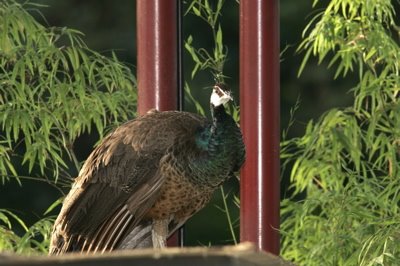
Indian Peafowl (Pavo cristatus), also known as Common Peafowl and Indian Peacock, are popular with parks and zoos worldwide. They are free ranging birds and are easily kept. The Singapore Zoological Garden’s peafowl frequently fly off to the nearby forest area along Mandai Lake Road to forage.
Lately, Meng and Melinda Chan came across a peahen that flew over to lay her eggs. The bird chose a large bird’s nest fern (Asplenium nidus) that grew on a raised tree stump to lay four eggs that were larger than chicken eggs. She was sitting on the fern incubating her eggs. The male was nowhere in sight.

According to the literature the female peafowl usually lays her eggs in a shallow scrape of ground and incubates them herself. The male seeks other females immediately after copulation.
Peahen generally attracts attention in Singapore and one laying eggs attracts more attention. Was it a wonder then that one egg was earlier destroyed by someone and another pinched by an irresponsible person?

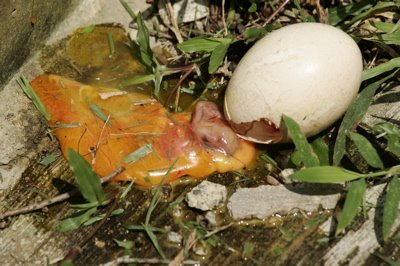
On that morning in early July 2006 when Meng and Melinda were there, they found a broken egg on the ground below the incubating bird. Melinda wondered, “…could the egg have rolled down from the nest and broke? Was it possible that the bird rejected the egg since someone was earlier seen handling it?”The bird later abandoned her last egg as she was seen wandering about and not incubating in her nest.

Apparently this was the second observed nesting. The first happened one month earlier when two eggs were laid on another bird’s nest fern. Unfortunately the eggs rolled down from the fern within a day they were laid.

Our bird specialist R. Subaraj has this to say: “This species is on my Singapore checklist due to the free-ranging population on Sentosa fulfilling the three criteria for Introduced Species. On Sentosa, there are several records over the years of young chicks accompanying females.”

Thank you Meng and Melinda Chan for the account and the images. The top image of a peacock in the Singapore Zoo is by YC.

Labels:

Tuesday, August 29, 2006

Anatomy of a nest: Yellow-vented Bulbul

Anatomy of a nest: Yellow-vented Bulbul

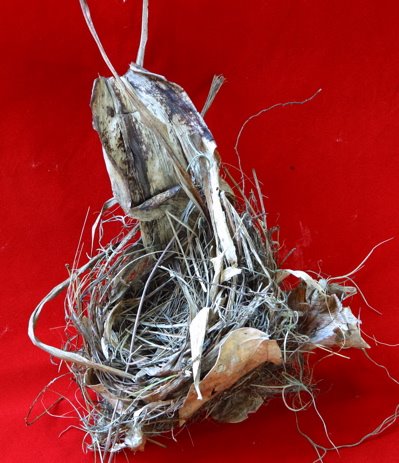
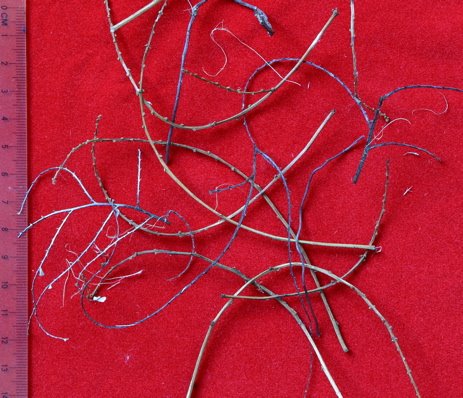
A Yellow-vented Bulbuls (Pycnonotus goiavier) built, for the second time, a nest that was lodged between the forking branches of a Dracaena reflexa ‘Song of India’ tree in my garden. It was about 2.5 m from the ground. The bird was seen earlier sitting on the nest on and off for more than a week but nothing came of it. Eventually the nest was abandoned. It was collected on 12th July 2006 and measured, dismantled and the various materials identified.The nest was built above an incomplete earlier nest. The upper nest was easily detached from the partially completed lower nest. The exterior dimension of the whole structure was 13 x 11 cm and 11 cm deep, the upper being 6 cm deep and the lower 5 cm. The completed upper nest had cup depth of 5 cm.

The foundation of the nest rim was constructed with thin and slender stems, probably inflorescence or fruiting branches (left). These were cleverly woven around other unidentified strips of vegetable matters and copious palm fibres meticulously stripped from the leaflets of palm fronds that grew in my garden. The green slender stems of Spanish moss (Tillandsia usneoides) was also used.

Whole leaves of Arabian jasmine (Jasminum sambac), small pieces of bird’s nest fern (Asplanium nidus), dried banana stem fibres (Musa hybrid), thin pieces of bark and even a few waringin (Ficus benjamina) leaves were used to construct the side of the nest.

The base of the nest was lined with the dried leaves of other narrow but extremely long (to 35 cm) Dracaena spp. as well as dicotyledonous leaves.

Nearly all the nesting materials came from my garden except the slender, unidentified flowering or fruiting branches. These probably came from neighbouring gardens. All the leaves used were dried, pliable and picked up from the ground. Many were in varying stages of rot except the fig leaves that still had traces of green. No leathery leaves were used.

It would be interesting to document the nesting materials used by other Yellow-vented Bulbuls for comparison.


Input and images by YC.

Labels:

Monday, August 28, 2006

Courtship of the Black-thighed Falconet

Courtship of the Black-thighed Falconet

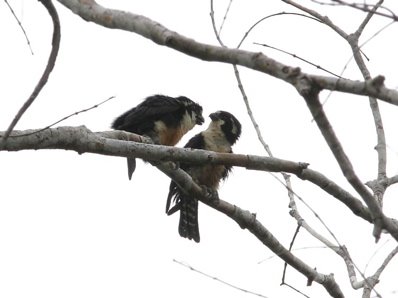
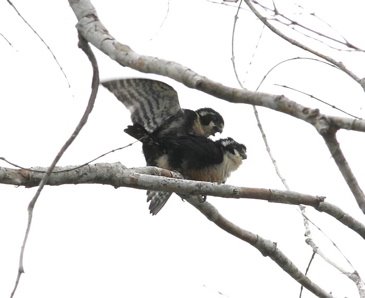
On 9th May 2006 Ong Kiem Sian sent a series of images recorded at Ayer Keroh, Malaysia on the courtship behaviour of the Black-thighed Falconet (Microhierax fringillarius). “At first the male and female were rather far apart. Then they came closer, even closer and started pecking each other. And then… happy ending.”Generally, the courtship of falconids includes bouts of intense allopreening that can last up to an hour. Some of these birds also indulge in spectacular aerial displays, soaring together high up into the air and then suddenly making a downward dive. These displays may include loud calling.

Courtship feeding is also commonly seen. This behaviour is seen as enhancing male fidelity. It allows the female to judge whether the male is a good provider and capable of feeding her and her brood during the nesting period.Falconids and raptors in general indulge in frequent copulation. As the male bird generally does not guard his partner but leaves for relatively long periods after copulation, the chances of extra-pair copulation and cuckoldry can be high. So frequent copulation enhances the chance of paternity.

These birds copulate on tree perches, the female bowing low and exhibiting submissive couching and whining prior to copulation.

Thanks, Sian, for the input and images.

Saturday, August 26, 2006

Large-tailed Nightjar: Nesting behaviour

Large-tailed Nightjar: Nesting behaviour

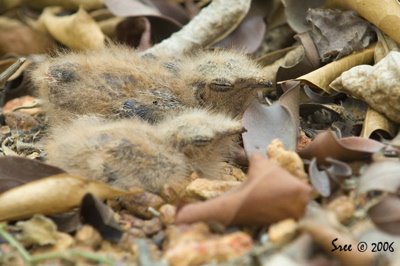
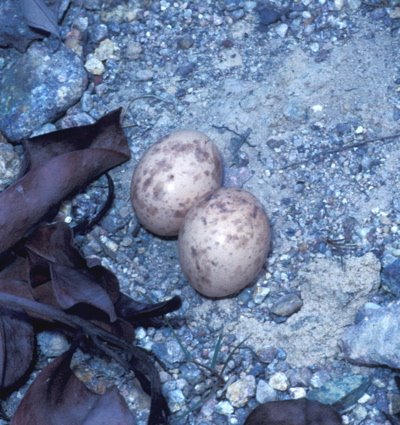
The Large-tailed Nightjar (Caprimulgus macrurus) is a nocturnal bird easily detected in the night when it responds to the beam of your torchlight with a pair of red eyes. In the day you come across it walking through scrubland when the bird suddenly scrambles off noisily. You would have probably disturbed it nesting on the ground. This cryptic bird is not easily detected otherwise. It nests on the open ground, using a small piece of ground that is scraped clean of debris.

Sreedharan Gopalsamy was at Air Keroh, Malaysia with his family in May 2006 when he encountered the antics of this bird. “I was there with my wife, Mala, and son, Varun, looking for and photographing birds. We eventually went to the area where we knew that the nightjar was nesting and walked around slowly and carefully, scanning the ground. When all of a sudden I felt and saw something brush my feet. It was the parent nightjar. It then moved about half a meter away and feigned an injured wing. After about 5-10 seconds of this, it moved about 5 meters away and repeated this behaviour and yet again about 10 meters away. Each time trying to get me to follow it. It subsequently flew to a long branch before heading into the undergrowth. Throughout this sequence my son, who was beside me, and I were rooted to our spot. My wife was a few meters behind. “It turned out that we were about 10 meters away from the nest (rather than stepping on the nest as Varun initially feared). I took my few shots and we moved away so that the mama could come back and look after her chicks. It was unusual for me in that I was not aware that nightjars exhibited this behaviour and that the parent would be so bold as to actually brush my feet.”

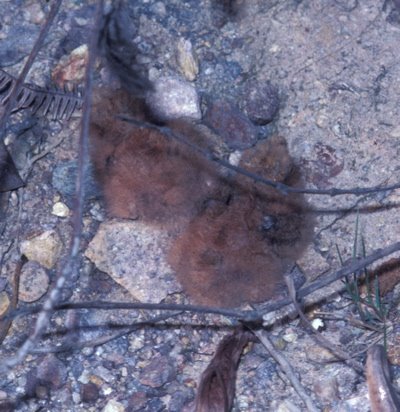
Comment by YC: I had the same experience some 20 years ago at Kent Ridge. As I was walking through the sparse undergrowth bordering the then Department of Botany, an adult Large-tailed Nightjar scrambled away and laid on the ground some distance away freigning a broken wing. As I followed it, it scrambled further away and so on. Returning to the original spot, I noticed a pair of eggs lying on a cleared piece of ground. A few days layer I when I was near the nest the incubating bird flew off noisily, leaving a pair of fluffy chicks. I returned the next morning taking care not to disturb the bird and managed to take a picture of the adult bird sitting on its crude nest.

Input by Sreedharan Gopalsamy; images by Tang Hung Bun (top), Sreedharan (middle) and YC (bottom, small).

Labels:

Thursday, August 24, 2006

Can the Masked Lapwing be considered a feral species?

Can the Masked Lapwing be considered a feral species?

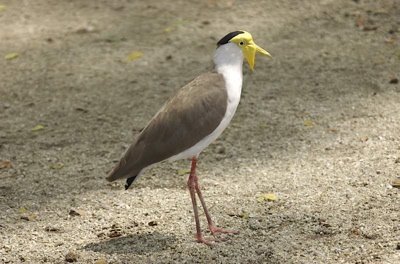
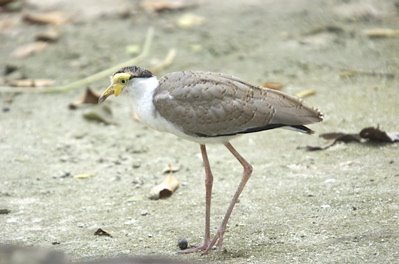
KC Tsang posted an account of his encounter with the Masked Lapwing (Vanellus miles) where there were two adults and a juvenile. These escapees are apparently breeding successfully, as the presence of a juvenile shows.

The question now is, can an escapee that has bred successfully be considered a feral species?

According to our bird specialist R. Subaraj, “Feral species are escapees/introductions that fulfill three basic criteria: 1. the species has been around for at least a decade; 2. presence of a stable, self sustaining population; and 3. at least one breeding record in the "wild" around Singapore.

“While it is noted that the an immature Masked Lapwing was seen with two adults, there is no proof that the actual breeding took place in the ‘wild’ as it is old enough to be free-flying. Breeding by free-ranging species within the grounds of the zoo, night safari or bird park does not count. Besides there is ample food provided at those areas that makes the species less self-sustaining.

“I know that this all sounds terribly confusing but this is the basic international rules for acceptance of a feral species onto a country's national bird checklist. There are obviously grey areas but we try to fulfill the above three criteria before adding anything introduced onto the checklist.“So as such, the Masked Lapwing will remain a mere escapee until otherwise proven, just like many other free-ranging species from our captive collections - Painted (Mycteria leucocephala) and Milky Storks (M. cinerea), Marabou Stork (Leptoptilus crumeniferus) (above), Brown Pelicans (Pelecanus occidentalis) (below), etc.“An interesting case is the Cattle Egret (Bubulcus ibis). In Singapore and most of the Malay Peninsula, this species is a common migrant occurring from September to April. However, over the western half of Singapore, we find Cattle Egrets throughout the year with many birds in breeding plumage even in December. They all fly out of the bird park each morning and return each evening. With thousands now present, the trees at the bird park become packed with egrets each evening and they intend to cull them. There isn't a single breeding record outside the bird park! This despite the large range of the originally released (despite bird park denying this) population. At the eastern side of Singapore, where I stay, we still see the first migrant arrive in September and the last leave in April, except when a few summer like at the airport this year. With no breeding records outside the bird park and possibly the zoo, this species remains a common migrant (CM) only.

“We need all records, no matter whether it involves escapees or naturally occurring species. Based on data collected over time, we can then gauge the actual status of many birds. For now, we can only follow the accepted rules and go with what we have, without making rash judgement regarding status.”

Thanks to Subaraj for the above and KC Tsang (Masked Lapwing) and YC (Marabou Stork, Brown Pelican) and for images

Masked Lapwing

Masked Lapwing

On 8th July 2006 KC Tsang came across three lapwings, two adults and a juvenile, at the Singapore Zoological Garden’s Rhino enclosure. Originally thought to be Yellow-wattled Lapwing (Vanellus malabaricus), it was later identified as Masked Lapwing (V. miles) by Mal Jenkins via the internet.

Apparently the English common name, Yellow-wattled Lapwing has been used for both V. malabaricus and (less commonly) for V. miles. Thus the resulting confusion.

Jeremy Lee wrote: “I remember seeing them as well last year. As you get into the zoo and walk straight towards the amphitheater, there is an open patch of turfed land on the right. I saw a pair walking there last year.”

Richard Hale added; “Oh dear. I omitted to report these three which I saw at the zoo car park on 1st March. What fascinated me was that as they walked on the shortish grass one foot was put forward to shake the grass ahead and presumably to stir up any insects lurking there. It was slow progress but seemed to work well as they got plenty to eat. Actually I had assumed they were part of the zoo.” Our bird specialist R. Subaraj has this to say: “These are actually Masked Lapwings from Australia. They were originally kept in animal enclosures at the zoo and the first batch escaped some years back when a tree fell onto the Pygmy Hippo enclosure, creating an opening. These birds were then seen at Lower Peirce, MacRitchie, Mandai Orchid Garden, Orchid Country Club, etc. Over the years they have become regular free-ranging species to be seen at the zoo and it's surroundings, and occasionally elsewhere. They have not bred or established themselves as a feral species. The only true Peninsula Malaysian record of a Yellow-wattled Lapwing was of one bird with golden plovers at the campus of University Malaya in Kuala Lumpur, Malaysia on December 8th, 1979.”

Our thanks to KC Tsang, Jeremy Lee, Richard Hale and R Subaraj for their input. Image by KC.

Labels: ,

Tuesday, August 22, 2006

Another visit by the Great Hornbill

Another visit by the Great Hornbill

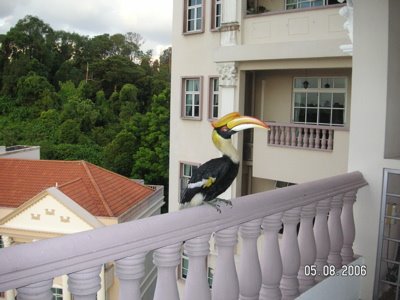
On the evening of 5th August 2006, Matt Quin was pleasantly surprised when a large bird landed on the balcony of his apartment at Bukit Tinggi. He went into the web and found out that it was a Great Hornbill (Buceros bicronis). The bird had a metal ring around its right foot and he presumed rightly that it was an escapee from somewhere.

The hornbill was very comfortable with his presence and stayed for about 15 minutes before it flew off to the balcony of the apartment above his. Matt's final words: “A truly impressive bird!”Yes, the Great Hornbill is truly impressive. This appears to be the only one left, probably an escapee from Jurong Bird Park many, many years ago. It is still flying around the Bukit Timah area, surprising Singaporeans who are generally not familiar with these birds with its presence.

In March this year the bird visited Stephen Lau's apartment, also in the Bukit Timah area. Apparently it roosts at night within the grounds of Brian Ng's condomonium. An earlier posting gives an account of it pairing with the Rhinoceros Hornbill (B. rhinoceros), another impressive bird, and checking on a cavity in an old tree for a potential nest.

Input and images courtesy of Matt Quin.

Labels:

Sunday, August 20, 2006

Yellow-vented Bulbul: Drying after the rain?

Yellow-vented Bulbul: Drying after the rain?

Lena Chow made an interesting observation on Yellow-vented Bulbuls (Pycnonotus goiavier) at Aljunied Park, Singapore one day in June 2006:

“…after a heavy downpour they fly out of a spot in the treetop for about 2 metres and immediately fly back into the same spot, repeating this for quite a while. It's quite a sight when a dozen or so bulbuls do this simultaneously, looks like a choreographed dance of sorts! I guess this must have something to do with drying themselves, but does anyone know if there's anything more to this behaviour? The other birds in the park are nowhere to be seen at this time." Our bird specialist R. Subaraj has this to say: “Most interesting observation. I cannot think of any other reason for this behaviour. You may be right in assuming that it has something to do with the drying process though we should continue observations on this ‘dance’ to see if there is more to it than meets the eye.”

Note: We need more observations by more birders before we can even try to understand this strange behaviour. So birders in the field, send in your observations.

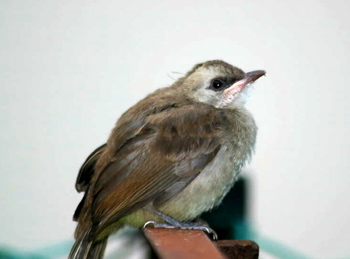
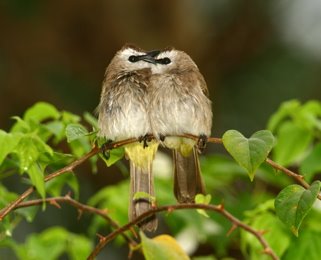
Thank you, Lena, for this observation. Unfortunately we do not have an image of this aerial dance, so the above two have been provided by YC.

Saturday, August 19, 2006

Little Terns: Feeding of the juveniles

Little Terns: Feeding of the juveniles

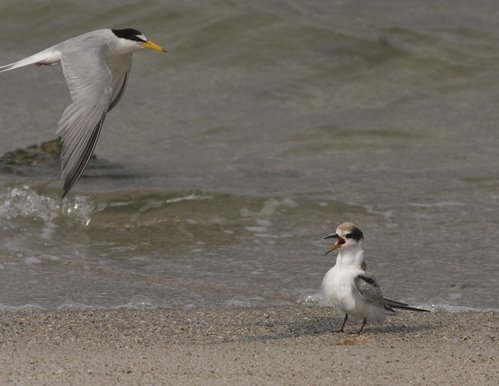
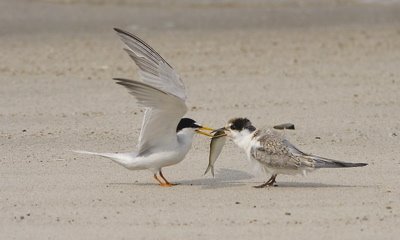
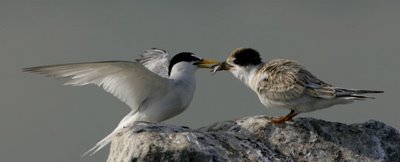
Allan Teo has been observing a group of Little Terns (Sterna albifrons) comprising of adults and juveniles somewhere in the western part of Singapore. He was fascinated by how disciplined the juveniles were when the parent bird brought fish to feed them.

“We observed a mother tern catering to two juveniles of about the same age. When one juvenile was hungry, it 'ruffled' its feathers and made a loud cry to the mother. "The mother bird would take off and hunt, while the juvenile waited along the shore stretching its wing or wading in the water.

“When the mother returned with a fish, both juveniles ruffled their feathers and gave loud cries. However, the mother knew exactly which juvenile had asked for the fish and would only hand over the fish to the requesting bird. “There was no struggle between the siblings for the fish. The receiving juvenile took its time to swallow the fish, confident that its sibling would not snatch it away.“I was waiting for a fight to occur but none materialised. The siblings remained where they were.

“The mother bird was observed feeding the juveniles one at a time as each took turns calling the mother for food.”

Input and images by Allan Teo.

Other postings on Little Terns include foraging, species of fish, courtship and after.

Labels:

Thursday, August 17, 2006

Breeding vigilance of decoy: The elusive pitta 2

Breeding vigilance of decoy: The elusive pitta 2

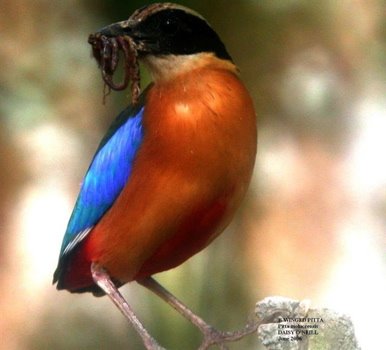
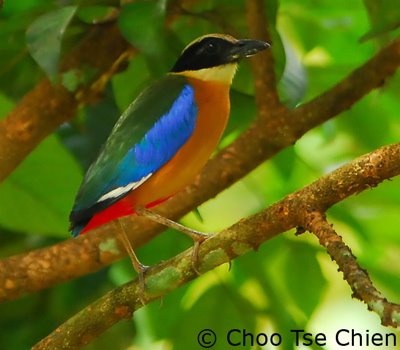
Heading out of the durian orchard, still mesmerised by the incredible luck my birding-photographer partner and I had (see 1), Chien spotted another Blue-winged Pitta (Pitta moluccensis) that flew into a fruit tree branch previously perched by the intruding Greater Racket-tailed Drongo (Dicrurus paradisus). We were soon to find out why.

We hastily headed for a low canopy tree and took cover. We held our breath and froze in between. Binoculars 8x42 were used at an approximate distance of 12 metres away. The pitta did some series of ‘hop and skip’ on the spot while perching under the tree canopy and shunting occasionally in different directions. The turning of it’s head from right to left with a visual field of 180 degrees and vice versa was done repeatedly while checking consistently for intruders. This behavior appeared to be the main feature of this species in breeding mode.

There were moments when the pitta paused and remained still as if to listen. The elusive pitta has an acute sense of hearing and indeed the ability to detect intruders a great distance away. The game will be over if the intruder is sighted by the bird. This will, in turn, send the intruder on a wild goose chase.

While the breeding bird remained and hopped-fly from one branch to another, a series of opportunity camera shots ‘clicked’ out from Chien’s Nikon D200, taken from our observation point, undercover and undetected by the bird. No flash photography was used or needed that morning.

The Blue Winged Pitta, in exercising extra precautions, flew and perched on a concrete post further away. Its repeated the usual breeding behavior before a quick dash flight over the fence and disappeared into the undergrowth.

The pitta was just out to stretch her wings, to feed and was on the way back to continue with the business of incubating the eggs. It was by chance we spotted her.

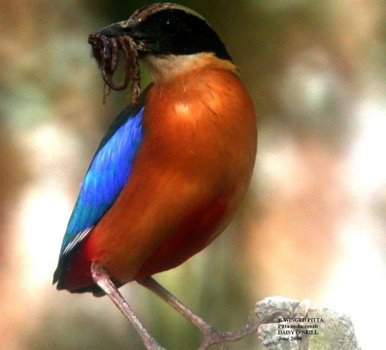
The Blue-winged Pitta is observed to practice a ‘two step’ approach to the nesting site – the location, which we were unaware of until about two weeks later. Both of us had not encountered a pitta’s nesting site before. Thus it did not dawn on us that the pitta was actually flying into a nest.Parenting behavior was witnessed on 27th June 2006, a week after four chicks were hatched. They were observed under camouflage drapes no less than 10 metres away at half-hour intervals on three occasions: morning, afternoon and evening over different days.

Parenting behavior of pittas is an observation that arouses human compassion. The amount of stress the parents took on, the hard work of sourcing and feeding four chicks every 10-12 minutes continuously, the team work of sharing, caring for their young and protecting against intruders, call for an immeasurable respect of this avian family.

As ground nesters, the chicks are more prone to predators like stray animals, reptiles, insects and human destructive predation. As such, more surveillance are required of such species designed to be excellent practitioners of vigilance and decoy.Earthworms were mainly the diet for one-week old chicks and abundantly had in the fertile orchards. It was also observed that initial trips to source earthworms were made further away from the nesting site. Towards the end of the fledging period, the exhausted parents, having lost considerable weight, were seen with less juicy pickings from near.

It was also observed that while a parent was foraging, the other vigilant parent was never far away and would use the fruit tree canopy for sentry duty. Any bird, strangers that approached too close for comfort, a series of alarm calls, ‘skyeew’ would ring out to ward off intruders and warn his mate to caution it’s approach.

Birder-photographers finding themselves in this situation should concede defeat and back off, leave the place altogether out of the bird’s sight to allow feeding to resume. The parent, with a beakful of worms, would fly off in opposite directions to the nesting site and wait it out patiently. It will only return on a ‘two step’ approach when all is clear. Such is the intelligence of this species.

Having witnessed the extreme fragility and harsh environment upon which Blue-winged Pittas choose to breed, this is one species that the best and kindest thing for humans when nestlings are found (having seen one before), is to leave the parents alone to get on with their business of fledging their chicks and let nature takes it’s own course.

It is unfortunate that I am not able to provide the first initial week’s documentary account and the after fledging of the chicks as Chien and I decided to abandon our observations under difficult circumstances of an increasing crowd. The birds’ welfare had to come first.

I would like to thank Choo Tse Chien for generously providing me with very decent photographs for your viewing pleasure and Connie Khoo of Ipoh for the picture of the juvenile chick. I take great pleasure in sharing the credit with them.

It was reported by other birders that three chicks fledged out of a clutch of four eggs.

Submitted by: DAISY O’NEILL PENANG, MALAYSIA

Wednesday, August 16, 2006

Nictitating membrane

Nictitating membrane

In April 2006 Johnny Wee spotted a White-throated Kingfisher (Halcyon smyrnensis) perching on a branch of a tree, eying a lizard on the ground nearby. He managed to take a few images with his digital camera as the bird launched at the prey. Back at his computer, he processed the images and found a number of them had birds whose eyes were white. Thinking that these were photographic artifacts, he erased them all.

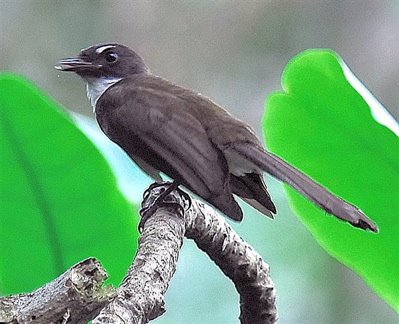
In July 2006 Johnny observed a Pied Fantail (Rhipidura javanica) eying an insect. While intently concentrating on the prey, its eyes turned white and its tail feathers fanned out. This time he did not erase his white-eyed bird images but kept them as comparisons. The eyes returned to normal after feeding.

Two different observations on two different species of birds, both with eyes turning white just before the birds lunged on their preys must mean something.Birds have three eyelids – one upper, one lower and a nictitating membrane. The third is between the two other eyelids and the cornea and moves sideways. It is used in cleaning and protecting the eye.

It is believed that birds cover their eyes with the nictitating membrane when under water. This has been disputed by some, as the membrane, being translucent and not transparent, would obscure the sight of the bird in its search for food. Others question the necessity of covering the eyes in water, based on our experience of seeing under water.

The nictitating membrane is also believed to comes in useful during flying. The bird cannot afford to close its eyelids often when in the air. Loss of vision, even momentary, caused by closed eyelids can throw the bird off balance.

Ornithologist Geoffrey Davison believes that the whiteness of the eye in the image is due to the nictitating membrane coming across the eye just at the moment the image was taken. This may or may not be related to the bird’s intended movement.

Birders-photographers, please keep a look out for this phenomenon in your images.

Latest: My copy of Handbook of Bird Ornithology (2nd ed.) (2004) by S. Podulka, R.W. Rohrbaugh, Jr. & R. Bonney (eds.), New York: Cornell Lab of Ornithology, arrived today. On page 1.7 it is said that "In raptors and other predatory birds, the nictitating membrane protects the eyes as the bird pursues prey through heavy cover, such as a blackberry thicket."

Input by YC and Geoffrey Davison, images of Pied Fantail by Johnny Wee.

Tuesday, August 15, 2006

Thoughts on a starling's nest

Thoughts on a starling's nest


On 15th June 2006, Lin Yangchen made this observation: “Although the Black-naped Tern (Sterna sumatrana) at Loyang have packed up, the Asian Glossy Starling (Aplonis panayensises) are still in business. I joined a pair of them at lunch. One was uttering expletives perched at the top of one of the dead coconut trunks sticking out of the sea while the other was feeding their kids in the cavity just below the top. The bill of the food-collecting parent was smeared with orange bits of leftovers which I couldn't identify and he/she didn't bother to wipe his/her beak. The food was transferred down from an opening at the top of the trunk, which means that the kids got rained on quite heavily. In any case the nest seemed too small for even one parent to enter; do the parents go hide somewhere else during a storm? I don't suppose leaving a nest unprotected during heavy rain would expose it to great risk of predation. But how about hypothermia? Does the glossiness of the species' plumage indicate the presence of some hydrophobic coating that confers higher water resistance?

“This seemingly hostile environment is, however, immune to land attack. Air strikes are mediated by communal nesting. And imagine yourself as a juvenile preparing for takeoff on your maiden flight. Anything less than Top Gun will be banished forever to the bottom of the sea.”

Input and images by Lin Yangchen.

Labels:

Sunday, August 13, 2006

Little Terns: Courtship and after

Little Terns: Courtship and after

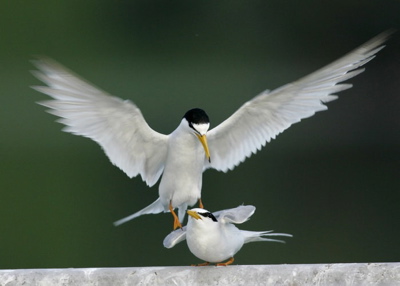
The breeding season of Little Terns (Sterna albifrons) in Singapore starts from May to end in July. The first step involves pairing, after which courtship begins. Typical courtship behaviour involves the male bird bringing fish to his mate. This may continue for some time before the pair actually bonds. After all, the female has to be convinced of the male’s ability to provide for her and her brood during the period of egg incubation and after. Only then will copulation actually takes place.

This involves the female crouching and the male hopping on her, to make cloacal contact. This happens only for a brief period but mating may take place many times a day.After copulation comes egg laying. The birds choose a piece of bare ground near water to lay the eggs. Once the nestlings fledge, both birds continue to feed them until the fledglings are able to care for themselves.

Meng and Melinda Chan were at the Neo Tiew area last year and brought back these dramatic images to share.

Saturday, August 12, 2006

An encounter with a Spotted Wood Owl

An encounter with a Spotted Wood Owl

Ho Shuping wrote: “On 10th July, 2006I heard a commotion outside with the repeated calls of a Collared Kingfisher (Todiramphus chloris). I looked up and saw this owl that I thought was a Spotted Wood Owl (Strix seloputo) in a tree in my garden.

“Many birds flew by and perched at a distance before taking off again. Then there was an unusual silence. There were two Oriental Magpie-robins (Copsychus saularis), two pairs of Yellow-vented Bulbuls (Pycnonotus goiavier), a pair of Black-naped Orioles (Oriolus chinensis) and I could also hear Long-tailed Parakeets (Psittacula longicauda) flying by and calling (though I am not sure if that was related to the presence of the owl). The owl sat in the tree (seemingly sleeping, occasionally opening an eye) from when I saw it at 1 pm and the last I saw it at 5.30 pm. It was gone when I went to check at 7.00 pm.

“I saw it again two days later in a neighbour’s coconut palm (Cocos nucifera), being actively mobbed by two pairs of Oriental Magpie-robins.

“Is it a Spotted Wood Owl and is it a common garden resident? The bird is reported to be forest edge dwellers and this is the first time I’ve seen one here. I am also surprised it chose to sit in such an exposed tree.” Our bird specialist R Subaraj replied: “This large owl is a Spotted Wood Owl, an uncommon resident in Singapore with about 20 or so known pairs, mostly from southern and central Singapore but also from the west and east as well as offshore islands like Ubin, Tekong, Sentosa and St. Johns.

“The owl is a resident of forest edge, woodlands, rural countryside and large wooded parkland and gardens. Birds usually roost in a large dense tree but when disturbed, may occasionally roost for the day in a more open tree. Recently fledged birds also tend to roost less sensibly while seeking out a new territory for themselves. We have a recent photo record of this owl at Chinatown and also an earlier record of it being mobbed. We have also posted an account of a Barn Owl (Tyto alba) being mobbed by House Crows (Corvus splendens).

“Predators like owls, snakes and raptors are often subjected to mobbing by various birds (and other animals) as they try to drive it away from their territory. Even owls that roost in dense vegetation may often be mobbed when accidentally discovered by a foraging party of birds.

“This spectacular bird normally starts calling (growls followed by loud barks) around dusk and departs its roost to feed soon after. I have observed it feeding on bats that hawk insects around a street lamp.”

Thank you Shuping, for this interesting encounter and images.

Labels:

Thursday, August 10, 2006

Greater Flamingoes

Greater Flamingoes


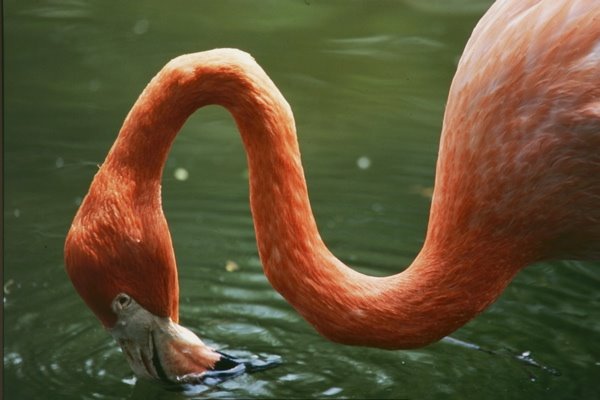
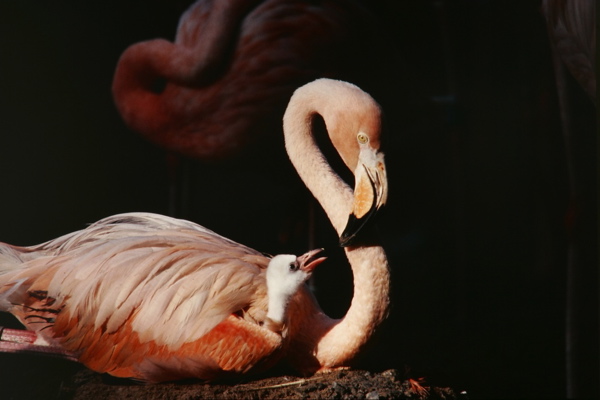
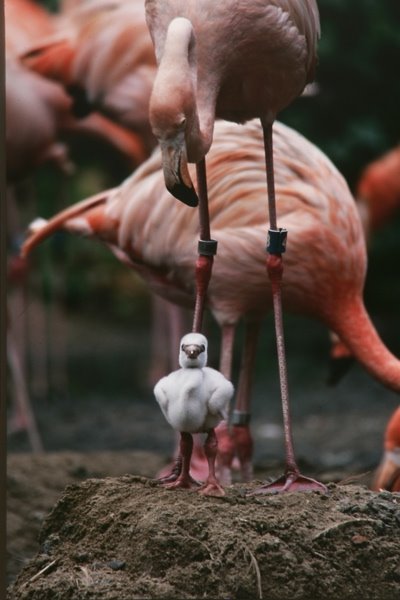
Chan Yoke Meng had the opportunity to observe the small colony of captive Greater Flamingoes (Phoenicopterus rubber), also known as Caribbean Flamingoes, at the Jurong Bird Park between December 2003 and January 2004. He witnessed and recorded on film the hatching of one egg and how the parent birds fed the chick.There were three nests, each a small mound of earth with a shallow depression at the top. On each of the nests was a single egg. The egg in one nest hatched on 1st January 2004 giving a healthy chick. The second nest gave a dead chick. The egg in the third nest failed to hatch. The successfully hatched chick was totally covered with white down feathers. During the first few days the chick was snugly tucked under the wing of the parent bird. With its head poking out of the wing, the chick was fed with a milky liquid secreted from the upper digestive track of the parent. The parent held its curved bill over the chick’s straight bill and dripped the secretion down. Flamingo chicks are usually fed by their parents until the former are quite old, even after their bill is completely curved and capable of filter feeding. Thanks Meng for sharing your observations and images. Obviously the chick did not approve of your presence.

Wednesday, August 09, 2006

Long-tailed Parakeet and yellow simpoh

Long-tailed Parakeet and yellow simpoh

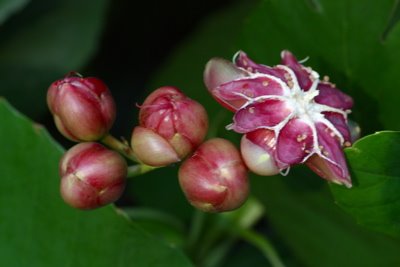
The yellow simpoh (Dillenia suffruticosa) is a common shrub of rural areas and secondary growths. The large leaves were once used to wrap food in wet markets. They are still being used to wrap tempeh, the slightly fermented soya bean cake used in local cooking.

The plant flowers throughout the year, putting forth its large and attractive yellow flowers found on long flowering stalks. Along each stalk usually only one flowering bud bursts open during the early hours of the morning. It becomes fully opened just before sunrise. Lasting only a day, the flower then sheds its petals by evening and the fleshy sepals fold back on the developing fruit. Along any flowering branch there would be flower buds and developing fruits that look like flower buds, usually larger. When the fruit is matured, the fleshy sepals surrounding it unfolds, and the fruit itself splits opens into a number of parts. The separate pink rays bordered by white is filled with pulpy scarlet seeds. This colourful structure may mislead some to think that it is the flowers. But it is definitely the fruit. The image above shows the ripe fruit (right) minus the seeds, which are a favourite with birds. The four bud-like structures are the developing fruits looking like flower buds.


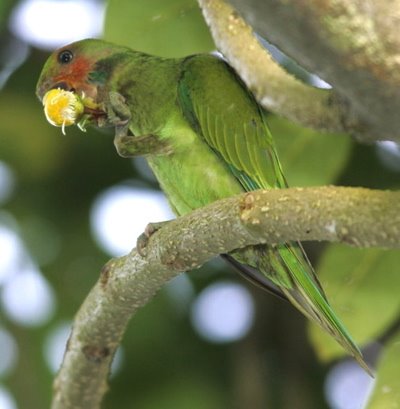
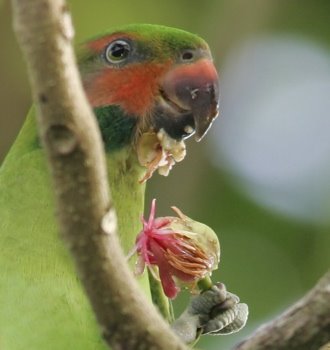
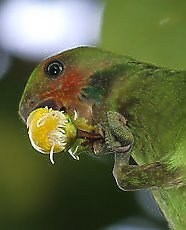
In April 2006 Chan Yoke Meng photographed a Long-tailed Parakeets (Psittacula longicauda) eating what looked like a flower bud (top and above right). The bud defied identification until Dr Shawn Lum suggested that it could be a flowering bud of a yellow simpoh. Going back to his collection of shots that were taken at Turut Track, Meng helped solved the problem when he sent one clearly showing a developing fruit (above, left) being chewed by the parakeet. Obviously the bird eats the flower buds as well as the young fruits. Can it be that it is unable to differentiate the two that are found along the same flowering branch?

Images by Chan Yoke Meng except that of fruits by YC. Thanks to Shawn Lum, KF Yap and Angie Ng for assisting in ID.

Labels:

Monday, August 07, 2006

Stalking in tandem: The elusive pitta 1

Stalking in tandem: The elusive pitta 1

Recent nesting site discovery of the Blue-Winged Pitta (Pitta moluccensis) in Ulu Paip, Kedah, Malaysia puts it as the third known location of breeding pittas in Malaysia – the other two being Langkawi Island and Taman Negara.

A 40 year old, relative to the fruit plantation owner, said that the Blue-winged Pittas have been around since her childhood days! There had been previous nesting sites in different orchards but the families had in the past dismissed them as mere colourful birds left to breed as nature would have it while their focus was purely on fruit harvests.

An accidental discovery of a breeding pair of Blue-winged Pittas was made on 28th May 2006 by a birder while on routine reconnaissance to explore new birding territories. A small monitoring team initiated by members of the Malaysian Nature Society Penang Branch made numerous, progressive trips in pursuit of a chance of documenting a pitta nesting.An eventful day was the 3rd June. It was a day made to capture and to reminiscence this historical moment with birder-photographer partner, Tse Chien, with whom I am delighted to share and prove that ethical birding and good photography do go hand in hand with those who love birds.

Our first encounter with breeding adults was a beginner lesson taught by the birds. They are fast, alert, intelligent, highly cautious and great practitioners of decoy. We were soon to discover that pittas love the game of 'hide and seek’. The game is over if we get spotted first. That meant, the bird would be leading us on, perched and teased only to fly off to another branch when our approach was too close to be comfortable and when it had enough, would disappear for good leaving the exasperated pursuer in despair.
We drummed up Sun Tzu’s strategy and prepared well for a photo shoot just for the Blue-Winged Pittas. Adorned with camouflaged drapes, we hid our vehicle at a restaurant car park. We took to our feet and approached stealthily from the rear towards a prospective pitta site.

There was an aura of total quiet as I led the way. We plodded along the narrow tarmac, running parallel to the orchards of durians while I looked through my 8x42 binoculars for any blue-white flying object. I felt a pair of eyes was quietly watching us and it was coming… coming from a fruit tree.
A Greater Racket-Tailed Drongo (Dicrurus paradisus) then decided to fly across the road and perched on the same tree. It was as though to say, “Hi birders, count me in too!”

Suddenly, silence was broken by a loud, continuous squawking of a bird.

“I cannot recognise that bird call” I whispered to my birding partner who was tailing me with his tripod and 8kg something of camera contraptions.

My ears followed the distressed signal chased by my binoculars which captured the image of a startled blue-winged, red bellied, no tail bird having a ‘stand- off’ with the Drongo.

The Drongo has blown the pitta’s cover. It’s the pitta! We froze in surprise while the bird continued screeching unceasingly. It was almost like a whole minute before the drongo took to a 100 metre flight into the orchard, leaving the screaming pitta behind and forgetting our presence.

As though harassment wasn’t sufficient, the pitta suddenly flew out and headed towards the same tree as the drongo. At a distance, we could see the silhouette of a pitta confronting and scolding the intruder perching on the same branch.

“Quick, quick, take that shot!” I said.

Excited, Chien did not have time to focus on the bird which went into a semi-concealed position. "Where is the bird now?" he asked.

I raised my binoculars to the direction of the scream and saw only a flash of red belly and something brown behind a vertical obstructed branch. We reviewed our position and decided I would remain hidden, standing behind the tree to prompt and watch of any change of pitta’s position. While Chien, having disengaged his tripod, maneuvered stealthily forward and towards the left to chance a clear view shot.Kneeling like a Xian Terracotta archer, Chien took aim and all I could hear then was clik! clik! and a few more clicks! The images of the elusive Blue Winged Pitta were finally captured in his Nikon D200 horned in by his lens. Chien recalled, dribbling in sweat and hailed that intense moment of bird-photography as simply, 'par-excellence.'

The Drongo-missing jig-saw puzzle to our gambit finally got the message and flew out of sight. The pitta continued to wallow screams for another one minute or so despite the ‘Black Knight’ having flown. The pitta waited a final half-minute more and finally disappeared, thus rewarding us a few more opportunity shots.

To me, not only was it a privilege to find ourselves compatible as birding partners, we also enjoyed encountering a unique contest of behavior of a Blue-Winged Pitta in breeding mode. It was also the image imprint in my memory bank that said and stayed. My partner has the makings of a true maturing professional bird-photographer and GOT style.

This photo shoot was taken under all natural conditions with no flash photography, to add stress to the bird and done with approved permission from the orchard owner in good birding partnership. Our actions fulfilled the international criteria within the Code of Good Ethical Birding Practice for which I advocate to those who aspire to become mature birders and share the love of birds.

Submitted by: DAISY O’NEILL, PENANG, MALAYSIA.

Labels: ,

Saturday, August 05, 2006

What species of fish does the Little Tern take?

What species of fish does the Little Tern take?

Birdwatchers are happy to just report that such and such a species of birds had been seen fishing. They are generally not interested in what species the birds take. You cannot blame them. After all birders are not biologists. And just catching a glimpse of a bird swooping down on a fish with the help of a pair of binoculars will not allow for the fish to be identified to specific or even generic level.

Not now. A growing band of bird photographers that has been roaming our countryside has brought back excellent images of birds fishing that allow for the fish to be identified.

In this posting we are highlighting the species of fish that the Little Tern (Sterna albifrons) takes from the freshwater reservoir in Kranji. This is only possible through the excellent photography of Chan Yoke Meng. Three species of freshwater fish have been identified through the courtesy of Dr Khoo Hong Woo, formerly with the then Department of Zoology, National University of Singapore. The giant snakehead or toman (Channa micropeltes), one of the largest of the world’s snakeheads, is cultured in our reservoirs and fish ponds as a food fish. The fish, held firmly between the beak of the juvenile shown in the image above is actually a young giant snakehead. These young fish gather in small, tight shoal near their parents and are thus easily predated by the Little Terns.The glass fish (Chanda spp.) are easily identified as the body is translucent. Found in brackish and saline water near the coast, several species are also found in freshwater. They have been known to occur in our reservoirs, probably deliberately introduced. These are a favourite aquarium fish and some are artificially coloured through the injection of dyes.The common tilapia (Oreochromis mossambicus, previously called Tilapia mossambicus) is not native to this region. Introduced as an aquaculture fish, it is popularly served in restaurants. This tilapia is common in our reservoirs. The fish taken by the Little Tern in the picture is a juvenile common tilapia.

Images of Little Tern with giant snakehead (top), glass fish (middle) and tilapia (bottom) by Chan Yoke Meng. Fish identification by Khoo Hong Woo.

Labels:

Friday, August 04, 2006

Status of the white-eyes in Singapore

Status of the white-eyes in Singapore

Following the posting of the nesting of the Oriental White-eye (Zosterops palpebrosus) by K.C. Tsang recently, Yong Ding Li sent in this report: “…appears that the Oriental White-eyes are fairly well established in Singapore in the form of feral populations and nowadays can be found in many housing estates. Might be wise to be very careful as far as identifying zosterops are concerned as at least four species of white-eyes have occurred in Singapore in a feral state, including Japanese White-eye (Z. japonicus), Chestnut-flanked White-eye (Z. erythropleurus), Mountain White-eye (Z. montanus) and Everett's White-eye (Z. everetti) and not assume them all to be mere orientals.” Our bird specialist R. Subaraj has this to say on the status of the Oriental White-eye: “The record by KC is a good confirmation of nesting but there have been records of immature birds being attended to by parents. The species has been feral and widespread in certain parts of Singapore, including Holland Woods, Ulu Pandan, Bukit Batok, Toh Tuck, etc. for more than a decade now.

“The native population of the Oriental White-eye died out long before the 1970s - that is just a starting date for modern records. The current population is believed to have started from escape birds (popular cage bird), both accidentally or deliberately freed. They have been around for at least 20 years and the numbers have been increasing without a confirmed observation of the actual nesting. However, the status of this species was accepted in the late 1990s to early 2000s as CI or common introduction, not a mere escapee!

“The current nesting record changed nothing in terms of the species
status. It will still remain a common introduction like Javan Myna (Acridotheres javanicus), House Crow (Corvus splendens), Red-breasted Parakeet (Psittacula alexandri) and White-crested Laughingthrushe (Garrulax leucolophus). They all originated from escapees/releases and will never become Residents (R) which is reserved for true native inhabitants of Singapore and natural colonists from elsewhere who have established themselves here, like the Oriental Pied Hornbills (Anthracoceros albirostris) on Pulau Ubin for example.

“The term feral is preferably reserved for established introduced populations while the occasional sighting of a different species of white-eyes is best described as escapees. With this in mind, only the Japanese White-eyes (as well as Oriental) are fairly common established feral species and I have them on my checklist as Common Introduction (CI). Populations of Japanese are found at sites like Mount Faber, Telok Blangah Hill, Kent Ridge Park and NUS. Other species of white-eyes are mere escapees including Chestnut-flanked, Mountain(?) and Mangrove White-eye (Zosterops chloris).

Thank you Ding Li and Subaraj for your input. Image by YC.

Labels: ,

Wednesday, August 02, 2006

Malaysian Plover: The cryptic chicks

Malaysian Plover: The cryptic chicks

The Malaysian Plovers (Charadrius peronii) nest along the open shore just above the high water mark. The nest is just a scrape on the ground and there is no vegetation to offer any protection. So how does it avoid detection from potential predators? Camouflage is the answer!
The brown, grey, blank and white plumage blends perfectly with the surroundings. The nest is not lined with any insulating plant material as this would make it conspicuous. Similarly the eggs are perfectly camouflaged. There is a long incubation period of up to 30 days during which the parent birds need be vigilant against egg poachers. However, this long period ensures that the chicks hatch with their eyes opened, covered with downy feathers and capable of independent movement within a few hours of hatching.

Such chicks do not need to be constantly brooded in the nest as they are able to maintain their body temperature, though not completely. Thus they initially need to get warm under the parent’s wings. As seen above, the two days old chick is still learning how to walk properly, sometimes toppling over while in a hurry trying to get to the female parent.
Finally able to stand tall and proud.

The account on the nesting behaviour has already been posted.

Input and images by Philip Tang.

Labels:

Tuesday, August 01, 2006

Buffy Fish Owl: The big yawn

Buffy Fish Owl: The big yawn

Connie Khoo of Ipoh, Malaysia came across a juvenile Buffy Fish Owl (Ketupa ketupu) at Kek Lok Tong in Ipoh, Perak recently. She was fascinated by the “yawning” behaviour of the bird and sent in this account to KC Tsang. Through the good office of KC, we got permission for this posting - on condition we include one of Connie’s cats.“This morning I went to check on the juvenile Buffy Fish Owl and saw that it was still on the same tree after fledging between 24-28 June 2006. By now it should be about 10-11 weeks old.

“…the juvenile started to show some 'action' by cleaning its face, stretching and flapping its wings and also stretching its long neck. It was yawning a bit, and a bit, and a bit again. That was at 8.30 am. I decided to stay a bit longer and ended up staying about 4 hours. "By 9.15 am I noticed something different in the yawning, because if we yawn, it lasts not more than 10 or maybe 15 seconds and we don't open our mouth that long. The juvenile bird kept yawning and yawning for long durations and at times held its mouth open for 10-15 seconds, then closed its mouth and yawned again and again. I then realized that it was not yawning but probably strengthen its ‘jaws’. Just like birds flapping its wings to strengthen them as well as the body.

“Finally I made notes of the number of seconds each yawn took and how long the bird held its mouth open. It could hold it open for as long as 20 seconds, showing off its tongue. Can you imagine, the bird was yawning (exercising) from 9.15 am and at the time I left the place at 11.30 am it was still yawning.

Note: Yes, birds do yawn, as do other animals, includingh fish. Now why do they yawn? Maybe to clear their ears as we do during descent on jet flights. Maybe their throat or ears are itchy. Or do they yawn for the same reason we do - to get extra oxygen?

PS from Connie: “Doesn’t Angel look like the owl? The first time I saw the Buffy Fish Owl, I thought it looked like my Angel… Just look at her eyes and forehead, don’t you see the similarity?”


Thank you Connie and KC for making this yawning post possible.

Labels:

Site Meter Amfibi Directory Singapore Blogger Organisation