Site Meter

Sunday, October 08, 2006

Arrival of the Asian Paradise-flycatcher

Arrival of the Asian Paradise-flycatcher

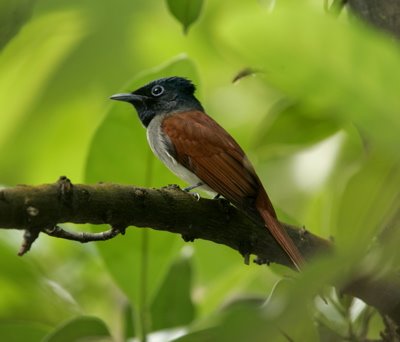
Asian Paradise-flycatcher (Terpsiphone paradisi), also known as the Common Paradise Flycatcher, is a migratory bird wintering in tropical Asia. It began to arrive in Singapore around late September and early October and this was the time Meng and Melinda Chan sighted a pair in the Central Catchment forest. The male was a white morph with tail longer than the female but the spectacular long central feathers were absent. The pair took turns darting out of the forest canopy to catch flying insects, returning immediately to feed.
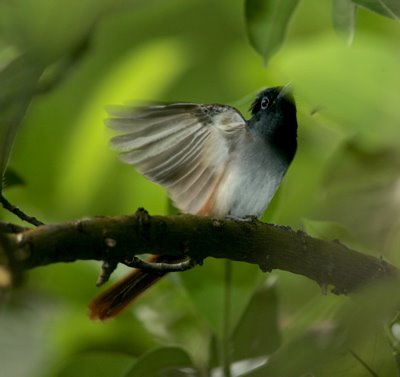
It is insectivorous, often hunting for insects like bees, small beetles, flies and neuropterans. It has been reported to hunt with mixed flock. In this instance the female was seen perching near to a Yellow-vented Bulbul (Pycnonotus goiavier).
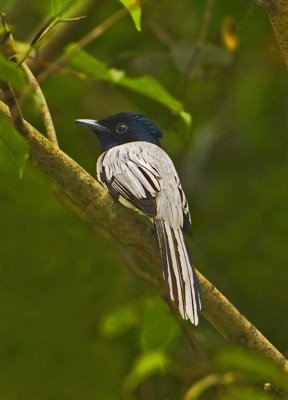
Note: On 12th June David Tan sent in images of the bird nesting in Taman Negara, Malaysia. On 28th September KC Tsang reported seeing a juvenile at Sungei Buloh Wetland Reserve. There may be other sightings as well. There is also an earlier posting on its nesting.


Input and images (top, male; rest female) by Meng and Melinda Chan.


The latest addition of the back view image of the bird (left) is by Allan Teo.

Labels: ,

Thursday, September 14, 2006

Purple Heron: Feeding behaviour

Purple Heron: Feeding behaviour

Herons are carnivores, feeding on a wide range of live animals found within their aquatic environment. These may include fish, frogs, snakes, lizards, birds and small mammals. They also take aquatic insects and crustaceans.

The long neck and sharp pointed bill are well adapted to harpoon preys. The bird stands motionless in shallow water among vegetation until a prey approaches. It then suddenly seizes it with the bill or if large enough, impales it. An account on the baiting strategy of Little Heron (Butorides striatus) has been posted earlier.

Herons swallow their prey whole. They have an excellent digestive system that takes care of their food efficiently, leaving only bones, feathers, exoskeletons and fur that get regurgitated as pellets.

Adults feed their chicks by regurgitating the prey whole. The chick may swallow the food whole or if too large, the parent bird may break it up into smaller bits.

The image above, provided by Chan Yoke Meng, of a Purple Heron regurgitating a rat, tail-first (it cannot be otherwise) to feed the chick, was taken at Yong Peng, Malaysia in August 2005. Obviously the regurgitated rat needed to be repositioned before the chick can swallow it. Or did it swallow the rat tail first?

The image below by YK Chia shows another Purple Heron, this time a juvenile, with a lizard between its beak. If you look closely, you can see where the lizard had its body pierced.
Thanks to Chan Yoke Meng and YK Chia for the use of their images. Check out YK's blog.

Labels:

Thursday, August 24, 2006

Masked Lapwing

Masked Lapwing

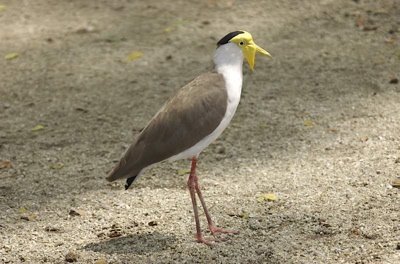
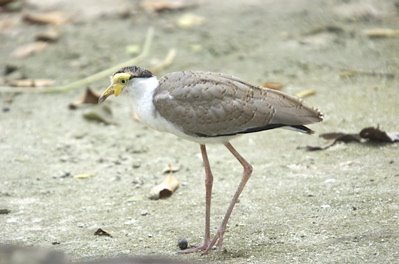
On 8th July 2006 KC Tsang came across three lapwings, two adults and a juvenile, at the Singapore Zoological Garden’s Rhino enclosure. Originally thought to be Yellow-wattled Lapwing (Vanellus malabaricus), it was later identified as Masked Lapwing (V. miles) by Mal Jenkins via the internet.

Apparently the English common name, Yellow-wattled Lapwing has been used for both V. malabaricus and (less commonly) for V. miles. Thus the resulting confusion.

Jeremy Lee wrote: “I remember seeing them as well last year. As you get into the zoo and walk straight towards the amphitheater, there is an open patch of turfed land on the right. I saw a pair walking there last year.”

Richard Hale added; “Oh dear. I omitted to report these three which I saw at the zoo car park on 1st March. What fascinated me was that as they walked on the shortish grass one foot was put forward to shake the grass ahead and presumably to stir up any insects lurking there. It was slow progress but seemed to work well as they got plenty to eat. Actually I had assumed they were part of the zoo.” Our bird specialist R. Subaraj has this to say: “These are actually Masked Lapwings from Australia. They were originally kept in animal enclosures at the zoo and the first batch escaped some years back when a tree fell onto the Pygmy Hippo enclosure, creating an opening. These birds were then seen at Lower Peirce, MacRitchie, Mandai Orchid Garden, Orchid Country Club, etc. Over the years they have become regular free-ranging species to be seen at the zoo and it's surroundings, and occasionally elsewhere. They have not bred or established themselves as a feral species. The only true Peninsula Malaysian record of a Yellow-wattled Lapwing was of one bird with golden plovers at the campus of University Malaya in Kuala Lumpur, Malaysia on December 8th, 1979.”

Our thanks to KC Tsang, Jeremy Lee, Richard Hale and R Subaraj for their input. Image by KC.

Labels: ,

Saturday, August 12, 2006

An encounter with a Spotted Wood Owl

An encounter with a Spotted Wood Owl

Ho Shuping wrote: “On 10th July, 2006I heard a commotion outside with the repeated calls of a Collared Kingfisher (Todiramphus chloris). I looked up and saw this owl that I thought was a Spotted Wood Owl (Strix seloputo) in a tree in my garden.

“Many birds flew by and perched at a distance before taking off again. Then there was an unusual silence. There were two Oriental Magpie-robins (Copsychus saularis), two pairs of Yellow-vented Bulbuls (Pycnonotus goiavier), a pair of Black-naped Orioles (Oriolus chinensis) and I could also hear Long-tailed Parakeets (Psittacula longicauda) flying by and calling (though I am not sure if that was related to the presence of the owl). The owl sat in the tree (seemingly sleeping, occasionally opening an eye) from when I saw it at 1 pm and the last I saw it at 5.30 pm. It was gone when I went to check at 7.00 pm.

“I saw it again two days later in a neighbour’s coconut palm (Cocos nucifera), being actively mobbed by two pairs of Oriental Magpie-robins.

“Is it a Spotted Wood Owl and is it a common garden resident? The bird is reported to be forest edge dwellers and this is the first time I’ve seen one here. I am also surprised it chose to sit in such an exposed tree.” Our bird specialist R Subaraj replied: “This large owl is a Spotted Wood Owl, an uncommon resident in Singapore with about 20 or so known pairs, mostly from southern and central Singapore but also from the west and east as well as offshore islands like Ubin, Tekong, Sentosa and St. Johns.

“The owl is a resident of forest edge, woodlands, rural countryside and large wooded parkland and gardens. Birds usually roost in a large dense tree but when disturbed, may occasionally roost for the day in a more open tree. Recently fledged birds also tend to roost less sensibly while seeking out a new territory for themselves. We have a recent photo record of this owl at Chinatown and also an earlier record of it being mobbed. We have also posted an account of a Barn Owl (Tyto alba) being mobbed by House Crows (Corvus splendens).

“Predators like owls, snakes and raptors are often subjected to mobbing by various birds (and other animals) as they try to drive it away from their territory. Even owls that roost in dense vegetation may often be mobbed when accidentally discovered by a foraging party of birds.

“This spectacular bird normally starts calling (growls followed by loud barks) around dusk and departs its roost to feed soon after. I have observed it feeding on bats that hawk insects around a street lamp.”

Thank you Shuping, for this interesting encounter and images.

Labels:

Monday, August 07, 2006

Stalking in tandem: The elusive pitta 1

Stalking in tandem: The elusive pitta 1

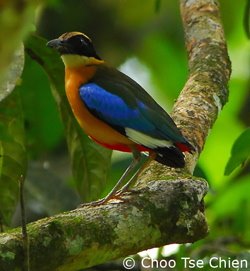
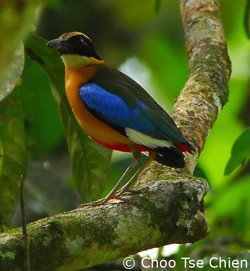
Recent nesting site discovery of the Blue-Winged Pitta (Pitta moluccensis) in Ulu Paip, Kedah, Malaysia puts it as the third known location of breeding pittas in Malaysia – the other two being Langkawi Island and Taman Negara.

A 40 year old, relative to the fruit plantation owner, said that the Blue-winged Pittas have been around since her childhood days! There had been previous nesting sites in different orchards but the families had in the past dismissed them as mere colourful birds left to breed as nature would have it while their focus was purely on fruit harvests.

An accidental discovery of a breeding pair of Blue-winged Pittas was made on 28th May 2006 by a birder while on routine reconnaissance to explore new birding territories. A small monitoring team initiated by members of the Malaysian Nature Society Penang Branch made numerous, progressive trips in pursuit of a chance of documenting a pitta nesting.An eventful day was the 3rd June. It was a day made to capture and to reminiscence this historical moment with birder-photographer partner, Tse Chien, with whom I am delighted to share and prove that ethical birding and good photography do go hand in hand with those who love birds.

Our first encounter with breeding adults was a beginner lesson taught by the birds. They are fast, alert, intelligent, highly cautious and great practitioners of decoy. We were soon to discover that pittas love the game of 'hide and seek’. The game is over if we get spotted first. That meant, the bird would be leading us on, perched and teased only to fly off to another branch when our approach was too close to be comfortable and when it had enough, would disappear for good leaving the exasperated pursuer in despair.

We drummed up Sun Tzu’s strategy and prepared well for a photo shoot just for the Blue-Winged Pittas. Adorned with camouflaged drapes, we hid our vehicle at a restaurant car park. We took to our feet and approached stealthily from the rear towards a prospective pitta site.

There was an aura of total quiet as I led the way. We plodded along the narrow tarmac, running parallel to the orchards of durians while I looked through my 8x42 binoculars for any blue-white flying object. I felt a pair of eyes was quietly watching us and it was coming… coming from a fruit tree.

A Greater Racket-Tailed Drongo (Dicrurus paradisus) then decided to fly across the road and perched on the same tree. It was as though to say, “Hi birders, count me in too!”

Suddenly, silence was broken by a loud, continuous squawking of a bird.

“I cannot recognise that bird call” I whispered to my birding partner who was tailing me with his tripod and 8kg something of camera contraptions.

My ears followed the distressed signal chased by my binoculars which captured the image of a startled blue-winged, red bellied, no tail bird having a ‘stand- off’ with the Drongo.

The Drongo has blown the pitta’s cover. It’s the pitta! We froze in surprise while the bird continued screeching unceasingly. It was almost like a whole minute before the drongo took to a 100 metre flight into the orchard, leaving the screaming pitta behind and forgetting our presence.

As though harassment wasn’t sufficient, the pitta suddenly flew out and headed towards the same tree as the drongo. At a distance, we could see the silhouette of a pitta confronting and scolding the intruder perching on the same branch.

“Quick, quick, take that shot!” I said.

Excited, Chien did not have time to focus on the bird which went into a semi-concealed position. "Where is the bird now?" he asked.

I raised my binoculars to the direction of the scream and saw only a flash of red belly and something brown behind a vertical obstructed branch. We reviewed our position and decided I would remain hidden, standing behind the tree to prompt and watch of any change of pitta’s position. While Chien, having disengaged his tripod, maneuvered stealthily forward and towards the left to chance a clear view shot.Kneeling like a Xian Terracotta archer, Chien took aim and all I could hear then was clik! clik! and a few more clicks! The images of the elusive Blue Winged Pitta were finally captured in his Nikon D200 horned in by his lens. Chien recalled, dribbling in sweat and hailed that intense moment of bird-photography as simply, 'par-excellence.'

The Drongo-missing jig-saw puzzle to our gambit finally got the message and flew out of sight. The pitta continued to wallow screams for another one minute or so despite the ‘Black Knight’ having flown. The pitta waited a final half-minute more and finally disappeared, thus rewarding us a few more opportunity shots.

To me, not only was it a privilege to find ourselves compatible as birding partners, we also enjoyed encountering a unique contest of behavior of a Blue-Winged Pitta in breeding mode. It was also the image imprint in my memory bank that said and stayed. My partner has the makings of a true maturing professional bird-photographer and GOT style.

This photo shoot was taken under all natural conditions with no flash photography, to add stress to the bird and done with approved permission from the orchard owner in good birding partnership. Our actions fulfilled the international criteria within the Code of Good Ethical Birding Practice for which I advocate to those who aspire to become mature birders and share the love of birds.

Submitted by: DAISY O’NEILL, PENANG, MALAYSIA.

Labels: ,

Friday, August 04, 2006

Status of the white-eyes in Singapore

Status of the white-eyes in Singapore

Following the posting of the nesting of the Oriental White-eye (Zosterops palpebrosus) by K.C. Tsang recently, Yong Ding Li sent in this report: “…appears that the Oriental White-eyes are fairly well established in Singapore in the form of feral populations and nowadays can be found in many housing estates. Might be wise to be very careful as far as identifying zosterops are concerned as at least four species of white-eyes have occurred in Singapore in a feral state, including Japanese White-eye (Z. japonicus), Chestnut-flanked White-eye (Z. erythropleurus), Mountain White-eye (Z. montanus) and Everett's White-eye (Z. everetti) and not assume them all to be mere orientals.” Our bird specialist R. Subaraj has this to say on the status of the Oriental White-eye: “The record by KC is a good confirmation of nesting but there have been records of immature birds being attended to by parents. The species has been feral and widespread in certain parts of Singapore, including Holland Woods, Ulu Pandan, Bukit Batok, Toh Tuck, etc. for more than a decade now.

“The native population of the Oriental White-eye died out long before the 1970s - that is just a starting date for modern records. The current population is believed to have started from escape birds (popular cage bird), both accidentally or deliberately freed. They have been around for at least 20 years and the numbers have been increasing without a confirmed observation of the actual nesting. However, the status of this species was accepted in the late 1990s to early 2000s as CI or common introduction, not a mere escapee!

“The current nesting record changed nothing in terms of the species
status. It will still remain a common introduction like Javan Myna (Acridotheres javanicus), House Crow (Corvus splendens), Red-breasted Parakeet (Psittacula alexandri) and White-crested Laughingthrushe (Garrulax leucolophus). They all originated from escapees/releases and will never become Residents (R) which is reserved for true native inhabitants of Singapore and natural colonists from elsewhere who have established themselves here, like the Oriental Pied Hornbills (Anthracoceros albirostris) on Pulau Ubin for example.

“The term feral is preferably reserved for established introduced populations while the occasional sighting of a different species of white-eyes is best described as escapees. With this in mind, only the Japanese White-eyes (as well as Oriental) are fairly common established feral species and I have them on my checklist as Common Introduction (CI). Populations of Japanese are found at sites like Mount Faber, Telok Blangah Hill, Kent Ridge Park and NUS. Other species of white-eyes are mere escapees including Chestnut-flanked, Mountain(?) and Mangrove White-eye (Zosterops chloris).

Thank you Ding Li and Subaraj for your input. Image by YC.

Labels: ,

Thursday, January 12, 2006

Termite hatch

Termite hatch


A termite hatch happens when a new generation, with wings, departs their old colony and disperse in search of a new area to begin a fresh colony. This happens when conditions are right and in the tropics it happens anytime of the year but particularly after rain. These hatches can sometimes be quite large as several colonies disperse at the same time. Usually this happens near dusk.

We often know about a hatch when large numbers of flying termites are found around bright lights and sometimes many end up in our swimming pool or bathtub. For the bird world, such hatches provide a buffet for the hawking insectivores. Over the years, I have had the opportunity to observe many a hatch on my evening walks in nature areas, golf courses and various other places. Around the forested areas of our island nation, these can be quite exciting as many woodland residents and migrants join in the feast and provide an aerial show that is a treat to watch.

Such an occasion recently occurred while I was conducting an evening bird survey at the treetop walkway at Sime Forest. From 6.00 pm onwards on December 7th, I started noticing quite a few bugs flying around. This intensified in number for the next half an hour or so. By 6.45 pm there was a huge cloud of flying termites above the walkway - the biggest hatch that I have ever encountered was fully underway.

A number of birds were wheeling around and feeding off this large flying buffet. Three Dollarbirds (Eurystomus orientalis), a few Greater Racket-tailed Drongos (Dicrurus paradiseus), a pair of Asian Fairy Bluebirds (Irena puella) and a couple of Pacific Swallows (Hirundo tahitica) were among the residents involved. Several Himalayan Swiftlets (Collocalia brevirostris), of both locally occurring races, and an Asian Drongo Cuckoo (Surniculus lugubris) were among the more expected migrants feasting as well. Surprisingly, very few Blue-tailed Bee-eaters (Merops philippinus) hawked as they flew over heading back to roost. This bird is usually one of the dominant species found at such occasions.

An Ashy Drongo (Dicurus leucophaeus) of the mouhati race (a race not previously recorded in Singapore) was also observed hawking. Also taking advantage of the easy meal were two migratory Grey Nightjars (Caprimulgus indicus) fluttering around catching termites at least a half hour before their usual dusk activity period. Interestingly, the resident Large-tailed Nightjar (Caprimulgus macrurus) did not come out to feed until the normal dusk period.

Of great interest to me were the opportunist feeders - birds that did not normally hawk insects but could not resist such a bonanza of slow flying insects. These clumsily flew around trying their best at catching the termites on the wing. They included two Hill Mynas (Gracula religiosa), two Large-billed Crows (Corvus macrorhynchos) and a Brahminy Kite (Haliastur Indus). They were comical to watch. The mynas did short flights through the swarm, catching what they could. The crows flew around slowly as they tried to maneuver for a meal. As for the poor Brahminy Kite, it actually tried to hover in the middle of the cloud of termites!

In all, 13 species of birds were observed taking part in the feast but everything was happening all at once that there could have been others involved. Apart from the birds, I also saw a Decorative Tiger (Ictinogomphus decoratus) dragonfly, another type of Gomphid (dragonfly) and at dusk, a Pouched Tomb Bat (Taphozous saccolaimus) also hawking the termites. So the next time that you go out for a late evening walk amidst nature, keep your eyes to the skies and you may just enjoy a unique aerial display too.

Contributed by Subaraj Rajathurai

NOTE:
A termite hatch is actually a nuptial flight of winged reproductive males and females that swarm out of the colony before landing on the ground below. A male and a female pair on the ground after losing their wings and then go looking for a site for the future colony. There they mate and the queen begins laying her eggs. Initially feeding the young with predigested food, both reproductive individuals will be in turn fed by the workers that develop from these eggs. The reproductive individuals have functioning eyes unlike the workers and soldiers that are blind.

Labels:

Friday, December 16, 2005

Mobbing of predator birds

Mobbing of predator birds

Many species of birds exhibit ‘mobbing’ tendencies, especially when they find predator birds resting alone or in small groups. Even those that are predominantly scavengers or fish-eaters are similarly mobbed. Such harassing behaviour is aimed at driving the predators off and in most cases they succeed. Mobbing is more pronounced if there is nesting involved, especially if eggs or young are present.

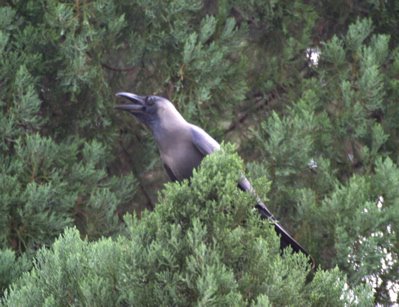
It is a common sight around Singapore to watch House Crows (Corvus splendens) flying after and driving off resident and migratory raptors of any species. I have personally seen Black-shouldered Kite (Elanus caeruleus), Brahminy Kite (Haliastur indus), White-bellied Fish-Eagle (Haliaeetus leucogaster), Oriental Honey-Buzzard (Pernis ptilorhyncus), Changeable Hawk-eagle (Spizaetus cirrhatus) and many other species being mobbed. House Crows do this individually or in a group, within and above their territories. Dr Wu Eu Heng has also reported seeing House Crows mobbing a Changeable Hawk-eagle around Jurong. Other bird species such as Black-naped Oriole (Oriolus chinensis) and Dollarbird (Eurystomus orientalis) also mob raptors in flight.

At many nature areas, particularly wooded areas, you often come across a party of highly agitated birds noisily moving around a tree or bush. Usually, this indicates the presence of a predator. In most cases this would either be an owl or a snake and the birds will both mob and scold in an aggressive manner. Greater Racket-tailed Drongo (Dicrurus paradisus) and Striped Tit-babblers (Macronus gularis) are often involved in such behaviour in the local forests.

Mobbing birds may comprise one or more species. It is a great opportunity to not only observe the irritated flock but to discover an usually illusive predator. I have seen some great snakes and owls in this manner. For example, the first Barred Eagle Owl (Bubo sumatranus) that I encountered in Malaysia was one that was being mobbed by a few bird species, including the Asian Fairy-Bluebird (Irena puella).

I am sure many birders would have encountered instances of mobbing and we would love to read about some of their accounts.

Contributed by R. Subaraj
Additional input by Dr Wu Eu Heng.

Labels:

Saturday, December 03, 2005

Richard's "Owler" - The mobbing of a Spotted Wood-owl

Richard's "Owler" - The mobbing of a Spotted Wood-owl

Years ago when I was living at a house in Swiss Club Road whose garden abutted the then Turf Club's outer car park, there was a pair of Spotted Wood-owls (Strix seloputo) living in some old trees just inside and outside the garden. They were resident for several years until their favorite tree blew down in a storm one day and they apparently moved away. Virtually any morning, if it had rained in the night, I could go down through the gate and find the pair drinking and bathing in a particular puddle. They took little notice of me as long as I remained at a distance. Would that I had been as interested then in photography as I am now, but I wasn't, and so have no pictorial record of this.

On one occasion I heard a lot of noise at the bottom of the garden in mid afternoon and walked down to see what was going on. There on a branch about twenty feet up sat two adult Spotted Wood-owls and two young ones. Some yards away on other branches were four Oriental Magpie-robins (Copsychus saularis) vociferously telling the owls to go away. The owls were taking not the slightest notice of this and ignored me. In due course the Oriental Magpie-robins gave up and peace reigned once more.

Contributed by Richard Hale


Comment by R. Subaraj: Great account! So little is understood about the Spotted Wood-owl that even their bathing in a puddle provides good data. Then you have the breeding record of this uncommon owl. I do not recall any other breeding records from the Swiss Club Road pair. Finally, local confirmation that the Oriental Magpie-Robin, also dislikes and protests the presence of a potential predator within it's territory... from a distance of course.

Labels:

Wednesday, November 23, 2005

Mobbing of a Barn Owl

Mobbing of a Barn Owl

This incident occurred about noon some two to three years ago around an old longan tree (Dimocarpus longan). The tree was planted from seed 37 years ago and at that time the branches had been pruned and new shoots were sprouting, producing 'bobs' of new leaves. It was the favourite of seven to eight House Crows (Corvus splendens) that used it to rest after feeding.

The tree was growing between our house and my uncle's who lived next door. He was gardening below the tree when he noticed a couple of crows circling above and calling loudly. Curious, he looked closely at the tree to find a Barn Owl (Tyto alba) resting on a branch, hidden by the one of the leaves bobs.

He called all of us out to see the owl. Naturally the bird ignored us as it was more concerned with the crows above. As long as my uncle was working below the tree, the crows kept their distance and the owl was left unmolested.

After a while, when my uncle finished his work and got further away from the tree, the crows came nearer to the tree, calling frequently. They did not land but I think their cries were too much for the resting owl. It took off soon after. It has not returned until today.

At present, the tree is no longer being used by crows. We have kept its branches pruned to the maximum and it is not as shady as before.

Contributed by Chew Ping Ting
Image of Barn Owl courtesy of Ashley Ng


This is a typical anti-predator behaviour and owls are popular targets, especially when caught resting during the daytime. Mobbing birds may include songbirds, crows, woodpeckers and those as small as hummingbirds. They make repeated dives as well as loud calls. They may or may not strike the predators. But cases have been known where owls were pecked on the eyes or the feathers. However, the owls are seldom hurt by these attacks and they seem to just ignore the mobbing birds, to eventually move away. It is possible that the mobbing birds know that it is safe to mob owls as these nocturnal birds are unable to attack the constantly moving mobbing birds.

Why birds mob predators? Probably to alert others of the presence of predator birds. Or to educate young birds on the identity of their enemies.

Comment by YC

Labels:

Site Meter Amfibi Directory Singapore Blogger Organisation