Site Meter

Sunday, January 28, 2007

The blog has shifted

The blog has shifted

The Bird Ecology Study Group's blog has shifted to a new location to serve you better.

Please follow this link to access the new blog where new postings are being made.

At the same time we are leaving this blog, including the archives, until further notice.

Sorry for the inconvenience.

Thank you.

Sighting of Sooty-headed Bulbuls

Sighting of Sooty-headed Bulbuls

At about 4.00 pm on 12th December 2006, K.C. Tsang sighted a small flock of the birds at the Punggol grasslands just before the rain. As can be seen in the above image, the birds were caught in the rain, and trying to dry themselves.

Sooty-headed Bulbuls (Pycnonotus aurigasteris) is native to Myanmar, South China and discontinuously through Southeast Asia to Java. The first sighting of this exotic species was reported in the early 1920s. The bird was recorded on and off, albeit rarely, throughout the remaining part of the century. A small feral population appears to have established in Tampines since 2003. Obviously the bird is breeding successfully.

According to our bird specialist R. Subaraj, “Sooty-headed Bulbuls (both gold-vented and red-vented forms) have occurred as escapees for many years now due to their popularity in the bird trade.

“In the 1970s, a feral population established itself and the species was listed on the Singapore checklist but that population apparently died out and the bulbul was subsequently removed from the list.

“There now appears to be a feral population in the Punggol-Serangoon area and a breeding record seems to have been obtained. As a result, it was been reinstated on to the Singapore checklist as a feral species in October.”

Input and image by K.C. Tsang.

Labels:

Saturday, January 27, 2007

Jerdon's Baza: Fourth sighting

Jerdon's Baza: Fourth sighting

“On 1st Jan, New Year Day, I was alone birding at Lim Chu Kang as the usual birding kaki were either overseas or suffering from hang-over from the previous year's indulgence.

“Just before 9.00 am, I caught sight of a raptor perched on a bare branch of an Albizia tree (Paraserianthes falcataria). Through the scope, the white tipped blackish crest was outstanding. I took a few shots but the bird had its back to me and the sun was not really favourable.

“Happy to have sighted the Jerdon Baza (Aviceda jerdoni), I took a loop trail hoping to get in front of it to have a better view but lost it. Shortly before 9.30 am I received a recall msg from home and had to turn back. On the way out, the raptor was back at the same perch. Perhaps another day.

“Viewing the not so sharp ID picture, there were doubts about the obvious shaded eye band of the bird - could it be a juvenile Rufous-bellied Eagle (Hieraaetus kienerii)? The best way was go find it again! “The following morning Jia Sheng was with me at Lim Chu Kang. Moments after arrival, we spotted the raptor but it flew off (mid-canopy flight) in the opposite direction. Happy it was around, we continued with our birding routine hoping it would return. Around 11 am we decided to leave. On the way out, the raptor flew in and landed on a tree just behind me. Out of the tree another raptor flew off. There were two of them! The raptor which flew off landed on the same bare branch as previous but this time there was no eye band but again, its back was facing us. After a few shots it flew off.

“Following the flight, we spotted both raptors in a cluster of Albizia trees. They were behaving like what I've observed of parents and fledged juvenile White-bellied Sea Eagle (Haliaeetus leucogaster). The juvenile raptor was trying to get close to the adult but every time it did, the adult would fly off, though never too far away.

“Later with the help of some experienced birders and sharper pictures taken by Jia Sheng, there was consensus about the raptors as an adult and a sub-adult. However, there was no frontal picture of the adult raptor. Hopefully someone could ID the sub-species.”

Happy Birding,
Danny Lau & Lau Jia Sheng.


This extremely rare passage migrant was spotted around the same area in early December 2006, the third time seen locally (see 1, 2 and 3). The current sighting by Danny Lau and his son Jia Sheng, less than a month later, would make it the fourth.

Our bird specialist, R. Subaraj has this to say: "Actually, the Jerdon's Baza was always considered a sendentary resident until the first one turned up as a roadkill a few years ago. As there are only 4 records (I have only seen 2 photographed records), it is too premature to determine the true status of this species. Thus, we should not say passage migrant as we are unable to confirm this yet. I would consider this bird a scarce visitor for now until we can formulate a better impression with more confirmed records."

Input and images by Danny Lau and his son Jia Sheng.

Labels:

Friday, January 26, 2007

Oriental Pied Hornbill: Courtship at Changi

Oriental Pied Hornbill: Courtship at Changi

“Oriental Pied Hornbills (Anthracoceros albirostris) (above), Tanimbar Corellas (Cacatua goffini) and Red-breasted Parakeets (Psittacula alexandri) making loud squawking and screeching sounds got me to abandon my figging at Turnhouse Road in Changi last week. “The birds all seemed to have a stake in the two Heritage trees (above); the parakeet flew in and then out. Eventually the corellas settled for the smaller cavity in the Gluta malayana while the bigger hornbills claimed the bigger hollow in the Shorea gibbosa tree. “The male hornbill waited outside while his female disappeared into the Shorea cavity (above, left). After a while he flew off and brought back a red fruit, possibly jumbu bol (Syzygium malaccense) which he fed to the female when she peered out from the tree-hole (above, right). It must be quite spacious in there because the male had to dip his head right into the hollow before she reappeared. They flew off after a while. An hour later they were back again for another short visit.

“I'm wondering if these activities in the hollow of the Shorea will harm the tree. Although there are only a few short branches high up there, clumps of fresh young leaves are growing at the ends. The Gluta seems to fare better with more foliage.

“Has the courtship ended? And then will the female be sealed in?”

Angie Ng
27th November 2006

Note: Oriental Pied Hornbills are getting common on mainland Singapore. There is an earlier account on the courtship behaviour of a pair at Changi, seen in October 2006.

Input and images by Angie Ng.

Labels:

Wednesday, January 24, 2007

Retraction of the first record of Long-billed Plover for Singapore

Retraction of the first record of Long-billed Plover for Singapore

On 24th February 1990, Volker Konrad encountered and photographed a plover new to Singapore at Changi. He sent his observation, including a picture, to the Singapore Records Committee set up by the Bird Group of the Nature Society (Singapore). The committee identified the bird as a Long-billed Plover (Charadrius placidus). This was reported in the Singapore Avifauna 11(4) that appeared only seven years later.

Subsequently Konrad published his finding, based on the identification provided, in the Oriental Bird Club’s scientific journal, Forktail (2005).

In the December 2006 issue of the OBC’s bulletin, BirdingASIA, Paul J. Leader, a birder based in Hongkong, successfully challenged the identification of the bird. According to Leader, the bird seen in Singapore way back in 1990 was actually a Kentish Plover (C. alexandrnius), not a Long-billed.

Konrad, the birder who sighted the bird at Changi, has so far retracted his published record and according to Birding ASIA, “…the Singapore Records Committee (Nature Society Singapore) now agrees that this record concerns the Kentish Plover.”

Well and good. A mistake has been rectified. There were no ornithologists in the Singapore Records Committee then, only experienced recreational birders. Even if there were, the best of ornithologists do sometimes make mistakes in identification.

It may therefore be a good idea if in future, to avoid mistakes as much as possible, the photographs of rarities reported are sent for their opinions to leading ornithologists overseas who have long experience of birds in Asia.

According to our bird specialist, R. Subaraj, “To put everything in perspective, regardless of the status of local records, the only confirmed Malaysian record is of one at Tanjong Rhu, Pulau Langkawi, on 19th March 1968 (Wells, 1999).

“This far south, many vagrants occur in heavily moulted, winter or juvenile plumages and this emphasises the value of exercising great caution when considering such records. One must always seek advise from those with greater experience and knowledge of such birds!”

References
Konrad, V. (2005). First record of Long-billed Plover Charadris placidus in Singapore. Forktail 21:181-182.
Leader, P.J. (2006). Comments on the purported first record of Long-billed Plover for Singapore. BirdingASIA 6: 45-47.
Wells, D.R. (1999). The birds of the Thai-Malay Peninsular. Vol. I, Non-passerines. Academic Press, London.

Labels:

Tuesday, January 23, 2007

Romancing ‘Laura’ - the Yellow-vented Bulbul

Romancing ‘Laura’ - the Yellow-vented Bulbul

There are several species of birds in Malaysia that are often seen flying in pairs. Some pair for life, some for several seasons and some just a single season only. The Yellow-vented Bulbul (Pyconontus goiavier) is just about the most frequently seen paired resident species in my area and this particular pair catches my eye for some particular reason (below). They became frequent visitors and nesters in my private garden balcony the last few years that we decided to name them Laurie and Laura. The birds took up residence besides a family of White-rumped Munias (Lonchura striata). Every hanging fern species that thrives in the balcony carries a nesting history. Some of the nests were made over from previous season. Last year, no nesting was observed. While the environment remained peaceful and conducive to raising their brood, Laurie and Laura did not bring in any nesting materials. I began wondering why and soon found out.

Since last September 2006, tinkling sounds, ‘tink.-tink-tink’ were heard coming from the driveway. Initially I passed then off to be a dribbling garden tap with droplets of water hitting a hollow tin can. It continued intermittently during the daytime and for several consecutive days until the sounds got into my nerves’ edge and I simply had to investigate.

A fascinating and entertaining observation of endearing avian showmanship followed. It was Laurie, the male Yellow-vented Bulbul who flew into the driveway and became fascinated with the winged mirror of my parked vehicle (above). He perched and stared so hard onto the shiny chromed mirror as though to say, ‘I wish, I wish… mm… Am I the most handsome guy in town?’ Laurie was not alone. He flew in with Laura but she decided to take to a more discreet and observation perch on the Christmas tree, about 15 feet away. Laurie with his broad and black loral stripe, stared into the mirror and saw another competitor, a look alike and furiously began pecking vigorously at the chromed mirror. He was pecking at a brown feathery bird - his own reflection! Over the period of weeks, Laurie became extremely obsessed with the winged mirror – his competitor. He continued relentlessly to impress Laura and showed off his skills of showmanship by roll flying around the mirror, performing balancing tricks, tap dancing and doing the flamenco, ballet and butterfly stance to just name a few (above). He was working and trying very hard to be the hero. Occasionally, Laurie would pause to await and listen for the approval of ‘Bravo! Bravo!’ coming from Laura’s chirping calls (above). Laurie would courteously give a bow showing his broad striped dark crown and threw a deep side glance at his ‘competitor’ as if to say, ‘Hey! This is my territory and that’s my gal, so clear off! Laurie did not fail to soil the mirror to get the message over and would end his performance by shining his yellow vent at my scope to ensure I did not miss out his bright rear plumage (above).
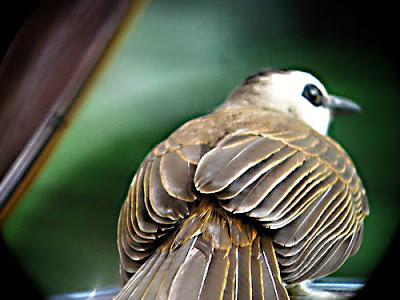
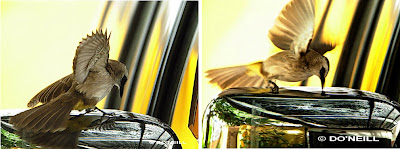
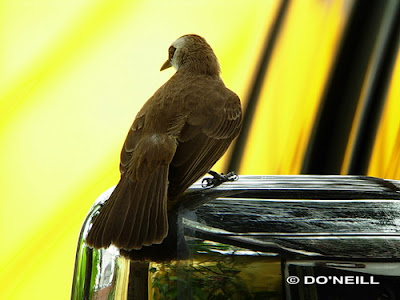
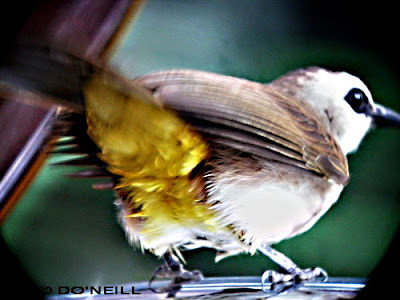
Is this a kind of challenging courtship display or is Laurie a weirdo with an obsession? I wonder if Laura is tired of seeing Laurie’s repeated performances. He was unperturbed by the family’s pet dog who had seen them all and more often than I had witnessed. She would just lie in the garage, her right ear cocked up and eyes rolled to the rhythm of Laurie’s performances just 8 feet away. At times, I could hear her sighed aloud as if to say, ‘Oh, for heaven’s sake not again, bird!’

My camera certainly did not give up that easily but provided additional silhouette shots through my spotting scope to look like an evening performance of a Yellow-vented Bulbul, romancing his beau with a repertoire of courtship tap dancing! I found out these birds disliked my ornamental Chinese bronzed bells with red tassels hung in the balcony garden, beginning of last year. I had them removed recently. Soon enough, they both flew in to prospect a new nesting site.
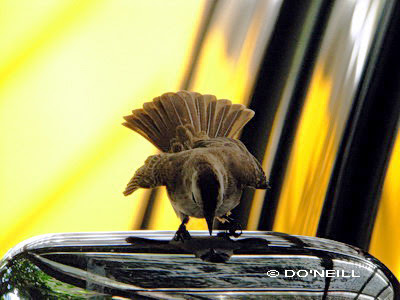
It was ‘Home Sweet Home….’

SUBMITTED BY: DAISY O’NEILL, PENANG, MALAYSIA.
21st January 2007


Check out our earlier postings on how birds react when they see their reflections on a mirror: (1 and 2).

Labels:

Monday, January 22, 2007

Starfruit tree

Starfruit tree

The starfruit tree (Averrhoa carambola) grows wild in Java and possibly in Borneo and the Philippines. However, there are people who believe that it originated from tropical America. Whatever its origin, the tree has been in cultivation for centuries and it has been grown in Singapore for a very long time.

This bushy, 15 metres tall tree is grown for its fruits that may be sweet or sour, depending on the cultivar (left). The tree flowers and fruits regularly throughout the year. The lilac flowers are small and borne in loose bunches (below). The fruit has five deep wings along its length and in cross-section appears star-shaped, thus the common name. It ripens golden yellow.

I have the tree growing in my garden for years now. The ripe fruits have always been attacked by fruit flies, falling on the ground to rot. It was some years ago that I noticed green, unripe fruits littering the ground below, always partley eaten. And then I noticed the visits of the noisy, white Tanimbar Corella (Cacatua goffini), an exotic species (below). These corella prefer the green, unripe fruits to the succulent ripe ones. They are wasteful eaters, pecking out pieces and leaving the many partly eaten fruits to rot below the tree. It would appear that this corella has exploited a food niche that other species of birds have been avoiding. It has similarly taking to eating the green pong pong fruits (Cerbera odollam) that no animals had previously been eating (see 1 and 2). The flowers of the starfruit tree attract ants, bees, moths and others (above), and these insects in turn attract birds. But I have so far failed to see many birds on this tree besides the corella. Except the smallish Common Tailorbird (Orthotomus sutorius) that regularly visits the tree, quietly gleaning for insects. The bird in the photo below is a male in breeding plumage, with long central tail feather and blackish sides to the neck. Now who says exotic plants do not attract wildlife?

If any birders have observed other birds visiting this tree, please leave your input here. Thanks.

Input and images by YC.

Labels:

Sunday, January 21, 2007

Javan Myna

Javan Myna

“It is perhaps by some freak chance that I actually chose to figure out where the incessant kaeeu kaeeu kaeeu sounds were coming from, and that I had the patience to wait quietly, hidden, till the creature appeared. After a minute or so, I noticed some movement on the roof of a nearby house. It was a Javan Myna (Acridotheres javanicus). Soon after, two myna nestlings appeared from the small cavity under the "wavy" roof tile (below). I moved in closer to get a better view, rather conspicuously I might add, and consequently startled the wary adult. It fluttered and stood on the roof, and then took off to a nearby grass patch, its eyes fixed on me. "It was only then I realize what I had discovered - it was a myna's nest! Mynas, like many members of the Starling Family are hole-nesters. While some species may not be obligate hole-nesters, others often take advantage of such cavities, whether man-made or natural. This is reflected in the unmarked, blue eggs laid by Javan Mynas, which indicates the reduced need for camouflage for cavity nesters.

“This was a chance discovery, so I wasn't blessed with the opportunity to clarify incubation periods. Neither would the eggs be openly viewable, in any case. According to the literature, Javan Mynas lay a clutch of 2–5 eggs at a time and incubate for 13–14 days in captivity. It is also probable that Javan Mynas, like many species of Asian sturnids, both sexes participate in incubating, though males contribute for only a portion of the day. This is unconfirmed and almost impossible to determine, as both sexes look identical and the nest is concealed. “Juveniles, unlike the adults, are paler and browner, and has a white iris (as compared to the lemon yellow iris of adults). The bird on the right (above) seems to be older and more active. My personal observation is that there appears to be many more juveniles during these few months. It is thus tempting for me to assume that breeding season is in the later part of the year. Would any ornithologist like to clarify or correct this? “As and after the juveniles fledge, they continue to be fed by the adults (above). Such food, which includes seeds, fruits or insects, is given whole and not regurgitated (at least at this stage). Pleas for food (kaeeu kaeeu kaeeu) are accompanied by the youngster's half-flaps and wing "quivering". This parent totally ignores the youngster.”

Lim Jun Ying
3rd January 2007

Input and images by Lim Jun Ying except bottom image by YC.

Labels:

Friday, January 19, 2007

Antics of the Pied Fantail

Antics of the Pied Fantail

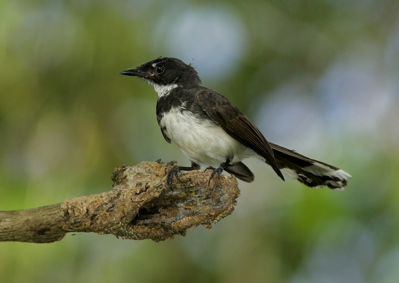
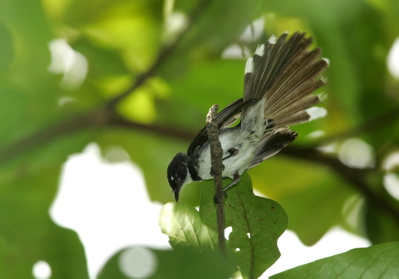
The Pied Fantail (Rhipidura javanica) is a small bird that is never still. The bird is constantly moving around, at the same time turning from side to side in a jerky way, lowering its wings, cocking up its head and constantly fanning its tail - opening and closing. It moves alone or in pairs, disturbing insects among vegetation with its movements and the fanning of the tail, to sally forth once an insect is disturbed from its rest. Sometimes it perches on a branch, but never remaining in one place for long, to hawk for flies and other insects.

Its antics are always amusing to watch. So much so that the Malays call it merbok gila, gila meaning mad. It is also known as murai gila, meaning crazy songbird or thrush. K.C. Tsang wrote: “This bird, according to the books, is supposed to be found in most areas in Singapore, from mangrove swamps, to parks, to gardens etc. In reality I have found it in the Singapore Botanic Gardens and Sg. Buloh Wetland Reserve. Maybe it has been hiding from me in, say, MacRitchie and other reservoirs. Also, I have found that it shares the same kind of food as the Ashy Tailorbird (Orthotomus ruficeps), taking insects from under leaf cover.

“It is an extremely shy bird and rarely do you find it out from under the cover of dense vegetation.” Our bird specialist R. Subaraj replies: “It is primarily a mangrove species but is also found in smaller numbers in various parts of Singapore. They are commonest at places like Sungei Buloh, Pulau Ubin, Pasir Ris mangrove and other natural coastal areas. Inland sites include Singapore Botanic Gardens, Bukit Batok Nature Park and many of the areas that support old abandoned farmland, particularly where there is water.
“Although it is occasionally found on the edge, where old farmland exists, this species does not normally occur within our true forested areas and this includes most of the margins of the reservoirs within the Central Catchment, including MacRitchie.

“On the balance of things here, this is still a common and fairly widespread bird.”

Input by KC and YC; images by Chan Yoke Meng (top two) and Johnny Wee (bottom).

Labels:

Wednesday, January 17, 2007

Changeable Hawk-eagle attacking colugo

Changeable Hawk-eagle attacking colugo


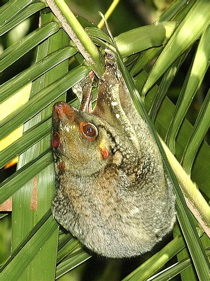
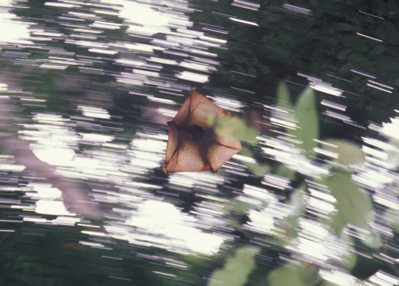
Colugo or flying lemur (Cynocephalus variegates) is a mammal that goes back to ancient times (above). Colugo is a better name as flying lemur can be misleading. Why? True lemurs are primates that are only found in the island of Madagascar. The images below show the Ring-tailed Lemur (Lemur catta), a true lemur, basking in the sun (below, left) and huddling from the cold (below, right).


Colugo is also a mammal but it is neither a lemur nor a primate. It belongs to a separate order of its own, the Dermoptera (Greek derma = skin; ptera = wing). It does not fly but actually glides. This it does with the help of a special membrane that extends from the neck region to the fore feet and the hind feet and thence to the tip of the tail (below). In Singapore, Colugo is found in the Bukit Timah Nature Reserve and the Central Catchment Forest.

Hot from the press is a book on this fascinating animal, written by Norman Lim with Morten Strange as editor (left). The book is published by Draco Publishing and Distribution Pte. Ltd. in conjunction with Raffles Museum of Biodiversity Research, National University of Singapore. It is currently available at the Botanic Gardens Shop, Nature's Niche.

The diet of this animal is mainly leaves, young shoots and flowers of selected plants. During the day it rest high up in the tree, clinging to a tree trunk or hiding in a tree hole. Comes dusk, it becomes active, gliding from tree trunk to tree trunk. The young is carried clinging to the flight membrane.

Cited in the book is a report by Tan Choo Eng; “On Aug 6, 2006, I was at an uncompleted stretch of the new Baling Gerik highway on the Perak section in Peninsular Malaysia together with two other members of the Malaysian Nature Society. We witnessed a Changeable Hawk-eagle (Spizaetus cirrhatus, pale morph) attack a Colugo.

“After the failed attack, the Colugo stayed motionless (11am) on an exposed mid section of a tree trunk for about 40 minutes, even after the threat was gone (11.40am). Then it scampered up the tree trunk and glided into some more leafy trees.”

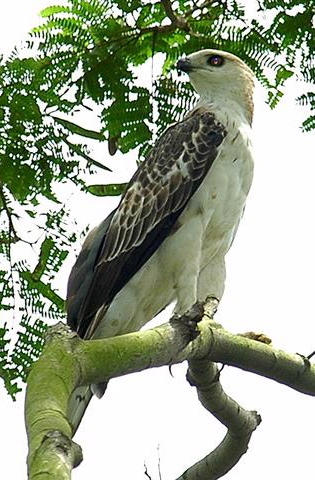
The image on the left is that of a Changeable Hawk-eagle, pale morph.


Images from top, of Colugo clinging on to tree trunk and palm frond by Johnny Wee, Ring-tailed Lemur by YC; Colugo gliding by YC; book cover by Morten Strange; and Changeable Hawk-eagle by Johnny Wee.

Labels:

Tuesday, January 16, 2007

Allobilling

Allobilling

Allan Teo submitted the above two images of a pair of Collared Kingfisher (Todiramphus chloris) coming together and gently grabbing each other's beak.

According to Marzluff & Angell (2005), the mutual mouthing between two birds is known as allobilling. This often escalate into sharp jabs and brief fighting. This is commonly seen in ravens and less common in crows.

The question now is, are the kingfishers allobilling? Unfortunately Allan is not able to provide information on what actually happened before and after the birds started mouthing each other.

Herring Gulls (Larus argentatus) indulge in bill-touching, but this happens when the female is trying to coax the male to regurgitate food. And this is not allobilling. Again, the mutual transfer of food is not allobilling.

So, is the image captured by Chan Yoke Meng of a pair of White-crested Laughingthrush (Garrulax leucolophus) as seen below, allobilling? Maybe. Maybe not. Or are the birds indulging in allopreening? Obviously more observations need to be done on this phenomenon. Birders are urged to make detailed observations when birds touch bills and report back. Only then can we slowly understand this seldom reported phenomenon outside ravens and crows. And I am not sure whether anyone has actually reported this happening with the local crows.

Reference:
Marzluff, J. M. & Angell, T. (2005). In the company of crows and ravens. New Haven & London: Yale University Press. (p166)

Input by YC, images of kingfishers by Allan Teo and laughingthrush by Chan Yoke Meng.

Labels:

Monday, January 15, 2007

Ruddy Kingfisher: A distinguishing feature

Ruddy Kingfisher: A distinguishing feature

The brief appearance of the Ruddy Kingfisher (Halcyon coromanda), an uncommon passage migrant and winter visitor to Singapore, towards the end of October 2006 caused quite a stir among local birders (1, 2). The bright rufous plumage and red bill make identification easy. However, there is another distinguishing feature that most birders miss as it is only seen in flight (above). This is the “back and rump silvery white to azure-blue” patch, according to Wells (1999). In the juvenile bird the patch is “wholly blue rather than silvery.” The image above shows the bird perching on a branch and eying a prey on the ground. Note the bright dark brown iris. In the image above, taken just before the bird dived down to catch a prey, the eye is covered with a translucent layer, the nictitating membrane. This has a protective function as the bird plunges among the vegetation.


The close-up views of the eyes above show the normal eye (left) and covered with the nictitating membrane (right).

Input by Melinda Chan, images by Chan Yoke Meng.

Labels:

Saturday, January 13, 2007

Cat kill: Asian Paradise Flycatcher

Cat kill: Asian Paradise Flycatcher

Domestic cats are excellent hunters, always stalking and in many cases catching garden birds. They may then present the caught bird to their owners, as if to repay them for the care and food. An earlier post details how a cat caught one of a pair of kingfisher. Mynas normally alert other birds whenever a cat is in my garden and we have also been told that cats are a definite no-no in Australia.

There are many cases of cats killing birds but there are just as many cases of the birds being rescued by the owners, to be nursed back to health and then released. This is a case where the bird ultimately found freedom when the owners intervened.
Teo Lee Wei has two cats in her house. Kitty the tortoise-shell cat and Meatball, the cat with the tuxedo suit and white socks (top). Well, in November 2006 Kitty (above) ran up very furtively to her bedroom with a strange bird in its mouth to be followed by Meatball.

Lee Wei’s husband Kais ran after the cats and managed to prise the bird from Kitty's jaw and took it away. The bird was in deep shock but did not appear to have any injuries (above). It was placed in a bird cage and both of them nursed it for a day (below). They then locked up their two cats before setting the bird free, giving it ample time to make a getaway before releasing the cats again. The strange bird was later identified as the Asian Paradise-flycatcher (Terpsiphone paradisi).

Input and images by Teo Lee Wei.

Labels:

Friday, January 12, 2007

Breeding ecology of the Little Tern 6: Addendum

Breeding ecology of the Little Tern 6: Addendum

The breeding ecology of the Little Tern (Sterna albifrons) was posted as a five part series earlier - 1, 2, 3, 4 and 5.

Jonathan Cheah and Ashley Ng were both involved in documenting the series during the entire nesting period of about five weeks. Two photographers were necessary in order to minimise disturbance to the nesting grounds.

The birds feed as a flock, leaving the nests unguarded during this period. It was then that each nest was marked with plastic pickets as otherwise it would be difficult to relocate them. Also, this would prevent accidental trampling of the nests. Even after hatching, there was the constant danger of stepping on the chicks as they remained camouflaged, lying low and still. As far as were possible, defined paths were used, especially when moving down the valleys, to further minimise accidents. A total of about 60 eggs were counted from the various nests, of which about 75% of the chicks that hatched survived. Those that did not survive died within a few hours of hatching. A number of chicks were victims of feral dogs that roamed the area. Some eggs remained unhatched, mostly from clutches of more than two.

Documenting the birds was not easy as the parent birds were constantly dive-bombing the intruders. There was also the loud screeching of the birds as well as the echoes of the cries from above bouncing off from the sand to contend with.

All these distractions were enough to confuse predator and allowed the chicks to get into the shadows or among the vegetation. But obviously not the photographers, who persisted in order to being back the images.

Input and images by Dr Jonathan Cheah Weng Kwong.

Labels:

Thursday, January 11, 2007

Koel, bulbul, myna and noni

Koel, bulbul, myna and noni

On 21st July 2006 at 3.30 pm, as I was entering my garden to do some weeding, I surprised a male Asian Koel (Eudynamys scolopacea) together with a family of Javan Mynas (Acridotheres javanicus) (two adult and a juvenile) that were on the ground below my noni tree (Morinda citrifolia). There were noni fruits on the ground and I suspected that the koel was feasting on a fruit when it was surprised by my sudden appearance. The koel flew to a nearby tree across the road and loitered there, quietly moving about on the branches as well as the boundary wall of the house in front.

Half an hour later the koel returned to the partially eaten noni fruit and continued it’s feasting. It was then that I was sure that it ate the fruit (above). A few minutes later after it had its full, it silently moved away.It was then that a pair of Yellow-vented Bulbuls (Pycnonotus goiavier) came and continued with the feast (above). This was followed by the Javan Mynas after the bulbuls left the scene (below).Later, I found by my gate, a mess of Alexandra palm (Archontophoenix alexandrae) seeds together with bits and pieces of the whitish flesh of the noni fruit (below). The whitish pieces still had the distinctive smell of the noni fruit. The palm seeds were clean of their flesh but traces of red skin were pesent. This mess must have been regurgitated by the koel, as it has been established earlier that this bird regularly regurgitates palm seeds. I did not witness the regurgitation but circumstantial evidence suggested that the koel did it. After all, the only other birds present there then were the bulbul and the myna, both birds have not been reported to regurgitate seeds.

R. Subaraj has this to say: "Though koels do not normally go to ground, it is my believe that most birds do occasionally... especially when there is a good reason. In this case, the noni fruit must have been attractive. Many birds seldom come to ground as there are more dangers there.

"Koels regularly come to feed on the fruits of low roadside palms including Alexandra and MacArthur (Ptychosperma macarthurii)."

Input and images by YC.

Labels:

Wednesday, January 10, 2007

Little Egret fishing

Little Egret fishing

K.C. Tsang was standing on the banks of the Sungei Punggol one morning in November 2006 watching all the Little Egrets (Egretta garzetta) massing along the banks very near to the water’s edge. Suddenly one of them took off, hovered over the surface of the water and within a split second plunged it long bill into the water and grabbed a fish.

He noticed that the birds always had the sun shining from the front of them in the morning, when hovering and fishing. There would thus be no shadow cast to alert the fish.

And K.C. added, “I though that these fellows feed mostly on insects among the grass. This has been observed most of the time. This is something new to me. Maybe a person with a video cam would be able to capture the whole episode.”

Our bird specialist R. Subaraj has this to say: “Little Egrets mainly feed by walking along the water's edge or in the shallows, catching fish by stabbing at them with it's long bill. The flying over the surface technique that you describe is therefore interesting and obviously an adaptation to take advantage of a situation. “The egrets feeding on grasshoppers in the fields around Singapore are usually Cattle Egrets (Bubulcus ibis) (above). This is their natural behaviour. Intermediate (Mesophoyx intermedia) and Little will also do that from time to time... but it is not their normal way of feeding.”

Input by K.C. Tsang; image of Little Egret by KC and Cattle Egret by John Lynn.

Labels:

Tuesday, January 09, 2007

Large-tailed Nightjar mating

Large-tailed Nightjar mating

Meng and Melinda Chan were out on the evening of 19th November 2006 hoping to take some romantic sunset scenes when they happened to witness a scene that few birders are privileged to see.

Just after dusk they heard the nightjars calling away. Then suddenly they saw one bird flying from a low perch towards the ground, to disappear in the undergrowth. Meng went forward to take a closer look. The nightjars were mating, with one mounting the other and then both wobbled away.

By the time he got his camera and flash ready, the nightjars had already finished their business. He only managed to get images of both birds quietly sitting side by side – after the event of course (above).

So it dawned on them that nightjars mate during the night.

I suppose they do mate during the night. As well as do everything else. After all, they are nocturnal birds.

As with all or most nocturnal birds, the breeding behaviour of nightjars remain little known. From whatever that have been reported, we know that these birds indulge in aerial courtship displays involving showing off their various white markings on the wings, making wing clapping sounds and sometimes even vocalisation. Copulation often follows a successful display. Our bird specialist R. Subaraj helped identify the birds in the images and reports: “Yes, they are Large-tailed Nightjars (Caprimulgus macrurus). I would say that the one on the right is a male (large white throat patch) but the one on the left is a bit more challenging... probably an adult female, based on the large but buffy throat patch. Other features, such as the size of the wing patch and the amount of white in the outer tail feathers, are not visible here."

Input and images by Meng and Melinda Chan.

Labels:

Monday, January 08, 2007

Juvenile birds begging for food

Juvenile birds begging for food

Nestlings are continuously fed by the parent birds as they are unable to fend for themselves. They can be seen bills agape, excitedly making soft calls whenever their parents arrive. These nestlings start to beg for food whenever their parents are around, either hearing the latter’s calls or actually seeing the parent birds around the nest. Vibrations as a result of the parent birds landing nearby will also trigger begging. In cavity nesting birds, the darkening of the nest as the parent bird enters the cavity triggers begging. Among some swifts air currents as a result of the adults’ arrival will do the trick.

Among recently fledged birds, the parents continue to feed them for some time before the former are independent enough to forage for themselves. During this period, the juveniles will persistently and noisily beg for food. At the same time they will crouch open-billed and flutter their wings while begging. This behaviour is said provide visual and acoustic cues to the parent birds that stimulate feeding.

Such begging posture and begging call are more or less the same in most species of birds. This has led to the adult birds sometimes feeding the wrong species, be it birds or other animals. In fact there is a picture of a Northern Cardinal feeding goldfish for a few days at the edge of a garden pond (p. 8.107, Winkler, 2004). The bird was seen stuffing mouthfuls of worms into the gaping mouths of the goldfish, obviously mistaking the gaping mouths for those of its nestlings.Reference
Winkler, D.W. (2004). Nests, eggs, and young: Breeding biology of birds. In: Podulka, S., Rohrbaugh, R.W. Jr & Bonney, R. (eds.) Handbook of bird biology. Ithaca, New York: Cornell Lab of Ornithology, p 8.1-152.

Credit for images from top: Yellow-vented Bulbul (Pycnonotus goiavier) nestling (YC), Pacific Swallow (Hirundo tahitica) fledgling (Chan Yoke Meng), Oriental Magpie-robin (Copsychus saularis) fledgling and parent (YC) and Asian Koel (Eudynamys scolopacea ) fledgling (YC).

Labels:

Saturday, January 06, 2007

Harassment of Black-shouldered Kites

Harassment of Black-shouldered Kites

The House Crow (Corvus splendens) is a rather aggressive bird (above). At slightly more than 40 cm from the tip of the bill to the end of the tail, this bird is up to 30% larger than the Black-shouldered Kite (Elanus caeruleus). The crow moves in small flocks whereas the kite is usually found singly or in pairs during nesting periods. Only outside the breeding season does the kite feeds and roosts communally. Thus in any confrontation between these two birds, the kite invariably ends up the loser. This is especially so during nesting when the kite is vulnerable to attacks by crows.

Allan Teo is one photographer-birder who has noticed the aggressiveness of the crows. In November 2006 he wrote in saying: “I observed many times that the poor Black-shouldered Kite is always getting harassed by House Crows and many raptors.“ Allan observed a single House Crow harassing the three juvenile kites (above). When one of the kites flew above and hovered around the crow, baring its talons in the process, the latter simply ignored it. Allan also witnessed adult kites being harassed, possibly by Changable Hawk Eagle (Spizaetus cirrhatus) - that may well be juvenile Brahminy Kite (Haliastur indus) (above). Thankfully the attack was only a mock one that concluded with only nerves ruffled. There was another case of these kites being harassed by marsh harriers. He has also seen images of the Steppe Eagles (Aquila nipalensis) that appeared some months ago around the Changi reclaimed areas attacking the nest of the Black-shouldered Kites. In this case the kites managed to chase off the eagles.

Tang Hung Bun reported seeing House Crows harassing White-bellied Sea Eagles (Haliaeetus leucogaster) in Malacca in March 2006. He managed to capture the action on video with the sea eagles rolling their bodies in flight and occasionally managing to turn the table on the crows, chasing them off in the process (1 and 2).

Input by Allan Teo and Tang Hung Bun. Images by Allan except House Crow by Tang.

Labels:

Friday, January 05, 2007

Breeding ecology of the Little Tern 5: Evasive tactics

Breeding ecology of the Little Tern 5: Evasive tactics

The various aspects of the breeding ecology of the Little Tern (Sterna albifrons) have already been posted earlier - 1, 2, 3 and 4. This, the fifth part, deals with the chicks' evasive tacticts in trying to stay undetected. From day two onwards, the chicks are actually mobile. However, they choose to stay on the nest mound for longer periods for feeding (above). Within hours they can move down the corners of the mound to the valleys or even hide among the vegetation (above). This is especially dangerous as photographers have earlier learnt to avoid the tops of mounds. Hence during hatching time, the valleys and vegetation need to be checked with much caution. When chicks spot predators, they usually disappear into the shadows whilst the adults call overhead and perform dive bombing. This allows the chicks time to move to cover and remain motionless. They are rather clumsy at times. As they grow larger, they will continue to use vegetation as cover (below). Parents get into dive bombing mode with shreaks and calls to drive predators like dogs and other birds away from the vicinity of the hiding chick (bottom left). The chick only opens its mouth for food and stay still. The rest of the adults wll sound the alarm for all the rest of the hiding chicks to remain motionless.
Once the threat is gone, the chick will slowly turn its head to locate the next hiding place. It will check two to three times to ensure that there is no more threat before making a quick dash for the next cover. When it senses that predators are approaching, it will remain stationary irregardless of whether it has reached a safe location or not (above). The aerial distractions are the main source of challenge that makes detection of the chicks hard.

Input and images by Dr Jonathan Cheah Weng Kwong.

Labels:

Thursday, January 04, 2007

Alexandra palm

Alexandra palm


The Alexandra palm (Archontophoenix alexandrae) is named in honour of Princess Alexandra of Denmark, who later became the Queen of England when her husband ascended the throne as Edward VII. The generic name comes from the Greek words archon and phoenix, meaning majestic and date palm. The palm is indeed majestic, with a slender upright stem ringed with the scars of the old fronds and topped with a crown of elegant fronds (above). This palm, considered one of the most graceful in cultivation, originated from the rainforest of Eastern Australia. It was introduced during the early 20th century and is now commonly grown in many urban gardens and along roadsides. It bears large bunches of red fruits throughout the year, attracting small flocks of Asian Glossy Starling (Aplonis panayensis) that descend on the fruiting branches (above). The fruit has a large seed and a thin covering of pulp, as shown in the cross-section above. The starlings are attractive in their all black plumage that appears glossy blackish-green or even slightly bluish-tinged under certain light conditions and of course their bright red eyes. The juveniles are less attractive (above). These birds swallow the fruits whole to later regurgitate the seeds. Asian Koel (Eudynamys scolopacea) (female, above) similarly eat the fruits, arriving stealthily to also swallow and regurgitate the seeds. Javan Myna (Acridotheres javanicus) and Yellow-vented Bulbul (Pycnonotus goiavier) can also be seen, feeding singly or in pairs and pecking on the fruits (above). The stunningly beautiful but extremely shy Black-naped Oriole (Oriolus chinensis) has also been seen around (above). And just recently three noisy Hill Mynas (Gracula religiosa) suddenly arrived to feast on the fruits. I have also observed Straw-headed Bulbul (Pycnontus zeylanicus) on the palm.

Input and images by YC.

Labels:

Wednesday, January 03, 2007

Dealing with bird poachers ‘my little way’

Dealing with bird poachers ‘my little way’

This is a short account of some of my personal experiences with bird trappers and how I dealt with them in exchange for freedom of the birds caught and perhaps saved some poachers from falling foul of the law.

1. When to approach a poacher/trapper and when not to do so:
Each situation is unique. Usually a poacher or trapper is a male and if he is found in a somewhat deserted environment or he looks a rough, tough sort of guy and I happened to be birding alone, I would avoid eye contact and make for a quick exit as though he wasn’t there. I would be hiding in some bush or undercover and looked to photograph his identification. Such as, his mode of transport, his face profile, in the act of setting up traps or with the poached bird.


Photography is great as it shows the official time and date the image is taken. Confrontation with a poacher or trapper that compromises my safety is the last I want to be embroiled in.

2. My identification and who I represent:

When I bird alone, which I prefer to do a lot, I would usually adorn a prominent identification tag that shows my name and the society I belong to. This is so especially when I visit the villagers for it gives them the assurance that I, as a lady birder, am there to watch and study birds only and come with good intentions. The villagers usually reciprocated well with a warm welcome.

This identification tag no doubt small, says it all with no further explanation needed to justify oneself. It is also effective to ward off the guilty conscience, ill intended ones who fear to confront me at the sight of the tag, regardless of whether the poacher or trapper can read or not.

I make a point to wear the tag with confidence and uphold myself to be a good representation of who I belong – no different a feeling from school days when one puts on a Prefect’s badge, wears a Prefect tie and adorns a School Prefect’s blazer and lead by good examples.

This method saved two juvenile water birds from the cooking pot that I found in fishing net of a tractor driver, ploughing the fields. He saw a lady approaching him with a scope, binoculars and an identification tag round her neck. A friendly discussion issued. I took some opportunity identification shots. He meekly surrendered the Watercock (Gallicrex cinerea) (above) and Slaty Breasted Rail (Gallirallus striatus) (bleow) and we gave the birds freedom.
3. Advise with visual aid - Copy of Wildlife Protection Laws:
Approaching any trapper or poacher is always done at own risk and I make a point to weigh it well that I am confident to approach the trapper in a friendly way and able to win him over with friendly advice for his sake. The use of a Copy of the Wildlife Protection Laws by flipping the pages, standing beside him to make sure he sees all those listed protected birds (above). Big words, penalty and jail sentences that confronts him is enough to shrink his pupils.

The result is promising with young trappers who on one occasion thanked me for briefing him and left never to be seen again. (A Copy of the Wildlife Protection Laws can be had in any state library of Malaysia for a small photostatting fee).

4. Report to relevant authorities with proof of photographs:
Photographing trappers and poachers are best done discreetly without their knowledge as the fear of them being reported to, drive poachers’ nuts and they will not hesitate to become verbally and physically abusive to defend themselves. (Their strategy of attack is best form of defence).

Having obtained all the evidence I required, the Branch Chairman of my Society is informed and all information required with photographs are posted to him to make a quick report to the Forestry Department.

The recent prompt action by Enforcement Officers in the Forestry Department to remove mist nettings found in the vicinity of the rare vagrant visitor, Common Hoopoe (Upupa epops) in Penang State is an example of good and effective co-ordination from prompt reporting, action and follow through.

It is a good feeling to know, the Common Hoopoe is saved from potentially flying into the net (below). The rare bird was seen again after the mist nettings were removed- two days after my reporting.

As I mentioned, it is only a personal account of what I do in small ways to save birds single-handedly. Others may do better in their different ways - their way. Some may say, I try to police others or impose others to think my way or whatever code of birding conduct I may drum up and call them ethics to dictate to others.

Say what they will, I am only answerable to the call of birds that continue to reward me with numerous rare sightings and fellow birders who truly love, respect and care for the avian of the wild have all my due respect.

SUBMITTED BY DAISY O’NEILL, PENANG, MALAYSIA,

Labels: