Site Meter

Monday, January 22, 2007

Starfruit tree

Starfruit tree

The starfruit tree (Averrhoa carambola) grows wild in Java and possibly in Borneo and the Philippines. However, there are people who believe that it originated from tropical America. Whatever its origin, the tree has been in cultivation for centuries and it has been grown in Singapore for a very long time.

This bushy, 15 metres tall tree is grown for its fruits that may be sweet or sour, depending on the cultivar (left). The tree flowers and fruits regularly throughout the year. The lilac flowers are small and borne in loose bunches (below). The fruit has five deep wings along its length and in cross-section appears star-shaped, thus the common name. It ripens golden yellow.

I have the tree growing in my garden for years now. The ripe fruits have always been attacked by fruit flies, falling on the ground to rot. It was some years ago that I noticed green, unripe fruits littering the ground below, always partley eaten. And then I noticed the visits of the noisy, white Tanimbar Corella (Cacatua goffini), an exotic species (below). These corella prefer the green, unripe fruits to the succulent ripe ones. They are wasteful eaters, pecking out pieces and leaving the many partly eaten fruits to rot below the tree. It would appear that this corella has exploited a food niche that other species of birds have been avoiding. It has similarly taking to eating the green pong pong fruits (Cerbera odollam) that no animals had previously been eating (see 1 and 2). The flowers of the starfruit tree attract ants, bees, moths and others (above), and these insects in turn attract birds. But I have so far failed to see many birds on this tree besides the corella. Except the smallish Common Tailorbird (Orthotomus sutorius) that regularly visits the tree, quietly gleaning for insects. The bird in the photo below is a male in breeding plumage, with long central tail feather and blackish sides to the neck. Now who says exotic plants do not attract wildlife?

If any birders have observed other birds visiting this tree, please leave your input here. Thanks.

Input and images by YC.

Labels:

Thursday, January 04, 2007

Alexandra palm

Alexandra palm


The Alexandra palm (Archontophoenix alexandrae) is named in honour of Princess Alexandra of Denmark, who later became the Queen of England when her husband ascended the throne as Edward VII. The generic name comes from the Greek words archon and phoenix, meaning majestic and date palm. The palm is indeed majestic, with a slender upright stem ringed with the scars of the old fronds and topped with a crown of elegant fronds (above). This palm, considered one of the most graceful in cultivation, originated from the rainforest of Eastern Australia. It was introduced during the early 20th century and is now commonly grown in many urban gardens and along roadsides. It bears large bunches of red fruits throughout the year, attracting small flocks of Asian Glossy Starling (Aplonis panayensis) that descend on the fruiting branches (above). The fruit has a large seed and a thin covering of pulp, as shown in the cross-section above. The starlings are attractive in their all black plumage that appears glossy blackish-green or even slightly bluish-tinged under certain light conditions and of course their bright red eyes. The juveniles are less attractive (above). These birds swallow the fruits whole to later regurgitate the seeds. Asian Koel (Eudynamys scolopacea) (female, above) similarly eat the fruits, arriving stealthily to also swallow and regurgitate the seeds. Javan Myna (Acridotheres javanicus) and Yellow-vented Bulbul (Pycnonotus goiavier) can also be seen, feeding singly or in pairs and pecking on the fruits (above). The stunningly beautiful but extremely shy Black-naped Oriole (Oriolus chinensis) has also been seen around (above). And just recently three noisy Hill Mynas (Gracula religiosa) suddenly arrived to feast on the fruits. I have also observed Straw-headed Bulbul (Pycnontus zeylanicus) on the palm.
Input and images by YC.

Labels:

Saturday, December 16, 2006

The fig tree at Upper Seletar: Addendum

The fig tree at Upper Seletar: Addendum

Meng and Melinda Chan reported fondly on the Benjamin fig (Ficus benjamina) at Upper Seletar that eventually fell and was chopped down (left).

The tree was the focus point of many birds as well as long tailed macaques (Macaca fascicularis) whenever it figged. As it was sited in a less accessible site, unlike that at Bukit Timah (1, 2 and 3), it attracted few birders and thus was less known.

The posting attracted the attention of Prof Vilma D’Rozario, a Nature Society stalwart and Chairman of its Education Group, who wrote: “I remember this tree fondly and will miss it. My family and I, and Angie, stationed ourselves just by the tree in May when we were doing our Vesak Day duty of watching out for illegal animal release. We saw monkeys feasting on the figs of this tree - beautiful. But yes, it was hanging precariously over the water. I think Angie took a photo of me and my family, if I am not mistaken... did you Angie?” Well, Angie Ng did take the pictures and kindly sent them to me, one of which is shown above. Vilma is in the centre, posing with her sister-in-law Adrianne, and niece Jillian (12) and nephew Andrew (7) - all members of the Nature Society (Singapore). The photograph was taken on Vesak Day this year at Upper Seletar. The group had chosen to 'guard' the water by the tree as this was a favourite release ground! And sure enough, they stopped three men from releasing four turtles and a family of four from releasing two baby red-eared sliders into the reservoir at that spot.

This clearly shows that there are nature lovers who are aware of this particular fig tree and are missing it now that it is there no more. As Vilma adds, "To me, the loss of this lovely fig tree is very sad indeed. I have on many occasions sat right by it, and enjoyed the vista before me. On Vesak Day this year, it was figging and there were macaques feeding on the figs."
Any more people with fond memories of this tree shown above?

Input by Prof Vilma D'Rozario, images by Meng and Melinda Chan (top and bottom) and Angie Ng (centre).

Labels:

Thursday, December 07, 2006

The fig tree at Upper Seletar

The fig tree at Upper Seletar

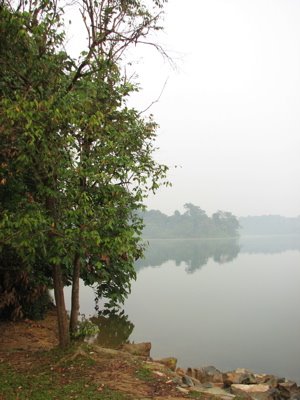
There was once an impressive fig tree growing by the water’s edge at Upper Seletar Reservoir (above). It was a Benjamin fig (Ficus benjamina), also known as waringin. It used to fig regularly but as far as I know, there was no pilgrimage by enthusiastic birdwatchers – as with the fig tree at Buklit Timah (1, 2 and 3).

Whenever the tree figged, there were the regular long tailed macaques (Macaca fascicularis) and there were birds but they did not come in droves that were seen at Bukit Timah. And I am sure if a birdwatcher was to keep count, the number of species visiting the tree would be very much lower than at the tree in Bukit Timah.

Now why is this so? The tree at the summit of Bukit Timah is at the highest point in Singapore. It is visible to all the birds that fly around the vicinity. Obviously, when the tree figs, it will attract hundreds of birds from all around the area. And when these birds land to feast on the figs, the noise generated will in turn attract other birds.

On the other hand the tree by the edge of the reservoir at Upper Seletar is not at a vantage point. It was clearly visible only from the reservoir end. It definitely did not enjoy the excellent position of the Bukit Timah tree.

But this does not mean that bird species was low. What it means is that there were not many birdwatchers observing the tree at the right time. According to Meng and Melinda Chan who were there on the 7th October 2006 and who provided the images, the tree subsequently collapsed and has now been chopped down (left). Melinda has the last word: “Such a majestic tree overlooking the water… The last figging brought a lot of monkeys feeding. For once, it was fun watching them feeding on fruits growing on the tree, not handouts from people in cars.

“The birds were frightened away by the monkeys. Only saw the Yellow-vented Bulbul (Pycnonotus goiavier), Asian Glossy Starling (Aplonis panayensis) and Javan Myna (Acridotheres javanicus) feeding on the figs. And yes, the Yellow-rumped Flycatcher (Ficedula zanthopygia) was there, but not for the figs.”

Input by YC and Melinda, images by Meng and Melinda Chan.

Labels:

Tuesday, October 10, 2006

The fig tree at Bukit Timah: 3. Suggestions for next year

The fig tree at Bukit Timah: 3. Suggestions for next year

Part 1 of the account on the fig tree at the summit of Bukit Timah lists the 29 species of birds that were documented in and around the vicinity of the Benjamin fig (Ficus benjamina) during its short figging period. The list was compiled by birder Yong Ding Li. In Part 2, our bird specialist R. Subaraj made a detailed analysis of the list as well as adding to the species of birds. In this final part, suggestions are made on what birders can do when the tree bears fig next year. For the 2007 figging, I would suggest that local birders move on to a higher level of birdwatching. The many old (in terms of experience as well as age) birdwatchers should begin to study the behaviour of these different birds that are attracted to the figging tree. Like when (in terms of time of day and days of the week) these birds visit and whether they all arrive at the same time or at different times? Do these species interact in a friendly manner or aggressively towards one another? Do the different species feast at different areas of the tree (peripheral of the crown, crown interior, branches, etc)? For a specific location of the tree, is there a pecking order of feasting? In fact there are so many aspects of bird behaviour that can be observed during this short span of less than two weeks the tree will be figging. If different birdwatchers report back on different periods of the day or days of the week, someone can then compile the information. This will help us have a better understanding of bird behaviour when the tree at Bukit Timah produces its next bountiful yield of figs.

Understandably, some of the older and more experienced birders have seen these birds already and may not be interested in spending time at the tree. Never mind. But the newer and younger (and dare I say, more energetic and enthusiastic) birdwatchers should lead the way to the next level of birdwatching in Singapore.

After nearly half a century of birdwatching in Singapore, it is about time we take the challenge to understand the birds that we see everyday, not just keep on listing them.

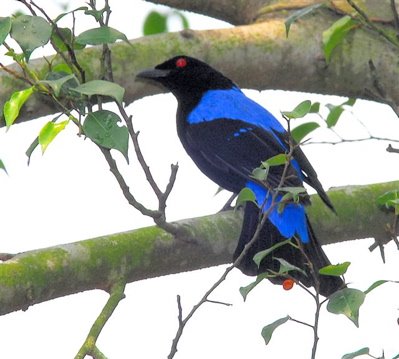
Input by YC, image of Tiger Shrike (Lanius tigrinus) eating insect (top) by Chan Yoke Meng and Asian Fairy Bluebird (Irena puella) (bottom) by Johnny Wee.

Labels:

Wednesday, October 04, 2006

The fig tree at Bukit Timah: 1. Efforts at documentation

The fig tree at Bukit Timah: 1. Efforts at documentation

A figging fig tree is heard long before it is actually seen. This is exactly the situation with the old fig tree growing at the summit of Bukit Timah. This Benjamin fig or waringin (Ficus benjamina) figs rather irregularly. But each time it figs, the tree attracts numerous birds, in terms of number of birds as well as number of species. At such times the tree generates great excitement among local birders. They all flock to it to watch the birds having a feast, to record the number of species that are attracted to the tree and to make a count of each species.

This has been going on for years and generations of birdwatchers continue to get excited by the event. With so many species of birds congregating in one tree, trampling around the countryside to see the different species becomes unnecessary. And each time the tree figs, one or a few enthusiastic birders will make available a list of species that visit the tree.
This year's figging happened during the last week of September and lasted for less that two weeks. The tree is once again silent. This time Yong Ding Li, an enthusiastic new-generation birder who provided the list, enthused: “The famous fig tree at the summit, known to be of sacred importance to many birdwatchers 'fruited' the last three days and activity is still on with massive clumps of orange red figs. The bulbuls and bluebirds are actively making their gastronomic pilgrimage there, and so should we! (avian pilgrimage I mean).”

Ding Li's list of the birds and their numbers (in and around the vicinity of the tree), recorded on 25th September: Oriental Honey Buzzard 1; Japanese Sparrowhawk 2; Great Hornbill 1; Rhinoceros Hornbill 1; Thick-billed Green-Pigeon 2; Himalayan Swiftlet 5-7; Edible-nest Swiftlet type 20-30; Asian Fairy Bluebird 15; Lesser Green Leafbird 2; Greater Green Leafbird 2; Blue-winged Leafbird 5; Red-eyed Bulbul 12; Cream-vented Bulbul 6; Olive-winged Bulbul 8; Black-crested Bulbul 2; Asian Paradise Flycatcher 2; Yellow-rumped Flycatcher 3; Arctic Warbler 4; Eastern Crowned Warbler 18; Hill Myna 10; Tiger Shrike 1; Chestnut-bellied Malkoha 2; Dark-necked Tailorbird 2; Crimson Sunbird 1; Scarlet-backed Flowerpecker 2; Orange-bellied Flowerpecker 3; Greater Racket-tailed Drongo 2; Large-billed Crow 2; and Blue-throated Bee-eater 2.

This is an impressive list of 29 species of birds that joined in the fig feast or were around the area. I am sure birdwatchers are appreciative of his efforts.

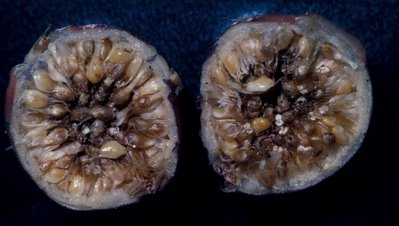
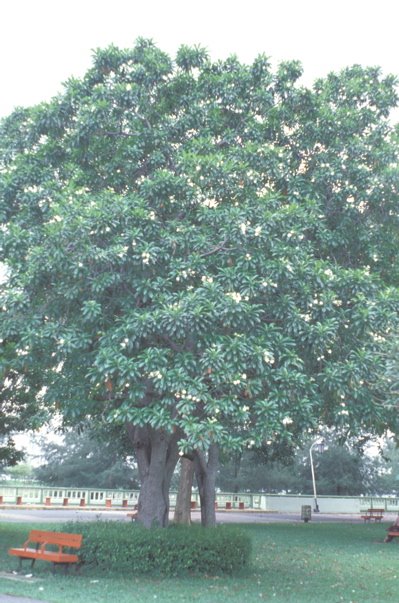
Thank you, Ding Li for compiling the list. Image of the tree (top) and longi-section of a ripe fig (bottom) by YC.

Labels:

Sunday, September 10, 2006

Pong pong tree

Pong pong tree

The pong pong (Cerbera odollam) is a medium sized tree that was once commonly planted along roads in Singapore. Its popularity then was because there was a plentiful supply of large fruits that collected on the ground below. These were collected and easily germinated to be used as wayside trees. With the maturity of the garden city and availability of a more varied selection of tree species, pong pong became less of a favourite. Its general shape is not all that attractive. Besides, the large, round fruits that litter the ground below became quite of a nuisance. However, there are still many areas where such matured trees can still be seen.

The tree has been called Singapore apple because of the large, round fruits. The green outer covering of the fruit encloses a thin pulp and a thick fibrous stone containing a single seed. This seed is reportedly poisonous, containing the poisonous substances cerebin and odollin. It has been used locally to poison rats.

For a long time now no animals have been observed to eat the fruits, or at least the outer pulp. Being a coastal tree, the fruits are adapted for water dispersal, not animal dispersal.
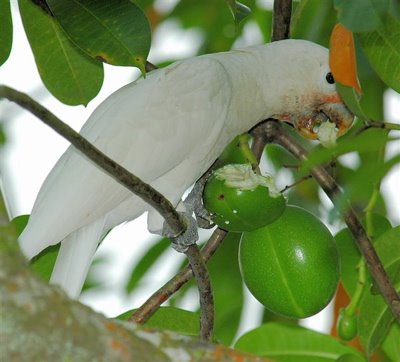
However, birders have recently observed seeing Tanimbar Corella (Cacatua goffini) feasting on these fruits. Johnny Wee sent an image of this bird eating through the outer part of a green fruit, apparently chewing through the tough fibrous layer covering the seed. The bird is seen perched on a branch with its right leg tightly clutching it while its left leg clutches the green fruit.

At Eng Neo area, certain mornings the pong pong trees will be swarmed with these corellas as they noisily fly from branch to branch and tree to tree, pecking on the fruits. Typically wasteful eaters, these birds end up littering the ground below with the partially eaten fruits.

According to our bird specialist R. Subaraj: “Tanimbar Cockatoo (now known as Tanimbar Corella) was first seen around 1970s when it was misidentified as Little Corella (Cacatua pastinator) from Australia. A visiting Aussie birder in the mid-1980s said it weren't theirs and that finally lead to the accurate confirmation of the species.”

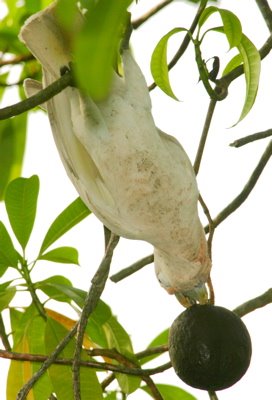
This is an introduced bird, now getting more common. It has obviously found a feeding niche that no other birds have occupied before. Besides feeding on pong pong fruits, it also goes for green starfruits (Averrhoa carambola) and fruits of sea almond (Terminalia catappa), fruits not popular with other species of birds.


Images by YC except second from top by Johnny Wee and bottom by Chan Yoke Meng.

Labels:

Sunday, June 04, 2006

Crimson Sunbirds and the noni tree

Crimson Sunbirds and the noni tree

The male Crimson Sunbirds (Aethopyga siparaja) are fascinating to watch as they flit from branch to branch or leaf to leaf in my noni or mengkudu (Morinda cirtifolia) tree. They announce their presence by their high-pitch ‘cheet-cheet-cheet’ and grab your attention by their bright crimson head and metallic blue forehead.

Some days they visit the tree mornings and evenings. Other days they also come during the afternoons. Mostly, they come to drink the nectar from the many white flowers.

However, during a slight drizzle or just after the rain, these birds visit for another purpose. The leaves are then covered with droplets of water and the birds come and dance around, rubbing their bodies against them in play. The large leaves apparently see to it that the birds do not get drenched as they provide some protection from the rain.

Just as suddenly as they appear, these birds suddenly disappear, with their feathers covered with droplets of water.

These Crimson Sunbirds regularly eat the fruits of the mistletoe Dendrophthoe pentandra that grow on the branches of the nearby mempat trees. These birds must have left some seeds in the noni tree when foraging for nectar. An old detached leaf was found on the ground with a mistletoe seedling growing from the stalk. Obviously this was a wrong location for leaves do not remain long on the tree.

Our young naturalist Serin Subaraj wrote about sunbirds bathing on leaves covered with water droplets after each watering in the garden. Well, these Crimson Sunbirds similarly are attracted to the noni tree whenever my volunteer gardener Eileen, waters the foliage instead of the ground below.

Text and images by YC.

Labels:

Tuesday, April 11, 2006

The mempat tree

The mempat tree

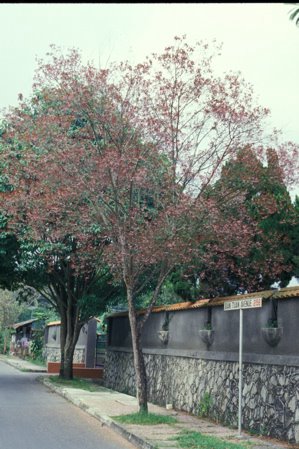
There is nothing like a mempat tree (Cratoxylum formosum) with its crown covered with new reddish pink growth and pale pink flowers to brighten a road. The tree fronting my house was leafless for about a week before it turned into an attractive tree just before Christmas last year. These trees do not shed their leaves together as each has its own schedule. A tree first sheds its leaves and remains leafless for days before the colourful new leaves slowly emerge together with the flowers. I have always admired the tree at this very stage. As the leaves expand in size they turn green and at the same time the flowers develop into fruits.

There are a few semi-parasitic plants growing on its branches. These round-fruited mistletoes (Macrosolen cochinchinensis) are easily seen when the tree is leafless but with the leaves growing back, they can still be discerned if you look hard enough.

The crown of the tree is a hive of activities, the various fauna being attracted by the fruits of the mistletoe plants and the nectar-filled flowers of mempat.

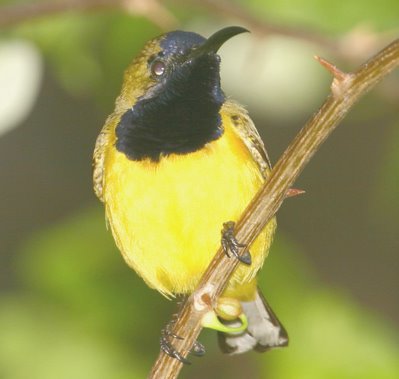
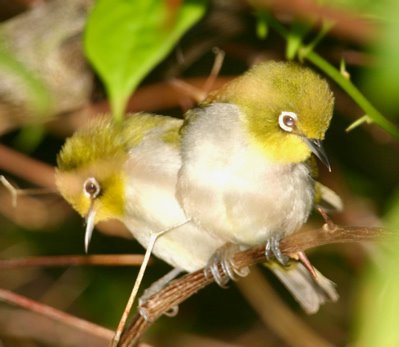
The flowers of mempat as well as those of the mistletoes attract bees, butterflies and of course birds. Various sunbirds find the flowers of irresistible because of the nectar they exude. These include Crimson (Aethopyga siparaja), Olive-backed (Nectarinia jugularis) and Brown-throated (Anthreptes malacensis) Sunbirds. The Oriental White-eye (Zosterops palpebrosus) visit for the mistletoe fruits, the mempat nectar as well as the flowers.

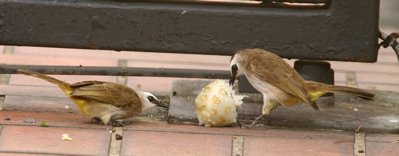
The tree is also popular with Yellow-vented Bulbuls (Pycnonotus goiavier) that visit for the insects that are attracted to the flowers. These birds also eat the mempat flowers, probably for the nectar they contain. They are also attracted to the tree because of the mistletoe fruits.

Input and images by YC.

Labels:

Saturday, April 01, 2006

The beautiful bottlebrush trees

The beautiful bottlebrush trees

Bottlebrushes (Callistemon spp.) are endemic to Australia where there are about 25 species. These shrubs to small trees are popularly grown as garden ornamentals for their attractive flowering bunches that look like bottle brushes. These ‘brushes’ are made up of numerous small flowers conspicuous in their long stamens, each tipped with a golden anther. The botanical name, Callistemon, comes from the Greek word kallistos (most beautiful) and stemon (stamens).

A few species of bottlebrushs have been introduced into Singapore, grown in gardens and as wayside plants. These are all with red flowers. C. citrinus or common bottlebrush has upright branches while C. viminalis or weeping bottlebrush has branches that cascade down. Both have red flowers found at the tips of branches. There are other species with yellow and green flowers. The narrow leaves of these plants contain a fragrant aromatic oil that can be detected if they are crushed between the fingers.

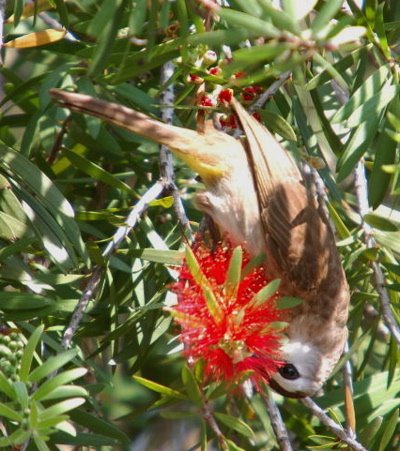
Bottlebrushes are excellent bird plants. Their flowers secrete copious nectar that attract sunbirds, mynas and Yellow-vented Bulbuls (Pycnonotus goiavier).
The leaves are a favourite food of the caterpillars of an unidentified butterfly or moth that in turn serve to attract birds to these trees. However, unlike sunbirds, mynas and bulbuls, the Common Ioras (Aegithina tiphia) are attracted to the plant when it is in season because of the caterpillars. The caterpillars normally congregate at the ends of branches, weaving the leaves together to form a protective cocoon. This strategy is not always full proof, as can be seen from the image (second down) where the Iora was found using it’s beak to dig into the cocoon to get at the caterpillars.

Although bottlebrush trees are not indigenous to Singapore, they have been around long enough to attract wildlife. As such more should be planted in gardens, parks and along roadsides. These plants are also attractive in their shape and colourful flowers.

Input by KC Tsang and Johnny Wee; images of bulbul, iora and caterpillar by KC and of male Purple-throated Sunbird (Nectariniua sperata) (bottom) by Johnny.

Labels:

Friday, March 10, 2006

Mistletoes 5: Germination of Macrosolen cochinchinensis

Mistletoes 5: Germination of Macrosolen cochinchinensis

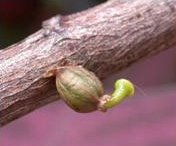
A Macrosolen cochinchinensis seed, when deposited on to the branch of a host plant by a bird, germinates by growing a green stalk with a disc-like tip. This stalk elongates, arching back to send its disc-like tip fusing into the stem of the host plant to become the haustorium. When the haustorium is firmly attached, the seed is lifted off, the seed coat shrivels and drops off to reveal the first pair of leaves, the cotyledons! The shoot then elongates, giving rise to further pairs of leaves.


Note: This plant is a tropical mistletoe, a semi-parasite that grows on the branches of many wayside trees and ornamental plants. Please see our earlier postings on the plants, seeds and germination and accounts by a naturalist and a sometime bird watcher.

Text and images by Angie Ng

Labels:

Monday, March 06, 2006

The noni tree

The noni tree

I have a pair of slender-stemmed mengkudu (Morinda cirtifolia) growing by my gate along the driveway. The plant grows wild throughout Southeast Asia, having been introduced from Queensland, Australia a very long time ago. Now the Malay name is not as well known, replaced by the up-market name of noni. This is because some enterprising person decided that the fruits have all sorts of health-giving properties. And started marketing the juice as a health product.

The pair of 3-metres tall trees must have been brought there in the form of seeds by a bird. They are continuously flowering and fruiting profusely. The flowers are regularly visited by a variety of insects for their nectar. Flies and bees are always around. A few butterflies like the Palm Bob (Suastus gremius gremius) and Lemon Emigrant (Catopsilia pomona alcmeone) are regular visitors.

Daily one or more male Crimson Sunbirds (Aethopyga siparaja) visit the flowers for the nectar. I am sure there is also a female around but the male is so much prominent and attractive with his crimson colouration. They announce their presence by their high pitch chit, chit, chew sound they make. These smallish birds do not stay long at one spot for a proper photographic shot but move rapidly from flower to flower all the time. And before you know it they have departed for another plant elsewhere.

Sunbirds also visit just after rain. They come and have a series of quick baths using the droplets that collect on the surface of the large leaves, see Bathing Sunbirds.

The ripe fruits litter the ground below. I have been told that in Hawaii, dogs love these fruits, growing fat on them. I am sure our local dogs eat them also, if given the opportunity. So far, I have seen two species of birds relish these rancid smelling fruits. Pairs of Javan Mynas (Acridotheres javanicus) will approach the ripe fruit lying on the ground, take a quick peck and retreat before coming again for another beak-full. Yellow-vented Bulbuls (Pycnonotus goiavier) similarly eat the fruits, but only when the mynas are not around.

On 24th December 2005 I was surprised to see a pair of these bulbuls making a ritual of eating the fruit. The pair was dancing around the fruit lying on the ground, tails flapping up and down and at regular intervals taking pecks from the fruit. It is interesting to note that these ripe fruits are never totally eaten, three quarters would always be left behind.

It would be interesting to receive feedback on what other birds go for these fruits.

Text and images by YC. Steven Chong assisted in identifying the butterflies.

Labels:

Sunday, February 26, 2006

Mistletoes 4: Observations of a sometime bird watcher

Mistletoes 4: Observations of a sometime bird watcher

Nearly every evening in early January, from about 6.00 pm, a pair of male Olive-backed Sunbirds (Nectarinia jugularis) (top) would settle down on my neighbour’s bougainvillea bush and spend some free time preening. In between preening they would simply sit tight, stretch their wings and enjoy the scenery. At exactly 7 pm when it was still light, they would suddenly fly off, where to, I do not know. Some days there would only be one bird.

On other days there would also be a pair of lovey-dovey Oriental White-eye (Zosterops palpebrosus) (bottom). I presume this was a pair, as the two birds would often sit close together, sometimes indulging in allopreening.

The Crimson Sunbird (Aethopyga siparaja) sometimes visit the bush but stayed only for a short while, never resting on a branch for more then a few seconds. They are the ones regularly visiting my noni tree (Morinda citrifolia).

These birds, together with Scarlet-backed Flowerpecker (Dicaeum cruentatum) and Brown-throated Sunbird (Anthreptes malacensis) were always around the mistletoe Macrosolen cochinchinensis when this plant was flowering and fruiting. This semi-parasitic plant grows on the branches of a nearby mempat tree (Cratoxylum formosum) that, thankfully have been left alone and not pruned away by the maintenance crew of the National Parks Board. When the mistletoe plants were flowering and fruiting, these birds enjoyed the copious nectar secreted by the flowers and the succulent berry-like fruits.


Being a regular perching bush of these birds that feed on the mistletoes, the bougainvillea obviously shows signs of the presence of their germinating seeds. These can clearly be seen growing on the stems of the bush (see germinating seed, above), no doubt in time to come, will weaken the flowering bush unless they are removed.

PS: About a month after the above piece was written, my neighbour's bougainvillea bush was heavily trimmed by her gardener. The mempat tree was similarly pruned and most of the mistletoe plants removed, but not completely. I await the return of the birds when the plants grow back to their former glory.

Labels:

Sunday, February 05, 2006

Mistletoes 3: A naturalist's account

Mistletoes 3: A naturalist's account

I have been tending mistletoes growing on my sui mei (Wrightia religiosa) and chillie (Capsicum annuum) plants for a couple of years now and seen the different stages of its growth and death!

There were three species of mistletoes growing at my old place: Dendrophthoe pentandra, Macrosolen cochincinensis (left) and M. retusus.

Seeds of D. pentandra grew and flourished on both the above plants and also on my limau perut (Citrus hystrix) [see seed germination]. These mistletoes attracted butterflies like Peacock Royal (Tajuria cippus maxentius) and other unknowns whose eggs hatched into queer caterpillars on my balcony. D. pentandra also attracted the lovely Painted Jezebels (Delias hyparete metarete), whose caterpillars will only eat leaves of this species. The flowers of sui mei attracted many sunbirds and flowerpeckers!

Seeds of M. cochinchinensis deposited on my sui mei never grew. In the garden below, D. pentandra and M. cochinchinsis were flourishing on the white champaka (Michelia alba), mock orange (Murraya paniculata) and mango (Mangifera indica) trees. It also grows on the guava (Psidium guajava) tree in my aunt's garden (that's where I got one batch of Jezebel babies). The M. retusus was found growing on mock orange. I know of other trees with D. pentandra - I often had to collect extra supplies for the ever hungry Jezebel cats!


I've seen the Olive-backed Sunbirds (Nectarinia jugularis) and Scarlet-backed Flowerpecker (Dicaeum cruentatum) (left) feasting on the fruits of D. pentandra and M. cochinchinensis. But I've seen only the male flowerpecker defecating the mistletoe seeds!

Contributed by Angie Ng, images by YC

Labels:

Site Meter Amfibi Directory Singapore Blogger Organisation