Site Meter

Tuesday, October 17, 2006

Do birds have teeth?

Do birds have teeth?

Do birds have teeth? A few species may look as if they do. But these are actually tooth-like notches on their mandibles. And they are also not used to chew food. However, a developing chick inside the egg may have an egg-tooth, a sharp projection on its bill. But this is not a true tooth. As the chick inside the egg develops, the shell thins from the inner lining as calcium is absorbed. Even then the shell is still a substantial barrier between the hatchling and the outside world.

The chick needs to break out of the egg by pecking hard on the inner wall of the eggshell. This it does with the help of a sharp egg tooth found at the tip of the upper beak. This tooth disappears in the weeks after hatching.

This is the theory most birders know. But how many of us have actually seen the egg tooth? Only with the help of photographs do we have a chance of actually see the tooth.

In the above image of two Peaceful Dove (Geopelia striata) (previously called Zebra Dove) chicks, the egg tooth can distinctly be seen at the tip of the beak.

The image below shows very clearly the egg tooth in two Pink-necked Green Pigeon (Treron vernans) chicks.
Text by YC, images by YC (top) and Chan Yoke Meng (bottom).

Labels:

Tuesday, June 20, 2006

Deformed bill

Deformed bill

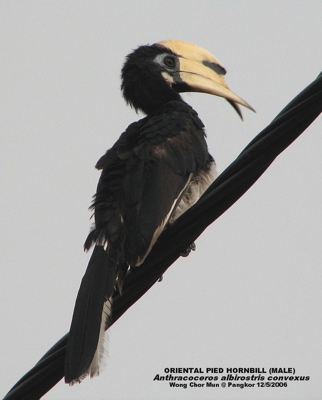
While holidaying in Pangkor Island, Malaysia in May 2005, Susan Wong caught sight of an Oriental Pied Hornbill (Anthracoceros albirostris) with a deformed bill. With such an unusual bill, the bird obviously would have problems feeding. Yet, considering its size, it would appear that it had not fared badly. Still, Susan wondered how the bird picked up its food.

I am not sure whether there are any earlier reports of birds with deformed bills coming from Malaysia and Singapore. However, there are dozens of observations by birders in the United States on beak deformities in chickadees (Parus spp.). Most of these come from feeder-watchers, people who set up bird feeders in their gardens to attract birds.

In most deformities the upper and lower mandibles are longer than usual, with the upper longer and decurved.

Scientists are still not sure what causes these deformities. One theory is that food may be a factor. The hardness of the food a bird eats can regulate bill growth. This is because bills, like fingernails, are soft structures that grow at a constant rate. Thus the harder the food, the more wear and tear the bill undergoes. And regular bill use keeps bill growth in check. Other than diet, injury, diseases, and parasites can affect bill growth.

It would be interesting if other birders visiting Pangkor Island can make observations on the feeding habits of this particular hornbill.

R. Subaraj, our bird specialist, reports that several years ago, he observed a Terek Sandpiper (Xenus cinereus), a shorebird with upturned bill, with a deformed, downcurved bill, in Punggol (Sungei Serangoon). This same bird turned up at the same spot for two winters, indicating that the bird had learnt to cope with its handicap and feed sufficiently well to not only survive for at least a year, but also managed to undertake at least two autumn migrations (south) and one spring migration (north).

Thank you Susan, for this rare image and note.

You can get more information on bill deformities at this web site.

Labels:

Site Meter Amfibi Directory Singapore Blogger Organisation